São Francisco riverbank
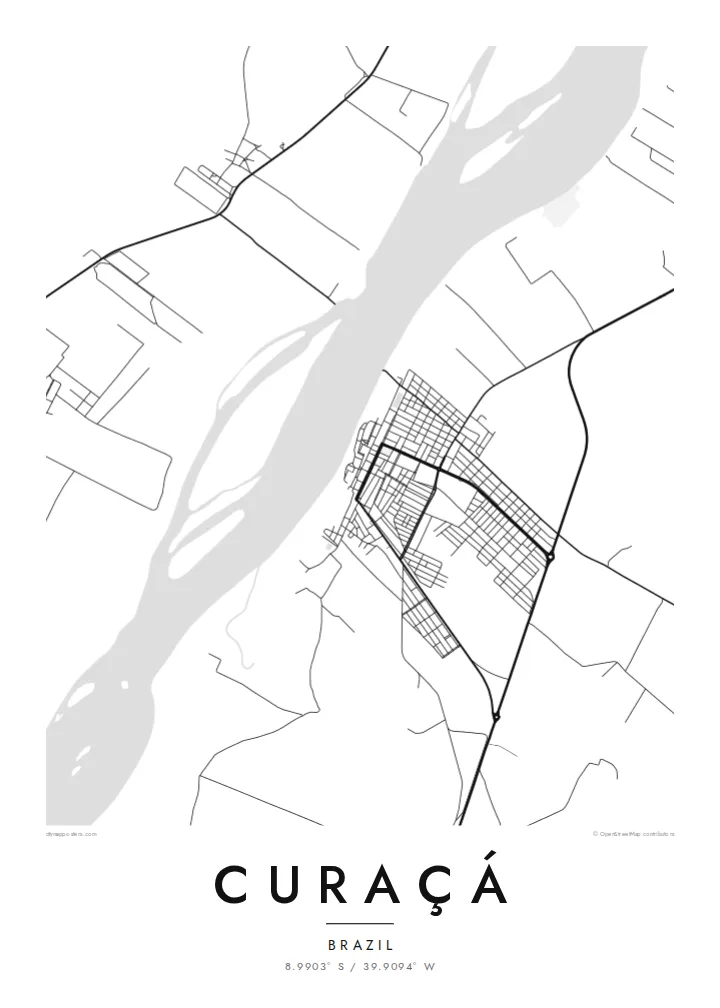
The town lines up along the São Francisco, one of Brazil's longest rivers. On the poster the water forms a broad band that frames the streets and gives the composition its main direction.
Nunap assingata plakatia minimalistiusoq · BR
8.9903° S / 39.9094° W
A compact river town on the São Francisco, its short grid laid against a wide bend of water and open dry country


Illoqarfik ataaseq, misigisat tallimat
Stiili toqqaruk illumi qanoq isikkoqarnersoq takuniassallugu. Stiilit tamaasa akiisa assigiipput — naqitat, qaammatitat imaluunniit HD-filit.
 Pikselit tamakkerlugit · 24 × 36″ naqitat filii
Naqitamut erseqqissoq
Tamanna naqitat filiata 100%-ia ilaannaanga. Poster tamaasa — naqitat, qaammatitallu imaluunniit aalajangersimasumik ikkussat — serverivitsinni 300 DPI-mik, 7,200 × 10,800 pikselinnut tikillugu, suliarineqarput, taamaattumik aqquserpiit mikinerpaaqisut 24 × 36″-imi naqitami erseqqissuarlutik takuneqarsinnaapput.
Sarfamiippoq


Nunap assinga
Curaçá sits on the bank of the São Francisco River in northern Bahia, deep in the semi-arid sertão. From above, the town is small and clearly bounded: a modest grid of streets pressed against the riverbank, with the broad, pale band of water on one side and thinly settled land stretching away on the other. The contrast between dense blocks and empty country gives the map an unusually clean edge.
The municipality is best known beyond Brazil for the Spix's macaw, a small blue parrot whose last wild population lived in the caatinga woodland around Curaçá. After years of being considered extinct in the wild, birds bred in captivity were released back into this landscape, and the name of the town is now closely tied to that conservation effort.
A Curaçá map poster reduces all of this to line and space. The river becomes a heavy, flowing shape, the town a tight cluster of rectangles, and the surrounding caatinga a quiet field of scattered tracks and field boundaries. It is a map about the relationship between a settlement and the single great river that makes life in dry country possible.
The town lines up along the São Francisco, one of Brazil's longest rivers. On the poster the water forms a broad band that frames the streets and gives the composition its main direction.
Curaçá's centre is a small, regular grid of blocks. Its compact size means the whole urban area fits comfortably on a single print with room left for the river and surrounding land.
Beyond the last streets, the map thins into sparse roads and tracks crossing dry scrubland. This emptiness is part of the picture and makes the dense town centre stand out clearly.
Nammineq ilusilersoruk
Ulloq, ateq imaluunniit oqaaseqaatitit ilanngukkit, ilusaa, angissusaa imaluunniit sammivia allanngortiguk.
Akeqanngitsoq takuniassaq qaffasissuseq appasinnerusoq ilisarnaataqarluni. Naqitat aamma HD filit 300 DPI-mik, 7,200 × 10,800 px-nut tikillugu, ilisarnaataqanngitsumik suliarineqarput.
Sooq Curaçá
People hang a map of Curaçá because it holds a very particular landscape: a river town in the sertão, linked to one of Brazil's most closely watched conservation stories. For anyone from the town or with family along the São Francisco, it is a recognisable outline of home rather than a generic view.
The title, subtitle and coordinates line can be changed, so the print might carry a family name or a year of arrival. Choose from Classic black & white, Noir, Paper, Blueprint or Sand, and order either the $9 HD files for home printing or a printed matte poster with an optional wooden frame.
Curaçá posteri tunisaqarfigiuk| Naqitap angissusia | Erseqqissusia | Fiilit |
|---|---|---|
| 30 × 40 cm (11.8 × 15.7″) | 3,543 × 4,724 px | PNG · PDF |
| 29.7 × 42 cm (A3, 11.7 × 16.5″) | 3,508 × 4,961 px | PNG · PDF |
| 42 × 59.4 cm (A2, 16.5 × 23.4″) | 4,961 × 7,016 px | PNG · PDF |
| 45.7 × 61 cm (18 × 24″) | 5,400 × 7,200 px | PNG · PDF |
| 50 × 70 cm (19.7 × 27.6″) | 5,906 × 8,268 px | PNG · PDF |
| 61 × 91.4 cm (24 × 36″) | 7,200 × 10,800 px | PNG · PDF |
Sanilliussigaanni takutitsineq akeqanngitsoq 900 px-inik silissuseqarpoq, nalunaaqutaqarpoq skærmimilu takuneqarnissaanut naatsorsuussaalluni. HD-fiilit sammivimmi tamarmi 8-riaammik erseqqinnerusinnaapput plakatitullu angissusilimmi tamarmi kusanartumik naqiterneqarsinnaallutik.
Qupperneq qulaani stiili toqqaruk, taavalu Poster Naqitat toqqarlugu — angissusia, kissaatigigukku qaammatitaaleraluarlutit — imaluunniit Digital HD Filit toqqaruk. Akiliuteqarnissaq ataatsimik pisarpoq, akiliutigineqareerpat tunisassat qupperneraat immiaassaaq.
Naqinneqarpoq assigiinngitsumik pitsaasumik 200 gsm-imik matte-mik paapimi, angissusit arfinillit ilaanni, 30 × 40 cm-miit 24 × 36″-mut. Naqitat posterit {printFrom}-miit aallartissapput, assartuineq ilanngullugu.
Aap. Qaammatit qernertumik, qaqortumik, naturimik eegimik imaluunniit qernertumik qisummik pilersorlugu toqqaruk. Igalaaq qisuutinnavianngitsoq ilaalluni tunniunneqarpoq, aammalu illumut qaleriiffigineqarnissamut piareersimavoq. Qaammatitat posterit {framedFrom}-miit aallartissapput, assartuineq ilanngullugu.
Assartuineq silarsuup tamakkerlugu akeqanngilaq. Poster tamaasa nunani 30+-mi suleqatigisatta naqitat naammattukkaanniit naqinneqarput, pisarialu ullormut 3-7-ni sulinerni tikittarpoq. Sumut killiffigisoq Tunisassakka ataani malinnaaffigisinnaavat.
Tikinneranit ullut 14-ni ingerlanngata ammasumik assiliaq nassiutigiuk, naqissaanngitsoq nutaamik naqinniassavarput imaluunniit akiliutit utertissavatit.
Aap. Qupperami editorimi, qulequtaq, qulequtaa ataani allaassutaq aamma sumiiffiup killiffiginera allanngortikkit kissaatigisatit malillugit, stiilillu angissusiallu toqqarlugit. Naqitat, qaammatitat aamma digitalit tunisassat tamarmik ilinnut sanaartorsimasoq atorput.
$9-mik akilerlugu 300 DPI PNG-mik aamma naqinnissamut piareersimasumik PDF-imik, angissusit arfinillit tamaasa, ilisarnaataqanngitsumik, sumiluunniit naqinniarnissamut pisaqassaatit. Suli isumaqanngiluit? Siullermik ilisarnaatilik akeqanngitsoq takuniassaq aallaqqaataani ikkussigit.
Qanittuni
