Two-part city plan
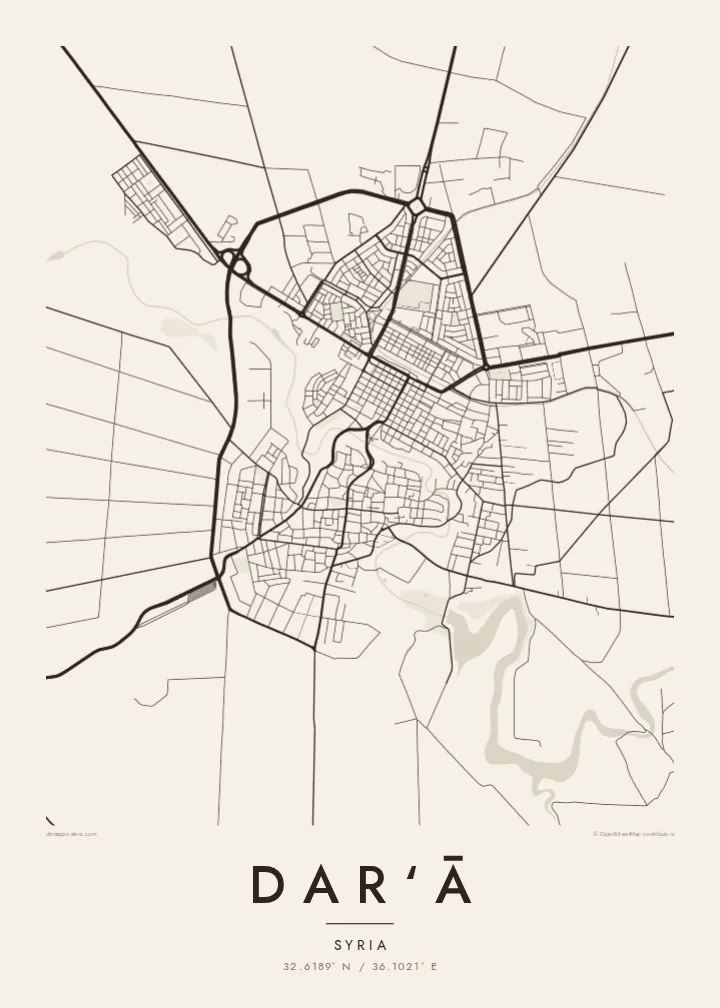
The old town and the station district sit on either side of a valley. Each has a distinct street pattern, so the map reads as two linked but separate places.
Nunap assingata plakatia minimalistiusoq · SY
32.6189° N / 36.1021° E
A Hauran city of two halves, the old town and the station quarter, divided by a valley near the Jordanian border




Illoqarfik ataaseq, misigisat tallimat
Stiili toqqaruk illumi qanoq isikkoqarnersoq takuniassallugu. Stiilit tamaasa akiisa assigiipput — naqitat, qaammatitat imaluunniit HD-filit.
 Pikselit tamakkerlugit · 24 × 36″ naqitat filii
Naqitamut erseqqissoq
Tamanna naqitat filiata 100%-ia ilaannaanga. Poster tamaasa — naqitat, qaammatitallu imaluunniit aalajangersimasumik ikkussat — serverivitsinni 300 DPI-mik, 7,200 × 10,800 pikselinnut tikillugu, suliarineqarput, taamaattumik aqquserpiit mikinerpaaqisut 24 × 36″-imi naqitami erseqqissuarlutik takuneqarsinnaapput.
Sarfamiippoq


Nunap assinga
Dar‘ā stands on the basalt plain of the Hauran in southern Syria, a short distance from the border with Jordan. From above, the city clearly splits into two parts. Daraa al-Balad, the old town, lies on one side. Daraa al-Mahatta, the newer district that grew up around the railway station, lies on the other. Between them runs a valley that separates the two street patterns.
The site is ancient and is generally identified with biblical Edrei. The old town has the tighter, irregular lanes of a long-settled place, centred on its historic Omari Mosque. The station quarter owes its origin to the Hejaz Railway in the early twentieth century, and its streets are straighter, wider and more regular. Around both halves, open farmland of the Hauran stretches in every direction.
A Dar‘ā map poster makes this double structure its subject. Two street patterns face each other across the valley: one organic and dense, the other planned and open. Main roads to Damascus and the border cross the plain toward the edges of the sheet. In black and white, the composition is clear and balanced, a portrait of a city defined by its crossroads position.
The old town and the station district sit on either side of a valley. Each has a distinct street pattern, so the map reads as two linked but separate places.
The historic quarter keeps its dense, irregular lanes around the Omari Mosque. It is the most intricate and closely drawn part of the poster.
Daraa al-Mahatta grew around the Hejaz Railway station. Its straighter, more regular streets contrast with the older town across the valley.
Nammineq ilusilersoruk
Ulloq, ateq imaluunniit oqaaseqaatitit ilanngukkit, ilusaa, angissusaa imaluunniit sammivia allanngortiguk.
Akeqanngitsoq takuniassaq qaffasissuseq appasinnerusoq ilisarnaataqarluni. Naqitat aamma HD filit 300 DPI-mik, 7,200 × 10,800 px-nut tikillugu, ilisarnaataqanngitsumik suliarineqarput.
Sooq Dar‘ā
For people from Dar‘ā, many of them now living far away, a map of both halves of the city keeps home present on the wall. The clear two-part structure also makes a strong graphic image in its own right. It is a considered piece for a living room or study.
The title, subtitle and coordinates line are all editable, whether you want an Arabic or English name, a neighbourhood or a date. Five styles are available: Classic black & white, Noir, Paper, Blueprint and Sand. Order HD files for $9 or a printed poster with an optional wooden frame.
Dar‘ā posteri tunisaqarfigiuk| Naqitap angissusia | Erseqqissusia | Fiilit |
|---|---|---|
| 30 × 40 cm (11.8 × 15.7″) | 3,543 × 4,724 px | PNG · PDF |
| 29.7 × 42 cm (A3, 11.7 × 16.5″) | 3,508 × 4,961 px | PNG · PDF |
| 42 × 59.4 cm (A2, 16.5 × 23.4″) | 4,961 × 7,016 px | PNG · PDF |
| 45.7 × 61 cm (18 × 24″) | 5,400 × 7,200 px | PNG · PDF |
| 50 × 70 cm (19.7 × 27.6″) | 5,906 × 8,268 px | PNG · PDF |
| 61 × 91.4 cm (24 × 36″) | 7,200 × 10,800 px | PNG · PDF |
Sanilliussigaanni takutitsineq akeqanngitsoq 900 px-inik silissuseqarpoq, nalunaaqutaqarpoq skærmimilu takuneqarnissaanut naatsorsuussaalluni. HD-fiilit sammivimmi tamarmi 8-riaammik erseqqinnerusinnaapput plakatitullu angissusilimmi tamarmi kusanartumik naqiterneqarsinnaallutik.
Qupperneq qulaani stiili toqqaruk, taavalu Poster Naqitat toqqarlugu — angissusia, kissaatigigukku qaammatitaaleraluarlutit — imaluunniit Digital HD Filit toqqaruk. Akiliuteqarnissaq ataatsimik pisarpoq, akiliutigineqareerpat tunisassat qupperneraat immiaassaaq.
Naqinneqarpoq assigiinngitsumik pitsaasumik 200 gsm-imik matte-mik paapimi, angissusit arfinillit ilaanni, 30 × 40 cm-miit 24 × 36″-mut. Naqitat posterit {printFrom}-miit aallartissapput, assartuineq ilanngullugu.
Aap. Qaammatit qernertumik, qaqortumik, naturimik eegimik imaluunniit qernertumik qisummik pilersorlugu toqqaruk. Igalaaq qisuutinnavianngitsoq ilaalluni tunniunneqarpoq, aammalu illumut qaleriiffigineqarnissamut piareersimavoq. Qaammatitat posterit {framedFrom}-miit aallartissapput, assartuineq ilanngullugu.
Assartuineq silarsuup tamakkerlugu akeqanngilaq. Poster tamaasa nunani 30+-mi suleqatigisatta naqitat naammattukkaanniit naqinneqarput, pisarialu ullormut 3-7-ni sulinerni tikittarpoq. Sumut killiffigisoq Tunisassakka ataani malinnaaffigisinnaavat.
Tikinneranit ullut 14-ni ingerlanngata ammasumik assiliaq nassiutigiuk, naqissaanngitsoq nutaamik naqinniassavarput imaluunniit akiliutit utertissavatit.
Aap. Qupperami editorimi, qulequtaq, qulequtaa ataani allaassutaq aamma sumiiffiup killiffiginera allanngortikkit kissaatigisatit malillugit, stiilillu angissusiallu toqqarlugit. Naqitat, qaammatitat aamma digitalit tunisassat tamarmik ilinnut sanaartorsimasoq atorput.
$9-mik akilerlugu 300 DPI PNG-mik aamma naqinnissamut piareersimasumik PDF-imik, angissusit arfinillit tamaasa, ilisarnaataqanngitsumik, sumiluunniit naqinniarnissamut pisaqassaatit. Suli isumaqanngiluit? Siullermik ilisarnaatilik akeqanngitsoq takuniassaq aallaqqaataani ikkussigit.
Qanittuni
