The Neisse border
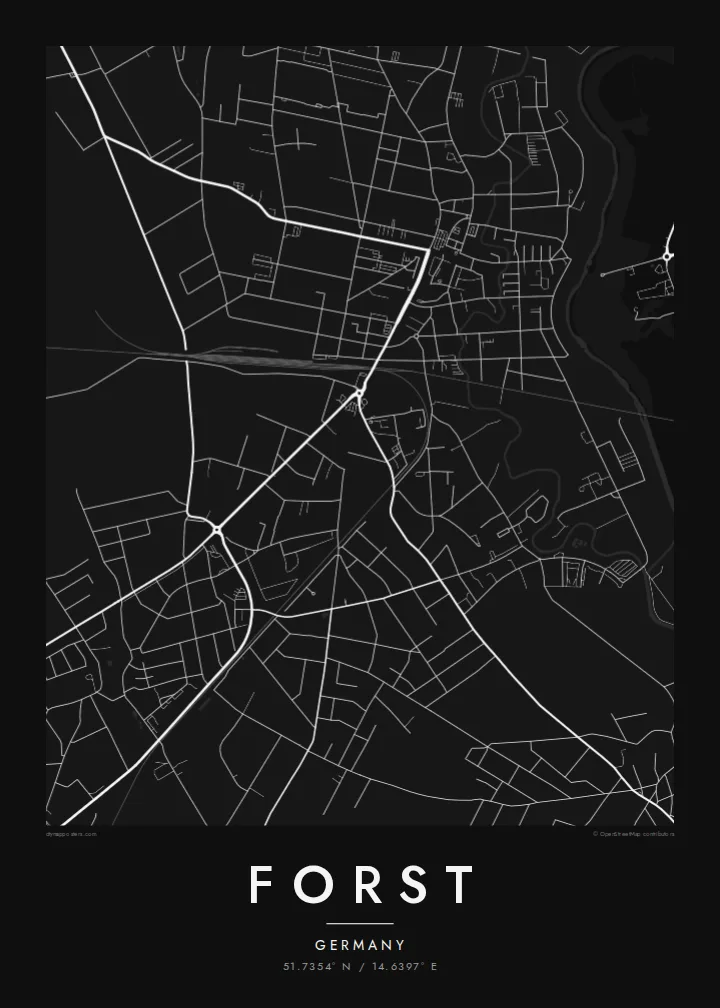
The Lusatian Neisse forms the eastern edge of the town and the frontier with Poland. It gives the map one strong vertical line, with the bridges crossing it clearly marked.
Nunap assingata plakatia minimalistiusoq · DE
51.7354° N / 14.6397° E
A textile town pressed against the Neisse, its streets stopping at the river that marks the Polish border



Illoqarfik ataaseq, misigisat tallimat
Stiili toqqaruk illumi qanoq isikkoqarnersoq takuniassallugu. Stiilit tamaasa akiisa assigiipput — naqitat, qaammatitat imaluunniit HD-filit.
 Pikselit tamakkerlugit · 24 × 36″ naqitat filii
Naqitamut erseqqissoq
Tamanna naqitat filiata 100%-ia ilaannaanga. Poster tamaasa — naqitat, qaammatitallu imaluunniit aalajangersimasumik ikkussat — serverivitsinni 300 DPI-mik, 7,200 × 10,800 pikselinnut tikillugu, suliarineqarput, taamaattumik aqquserpiit mikinerpaaqisut 24 × 36″-imi naqitami erseqqissuarlutik takuneqarsinnaapput.
Sarfamiippoq


Nunap assinga
Forst sits in Lower Lusatia on the west bank of the Lusatian Neisse. From above the river is the town's most defined edge: it runs north to south along the eastern side, and across the water lies Poland. The streets fan out westward from the river in a loose, uneven layout. That layout owes more to a century of industrial growth than to any one plan, and the river keeps the whole map oriented.
For much of the nineteenth and early twentieth centuries Forst was a centre of cloth production, known then as a German Manchester. The mills needed rail sidings, long factory plots and workers' housing close by, and that industrial past still shows in the size of the blocks. Some districts have large, regular parcels. Others are tighter, where terraced housing filled the space between works.
The town's best-known green space is the East German Rose Garden, laid out near the river in the early twentieth century and still one of the larger rose gardens in the country. On a Forst map poster it appears as a patch of curving paths set against the straighter streets around it. The eye tends to settle there, between the town's grid and the river.
The Lusatian Neisse forms the eastern edge of the town and the frontier with Poland. It gives the map one strong vertical line, with the bridges crossing it clearly marked.
The East German Rose Garden adds a cluster of curved walks and beds near the river, a softer pattern than the streets and industrial plots that surround it.
Large parcels left by the cloth industry sit beside denser housing streets. The result is a clear contrast in scale across the town that works well in black and white.
Nammineq ilusilersoruk
Ulloq, ateq imaluunniit oqaaseqaatitit ilanngukkit, ilusaa, angissusaa imaluunniit sammivia allanngortiguk.
Akeqanngitsoq takuniassaq qaffasissuseq appasinnerusoq ilisarnaataqarluni. Naqitat aamma HD filit 300 DPI-mik, 7,200 × 10,800 px-nut tikillugu, ilisarnaataqanngitsumik suliarineqarput.
Sooq Forst
People from Forst often want a map that shows how close the town and the border are, with the river running right past the old streets. It also suits anyone with family ties to Lusatia's textile past, or to both sides of the Neisse.
Add a title, a family name or a meaningful date, and choose from Classic black & white, Noir, Paper, Blueprint or Sand. The digital files cost $9 and cover six print sizes. Printed posters on matte paper, with an optional wooden frame, ship from partners in more than 30 countries.
Forst posteri tunisaqarfigiuk| Naqitap angissusia | Erseqqissusia | Fiilit |
|---|---|---|
| 30 × 40 cm (11.8 × 15.7″) | 3,543 × 4,724 px | PNG · PDF |
| 29.7 × 42 cm (A3, 11.7 × 16.5″) | 3,508 × 4,961 px | PNG · PDF |
| 42 × 59.4 cm (A2, 16.5 × 23.4″) | 4,961 × 7,016 px | PNG · PDF |
| 45.7 × 61 cm (18 × 24″) | 5,400 × 7,200 px | PNG · PDF |
| 50 × 70 cm (19.7 × 27.6″) | 5,906 × 8,268 px | PNG · PDF |
| 61 × 91.4 cm (24 × 36″) | 7,200 × 10,800 px | PNG · PDF |
Sanilliussigaanni takutitsineq akeqanngitsoq 900 px-inik silissuseqarpoq, nalunaaqutaqarpoq skærmimilu takuneqarnissaanut naatsorsuussaalluni. HD-fiilit sammivimmi tamarmi 8-riaammik erseqqinnerusinnaapput plakatitullu angissusilimmi tamarmi kusanartumik naqiterneqarsinnaallutik.
Qupperneq qulaani stiili toqqaruk, taavalu Poster Naqitat toqqarlugu — angissusia, kissaatigigukku qaammatitaaleraluarlutit — imaluunniit Digital HD Filit toqqaruk. Akiliuteqarnissaq ataatsimik pisarpoq, akiliutigineqareerpat tunisassat qupperneraat immiaassaaq.
Naqinneqarpoq assigiinngitsumik pitsaasumik 200 gsm-imik matte-mik paapimi, angissusit arfinillit ilaanni, 30 × 40 cm-miit 24 × 36″-mut. Naqitat posterit {printFrom}-miit aallartissapput, assartuineq ilanngullugu.
Aap. Qaammatit qernertumik, qaqortumik, naturimik eegimik imaluunniit qernertumik qisummik pilersorlugu toqqaruk. Igalaaq qisuutinnavianngitsoq ilaalluni tunniunneqarpoq, aammalu illumut qaleriiffigineqarnissamut piareersimavoq. Qaammatitat posterit {framedFrom}-miit aallartissapput, assartuineq ilanngullugu.
Nassiussineq nuna tamakkerlugu akeqanngilaq. Assitaq tamaat nunani 30+-ni naqiterisartugut ataani qaninnerpaamit naqiterneqartarpoq, ullunilu sulifiusuni 3–7-ni tikittarluni. Pisiat atuuffissaat aamma malinnaaffigineqarsinnaavoq Pisiassanni (My Orders). Nunat ilaanni sapaatit-akunneri 2–5-ni sivisussuseqarpoq, nunanilu suliffissaarutitsinnik nassiussaqarsinnaanngitsuni qiffissap saqqummiunneqartarpoq akiliinnginnermi.
Tikinneranit ullut 14-ni ingerlanngata ammasumik assiliaq nassiutigiuk, naqissaanngitsoq nutaamik naqinniassavarput imaluunniit akiliutit utertissavatit.
Aap. Qupperami editorimi, qulequtaq, qulequtaa ataani allaassutaq aamma sumiiffiup killiffiginera allanngortikkit kissaatigisatit malillugit, stiilillu angissusiallu toqqarlugit. Naqitat, qaammatitat aamma digitalit tunisassat tamarmik ilinnut sanaartorsimasoq atorput.
$9-mik akilerlugu 300 DPI PNG-mik aamma naqinnissamut piareersimasumik PDF-imik, angissusit arfinillit tamaasa, ilisarnaataqanngitsumik, sumiluunniit naqinniarnissamut pisaqassaatit. Suli isumaqanngiluit? Siullermik ilisarnaatilik akeqanngitsoq takuniassaq aallaqqaataani ikkussigit.
Qanittuni
