Confluence of rivers
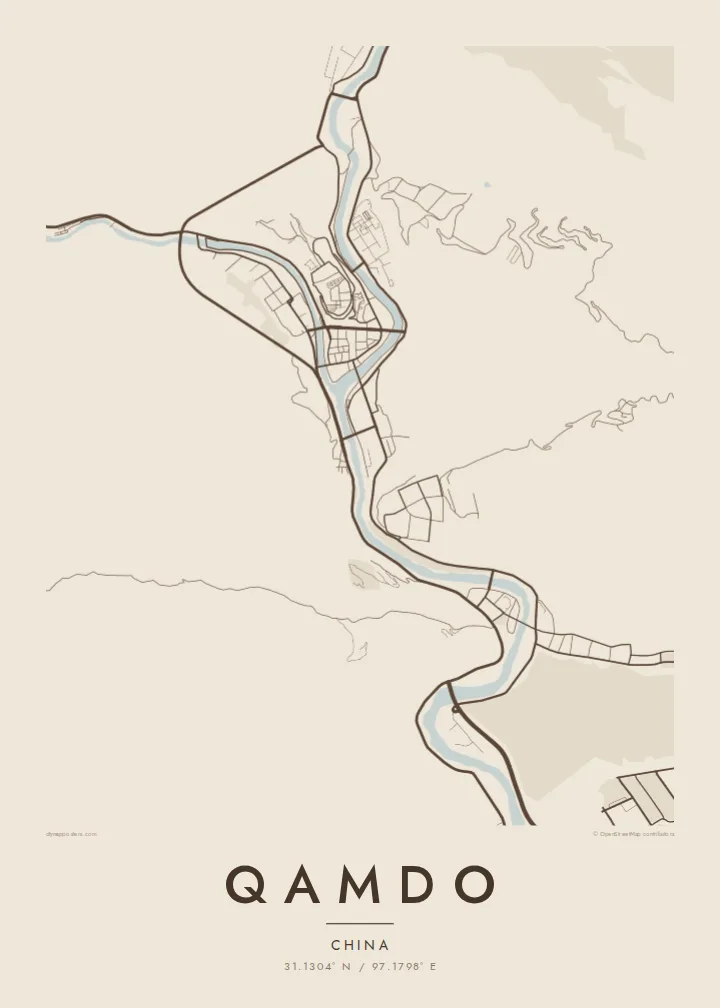
The Dza Chu and Ngom Chu meet at the heart of the town. Their joined channel heads south as the Lancang, and the fork gives the map its clear Y-shaped outline.
Nunap assingata plakatia minimalistiusoq · CN
31.1304° N / 97.1798° E
A narrow wedge of streets where two mountain rivers meet and join to form the upper Mekong, walled in by steep slopes


Illoqarfik ataaseq, misigisat tallimat
Stiili toqqaruk illumi qanoq isikkoqarnersoq takuniassallugu. Stiilit tamaasa akiisa assigiipput — naqitat, qaammatitat imaluunniit HD-filit.
 Pikselit tamakkerlugit · 24 × 36″ naqitat filii
Naqitamut erseqqissoq
Tamanna naqitat filiata 100%-ia ilaannaanga. Poster tamaasa — naqitat, qaammatitallu imaluunniit aalajangersimasumik ikkussat — serverivitsinni 300 DPI-mik, 7,200 × 10,800 pikselinnut tikillugu, suliarineqarput, taamaattumik aqquserpiit mikinerpaaqisut 24 × 36″-imi naqitami erseqqissuarlutik takuneqarsinnaapput.
Sarfamiippoq


Nunap assinga
Seen from above, Qamdo sits on a point of land in eastern Tibet, at the spot where two rivers, the Dza Chu and the Ngom Chu, flow together. Below the junction they carry on as the Lancang, the name the upper Mekong takes in China. The town fills the flat ground at the confluence and follows both valleys upstream, so its street plan looks like a letter Y cut into the mountains.
The terrain sets the shape of the city more than any plan does. The valley floors are narrow, and the slopes rise sharply on every side, so buildings line the riverbanks in long bands and the roads bend with the water. Bridges link the neighbourhoods on the far banks back to the central point. On a Qamdo map poster the rivers stay in clear view, and the blank hillsides around them read as open space.
Qamdo has long been one of the main towns of the Kham region and a stop on the old routes between Tibet and Sichuan and Yunnan. On a terrace above the confluence stands Qamdo Monastery, a large Gelug monastery founded in the fifteenth century, which still shapes the skyline. The town lies at roughly 3,200 metres, and that height matters in every valley and slope you see on the map.
The Dza Chu and Ngom Chu meet at the heart of the town. Their joined channel heads south as the Lancang, and the fork gives the map its clear Y-shaped outline.
Qamdo Monastery sits on raised ground between the two rivers, above the central streets. Its large compound shows up on the map as a distinct block at the top of the confluence.
Steep slopes hem the town in, so its roads run in long, curving lines beside the rivers. Bridges cross the water at intervals and tie the separate banks into one town.
Nammineq ilusilersoruk
Ulloq, ateq imaluunniit oqaaseqaatitit ilanngukkit, ilusaa, angissusaa imaluunniit sammivia allanngortiguk.
Akeqanngitsoq takuniassaq qaffasissuseq appasinnerusoq ilisarnaataqarluni. Naqitat aamma HD filit 300 DPI-mik, 7,200 × 10,800 px-nut tikillugu, ilisarnaataqanngitsumik suliarineqarput.
Sooq Qamdo
Qamdo appeals to people who have made the long overland journey through Kham, or to anyone who grew up in these valleys. Where rivers meet in the mountains, the map has a strong outline, and in black and white it reads almost like a drawing of how the water runs.
You can personalise the poster with your own title, subtitle and coordinates line, perhaps the date you crossed a pass or first reached the town. Choose from five styles: Classic black & white, Noir, Paper, Blueprint or Sand. Get HD files for $9, or order a matte print with an optional wooden frame.
Qamdo posteri tunisaqarfigiuk| Naqitap angissusia | Erseqqissusia | Fiilit |
|---|---|---|
| 30 × 40 cm (11.8 × 15.7″) | 3,543 × 4,724 px | PNG · PDF |
| 29.7 × 42 cm (A3, 11.7 × 16.5″) | 3,508 × 4,961 px | PNG · PDF |
| 42 × 59.4 cm (A2, 16.5 × 23.4″) | 4,961 × 7,016 px | PNG · PDF |
| 45.7 × 61 cm (18 × 24″) | 5,400 × 7,200 px | PNG · PDF |
| 50 × 70 cm (19.7 × 27.6″) | 5,906 × 8,268 px | PNG · PDF |
| 61 × 91.4 cm (24 × 36″) | 7,200 × 10,800 px | PNG · PDF |
Sanilliussigaanni takutitsineq akeqanngitsoq 900 px-inik silissuseqarpoq, nalunaaqutaqarpoq skærmimilu takuneqarnissaanut naatsorsuussaalluni. HD-fiilit sammivimmi tamarmi 8-riaammik erseqqinnerusinnaapput plakatitullu angissusilimmi tamarmi kusanartumik naqiterneqarsinnaallutik.
Qupperneq qulaani stiili toqqaruk, taavalu Poster Naqitat toqqarlugu — angissusia, kissaatigigukku qaammatitaaleraluarlutit — imaluunniit Digital HD Filit toqqaruk. Akiliuteqarnissaq ataatsimik pisarpoq, akiliutigineqareerpat tunisassat qupperneraat immiaassaaq.
Naqinneqarpoq assigiinngitsumik pitsaasumik 200 gsm-imik matte-mik paapimi, angissusit arfinillit ilaanni, 30 × 40 cm-miit 24 × 36″-mut. Naqitat posterit {printFrom}-miit aallartissapput, assartuineq ilanngullugu.
Aap. Qaammatit qernertumik, qaqortumik, naturimik eegimik imaluunniit qernertumik qisummik pilersorlugu toqqaruk. Igalaaq qisuutinnavianngitsoq ilaalluni tunniunneqarpoq, aammalu illumut qaleriiffigineqarnissamut piareersimavoq. Qaammatitat posterit {framedFrom}-miit aallartissapput, assartuineq ilanngullugu.
Assartuineq silarsuup tamakkerlugu akeqanngilaq. Poster tamaasa nunani 30+-mi suleqatigisatta naqitat naammattukkaanniit naqinneqarput, pisarialu ullormut 3-7-ni sulinerni tikittarpoq. Sumut killiffigisoq Tunisassakka ataani malinnaaffigisinnaavat.
Tikinneranit ullut 14-ni ingerlanngata ammasumik assiliaq nassiutigiuk, naqissaanngitsoq nutaamik naqinniassavarput imaluunniit akiliutit utertissavatit.
Aap. Qupperami editorimi, qulequtaq, qulequtaa ataani allaassutaq aamma sumiiffiup killiffiginera allanngortikkit kissaatigisatit malillugit, stiilillu angissusiallu toqqarlugit. Naqitat, qaammatitat aamma digitalit tunisassat tamarmik ilinnut sanaartorsimasoq atorput.
$9-mik akilerlugu 300 DPI PNG-mik aamma naqinnissamut piareersimasumik PDF-imik, angissusit arfinillit tamaasa, ilisarnaataqanngitsumik, sumiluunniit naqinniarnissamut pisaqassaatit. Suli isumaqanngiluit? Siullermik ilisarnaatilik akeqanngitsoq takuniassaq aallaqqaataani ikkussigit.
Qanittuni
