Castello Doria
The castle and its grounds form a distinct block within the tight historic centre, one of the few larger open shapes among the closely packed streets of the old town.
Pōhita mape faigofie · Italy
40.7381° N / 14.5707° E
A dense Campanian town on the Sarno plain, pressed against the foot of the Lattari mountains with Vesuvius to the north




Taone e tahi, lagona e lima
Pa'i se ata ke va'ai ai i luga o te pā. E tutusa te tau o ata uma — i lomiga, fakapipi'i i faleata, pe ko faila HD.
 Pixels mo'i · Faila lomiga 24 × 36″
Manino mo te lomiga
Ko se kupega 100% mai te faila lomiga mo'i. Poster uma — pe lomiina, fakapipi'i i faleata, pe download-ina — e fakaatagia i luga o a matou setula i te 300 DPI, e oo atu ki te 7,200 × 10,800 pixels, ina ia mautinoa e ma'ai pea auala tuai foki i luga o se lomiga 24 × 36″.
I luga o te pa


Te mape
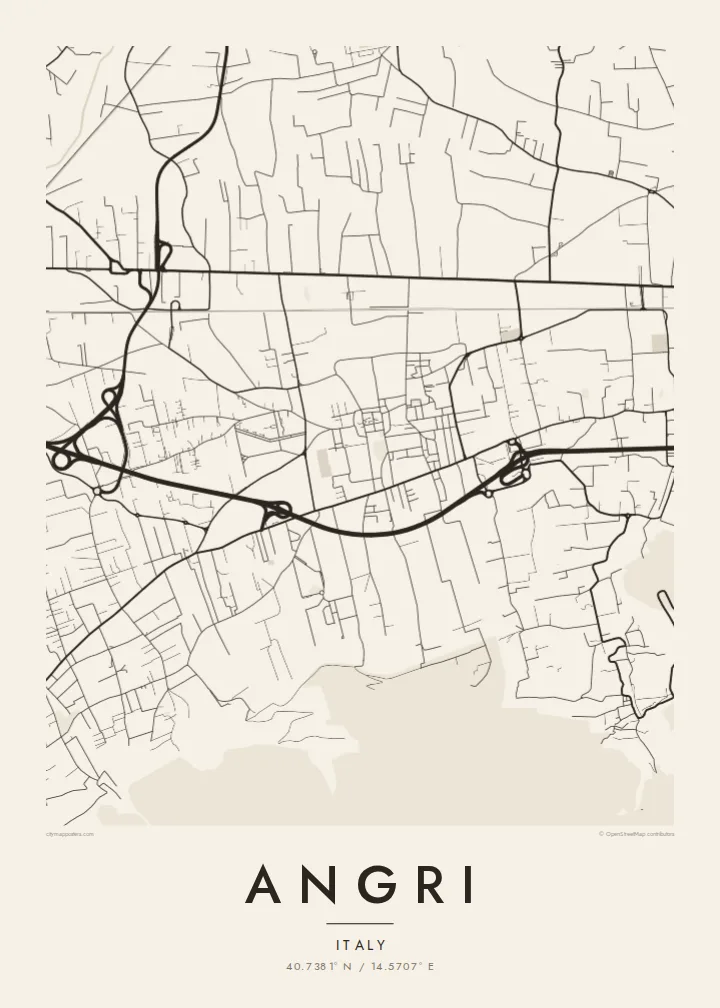
Angri lies in the Agro Nocerino-Sarnese, the fertile plain between Vesuvius and the Monti Lattari in the province of Salerno. The town sits where the flat land meets the first slopes of the mountains that separate the plain from the Amalfi Coast, and on a map its southern edge rises into contour-hugging roads while the northern side spreads across the lowland.
The centre is dense and irregular, with narrow streets around the Castello Doria, the historic castle that now serves as the town hall. Beyond it, Angri merges almost seamlessly with its neighbours, so the built-up area continues toward Scafati, Sant'Egidio del Monte Albino and Pagani with hardly a break. The Naples to Salerno motorway runs across the plain just north of the town.
An Angri map poster captures this crowded, productive corner of Campania, known for intensive farming, especially tomatoes, and for towns that grew close enough to touch. The black lines of streets fill much of the frame, set off by the empty space of the mountains to the south.
The castle and its grounds form a distinct block within the tight historic centre, one of the few larger open shapes among the closely packed streets of the old town.
South of the town, the land climbs steeply toward the Monti Lattari, and the roads twist into switchbacks, leaving the upper part of the map open and uncluttered.
To the north and west, Angri's streets run into those of neighbouring towns across the Sarno plain, forming an almost unbroken urban fabric crossed by the motorway.
Fai mo koe
Fakaopoopo he aho, he igoa pe he upu a koe, hui te faiga, te lahi pe te tūlaga.
Ko te va'aiga e leai se totogi e maualalo tona resolution ma iai se fakailoga vai. E fakaatagia lomiga ma faila HD i te 300 DPI, e oo atu ki te 7,200 × 10,800 px, e aunoa ma se fakailoga vai.
Aiheā Angri
Many families from the Agro Nocerino-Sarnese have spread across Italy and abroad, and a map of Angri keeps the town's streets and castle close. Add a surname, a wedding date or a line in Italian as the subtitle, and the coordinates finish the design.
Paper and Sand bring out the warmth of southern Italy, while Classic black and white, Noir and Blueprint give a sharper look. Order a matte printed poster, or buy the $9 digital files in six sizes for printing locally.
Oka te poster Angri| Lahi o te lomiga | Manino | Faila |
|---|---|---|
| 30 × 40 cm (11.8 × 15.7″) | 3,543 × 4,724 px | PNG · PDF |
| 29.7 × 42 cm (A3, 11.7 × 16.5″) | 3,508 × 4,961 px | PNG · PDF |
| 42 × 59.4 cm (A2, 16.5 × 23.4″) | 4,961 × 7,016 px | PNG · PDF |
| 45.7 × 61 cm (18 × 24″) | 5,400 × 7,200 px | PNG · PDF |
| 50 × 70 cm (19.7 × 27.6″) | 5,906 × 8,268 px | PNG · PDF |
| 61 × 91.4 cm (24 × 36″) | 7,200 × 10,800 px | PNG · PDF |
Mo te fakatatau, ko te fakaakoakoga e hē totogi e 900 px te lautele, e ihi te fakailoga ma mo te lau komipiuta. Ko nā faila HD e oko ki te 8× te manino i itū taki tahi ma e lomia lelei i te lahi kātoa o te pōhita.
Filifili se ata i te pito i luga o te itulau, ona filifili lea o te Poster Lomiina — se lapoa ma, ka manako ai koe, se faleata — pe ko Faila HD Fakaonaonaina. E tasi te laasaga o te ōkaina, ma ka fakafou loa lau itulau ōkaina pe a mae'a te totogi.
E lomiina i luga o se pepa matte kaliki maualuga e 200 gsm, i se tasi o ni lapoa e ono, mai le 30 × 40 cm ki te 24 × 36″. E kamata te tau o poster lomiina mai le {printFrom}, aofia ai te uta.
Ioe. Filifili se faleata lakau malō i te lanu uli, tea, oki masani pe lakau pouli. E aumai fakatasi mo se tioata e le gagamu ma ua sauni ke tautau. E kamata te tau o poster fakapipi'i i se faleata mai le {framedFrom}, aofia ai te uta.
E leai se totogi o te ave i te lalolagi katoa. Ko te pepa ata taki tasi e lomi e te hoa lomi e latalata mai ki a matou i atunuku e 30+, ma e masani ona aulia i aso galuega e 3–7. E mafai ke e mulimuli i te tulaga ma te ala o tau poloaiga i lalo o Aku Poloaiga. E nai atunuku e 2–5 vaiaso te umi, ma i te mea e le i ave ai matou, e fakailoa atu e te initeneti a e le i totogi koe.
Auina mai se ata pikitia i loto o te 14 aso mai te taimi na oo mai ai, ka toe lomiina e matou e leai se totogi pe toe totogi atu lau tupe.
Ioe. I te mea fakasa'o i luga o lenei itulau, sui te ulutala, te ulutala lalo ma te laina fakamaoniga tulaga ki so se mea e manako ai koe, ona filifili lea o se ata ma se lapoa. Okaina lomiina, fakapipi'i i faleata, ma fakaonaonaina e fakaaogā uma i tau ata tonu.
Mo le $9 e maua e koe ni faila PNG 300 DPI ma PDF sauni-mo-lomiga i lapoa e ono uma, e aunoa ma se fakailoga vai, ke lomiina i so se mea. E le'i mautinoa? Download muamua se va'aiga fakailoga vai e leai se totogi.
