Valley-floor streets
The town's lanes bend and branch to follow the valley's gentle gradient. The result is an organic network that contrasts with the planned grids of lowland Uzbek cities.
Pōhita mape faigofie · Uzbekistan
38.2084° N / 67.2066° E
A mountain town in a high valley of southern Uzbekistan, its streets following streams down from the Boysuntov range.



Taone e tahi, lagona e lima
Pa'i se ata ke va'ai ai i luga o te pā. E tutusa te tau o ata uma — i lomiga, fakapipi'i i faleata, pe ko faila HD.
 Pixels mo'i · Faila lomiga 24 × 36″
Manino mo te lomiga
Ko se kupega 100% mai te faila lomiga mo'i. Poster uma — pe lomiina, fakapipi'i i faleata, pe download-ina — e fakaatagia i luga o a matou setula i te 300 DPI, e oo atu ki te 7,200 × 10,800 pixels, ina ia mautinoa e ma'ai pea auala tuai foki i luga o se lomiga 24 × 36″.
I luga o te pa


Te mape
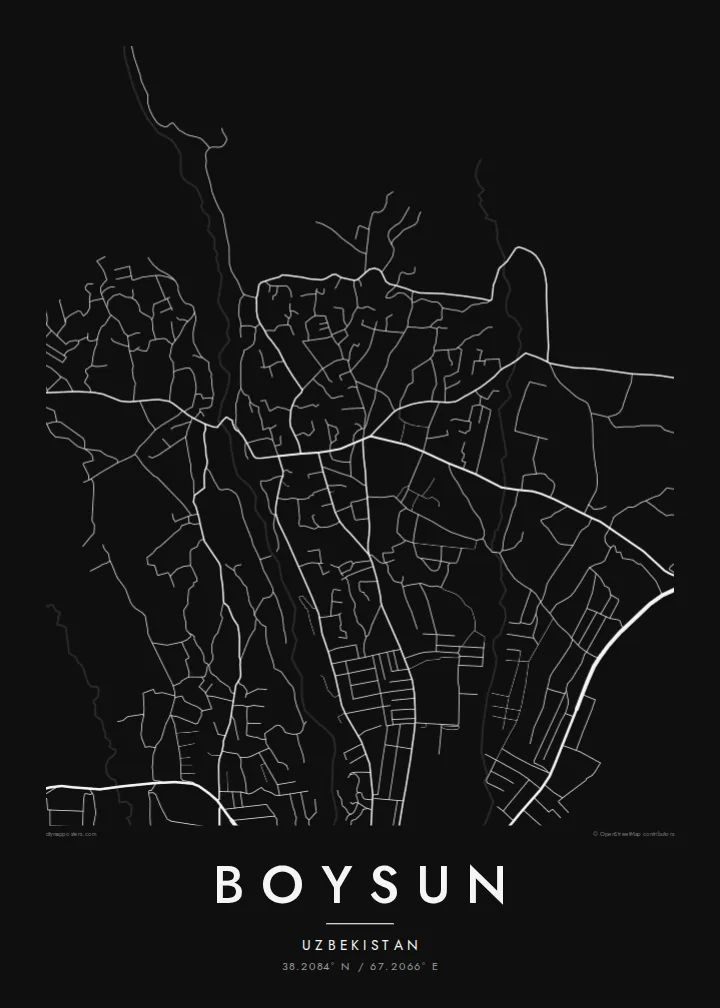
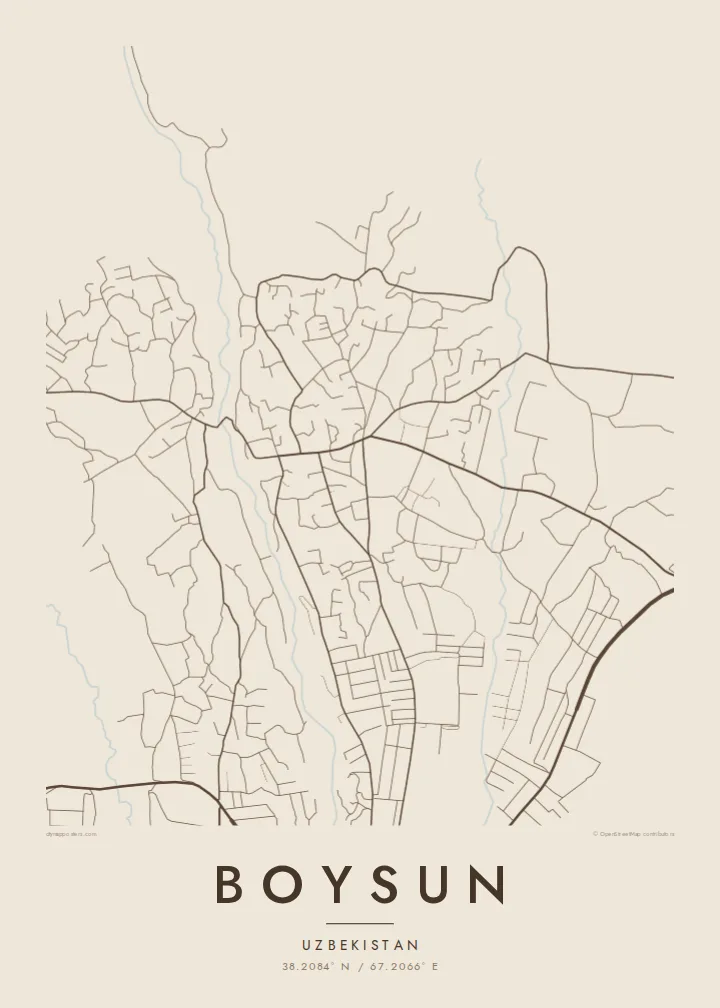
Boysun lies in the foothills of the Boysuntov mountains in Surxondaryo, the southernmost region of Uzbekistan. The town occupies a valley floor, and from above its streets follow the lie of the land rather than a strict grid. Lanes bend with small watercourses and orchard plots, and the contour-like rhythm of the slopes presses in from the surrounding hills.
The district is known far beyond Uzbekistan for its living traditions. UNESCO recognised the Cultural Space of Boysun District as intangible heritage, for the music, rituals and crafts preserved in its villages. The wider district also contains Teshik-Tash cave, where Neanderthal remains were found in the 1930s. The mountains that kept these traditions intact are just as visible on a map as the town itself.
A Boysun map poster shows a settlement shaped by terrain. Irrigation channels, garden walls and roads climbing out of the valley create a pattern that is irregular but coherent. It suits styles with warm tones, where the fine, winding lines of a highland town can read almost like a drawing on old paper.
The town's lanes bend and branch to follow the valley's gentle gradient. The result is an organic network that contrasts with the planned grids of lowland Uzbek cities.
Narrow irrigation channels and garden plots run between houses, giving the map a fine, textured interior of short, irregular lines.
The mountains close in around the settlement, and roads leading out of town climb and twist, marking the edge of the inhabited valley.
Fai mo koe
Fakaopoopo he aho, he igoa pe he upu a koe, hui te faiga, te lahi pe te tūlaga.
Ko te va'aiga e leai se totogi e maualalo tona resolution ma iai se fakailoga vai. E fakaatagia lomiga ma faila HD i te 300 DPI, e oo atu ki te 7,200 × 10,800 px, e aunoa ma se fakailoga vai.
Aiheā Boysun
For people from Surxondaryo, or travellers who came for the district's music and crafts, this map is a reminder of a place defined by its mountains. It is less a city portrait than a record of a valley and how people settled it.
Personalise the title, add a subtitle in any language and adjust the coordinates line. The five styles are Classic black & white, Noir, Paper, Blueprint and Sand. Download a free 900 px preview first, then get the full HD files for $9 or order a print.
Oka te poster Boysun| Lahi o te lomiga | Manino | Faila |
|---|---|---|
| 30 × 40 cm11.8 × 15.7″ | 3,543 × 4,724 px | PNG · PDF |
| 29.7 × 42 cm (A3)11.7 × 16.5″ | 3,508 × 4,961 px | PNG · PDF |
| 42 × 59.4 cm (A2)16.5 × 23.4″ | 4,961 × 7,016 px | PNG · PDF |
| 45.7 × 61 cm18 × 24″ | 5,400 × 7,200 px | PNG · PDF |
| 50 × 70 cm19.7 × 27.6″ | 5,906 × 8,268 px | PNG · PDF |
| 61 × 91.4 cm24 × 36″ | 7,200 × 10,800 px | PNG · PDF |
Mo te fakatatau, ko te fakaakoakoga e hē totogi e 900 px te lautele, e ihi te fakailoga ma mo te lau komipiuta. Ko nā faila HD e oko ki te 8× te manino i itū taki tahi ma e lomia lelei i te lahi kātoa o te pōhita.
Filifili se ata i te pito i luga o te itulau, ona filifili lea o te Poster Lomiina — se lapoa ma, ka manako ai koe, se faleata — pe ko Faila HD Fakaonaonaina. E tasi te laasaga o te ōkaina, ma ka fakafou loa lau itulau ōkaina pe a mae'a te totogi.
E lomiina i luga o se pepa matte kaliki maualuga e 200 gsm, i se tasi o ni lapoa e ono, mai le 30 × 40 cm ki te 24 × 36″. E kamata te tau o poster lomiina mai le $39, aofia ai te uta.
Ioe. Filifili se faleata lakau malō i te lanu uli, tea, oki masani pe lakau pouli. E aumai fakatasi mo se tioata e le gagamu ma ua sauni ke tautau. E kamata te tau o poster fakapipi'i i se faleata mai le $99, aofia ai te uta.
E tuku uma te uta ki fenua e 60+. Ko te pepa takitasi e lomi e te tasi o a matou paaga lomi i fenua e 30+, ka tae mai i aso galue e 3–7. E mafai ke e maimoa ki te tulaga mo te tulitaki i lalo o Taku Fakatonuga. E lauiti nei fenua e 2–5 wiki, ka ko nei fenua e le o tuku atu ai, e fakamatala atu e te weepisi i mua o te totogi.
Auina mai se ata pikitia i loto o te 14 aso mai te taimi na oo mai ai, ka toe lomiina e matou e leai se totogi pe toe totogi atu lau tupe.
Ioe. I te mea fakasa'o i luga o lenei itulau, sui te ulutala, te ulutala lalo ma te laina fakamaoniga tulaga ki so se mea e manako ai koe, ona filifili lea o se ata ma se lapoa. Okaina lomiina, fakapipi'i i faleata, ma fakaonaonaina e fakaaogā uma i tau ata tonu.
Mo le $9 e maua e koe ni faila PNG 300 DPI ma PDF sauni-mo-lomiga i lapoa e ono uma, e aunoa ma se fakailoga vai, ke lomiina i so se mea. E le'i mautinoa? Download muamua se va'aiga fakailoga vai e leai se totogi.
