The main road
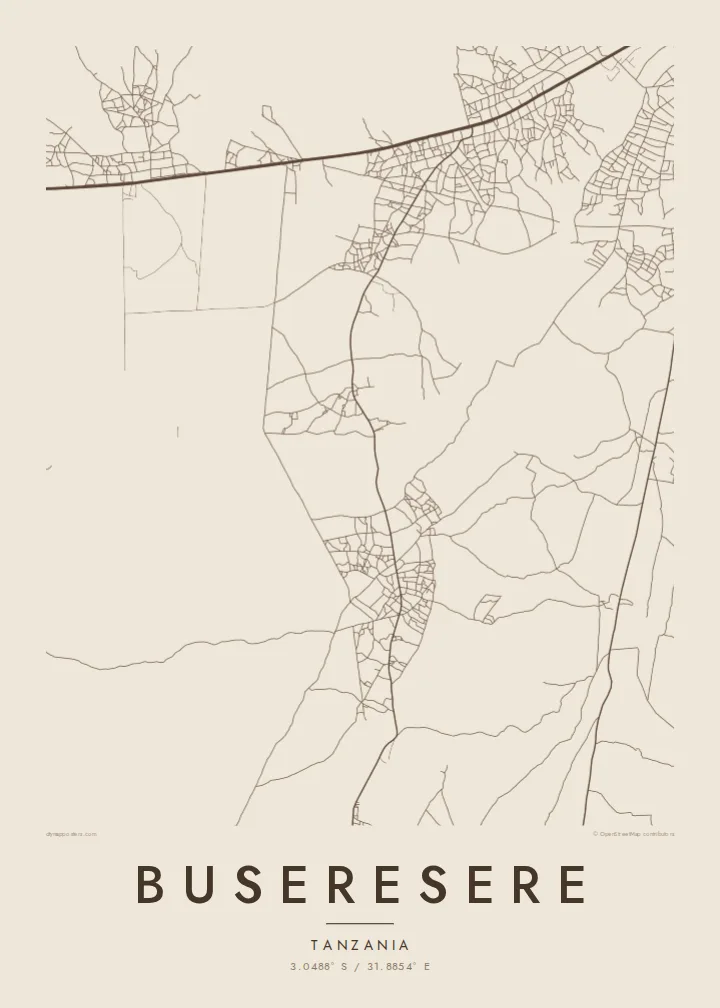
The strongest line on the map is the road the town grew up along. Most of the commercial streets cling to it, so its path organises the rest of the drawing.
Pōhita mape faigofie · Tanzania
3.0488° S / 31.8854° E
A market town built along a road through open country, its compact centre loosening into scattered homesteads and fields


Taone e tahi, lagona e lima
Pa'i se ata ke va'ai ai i luga o te pā. E tutusa te tau o ata uma — i lomiga, fakapipi'i i faleata, pe ko faila HD.
 Pixels mo'i · Faila lomiga 24 × 36″
Manino mo te lomiga
Ko se kupega 100% mai te faila lomiga mo'i. Poster uma — pe lomiina, fakapipi'i i faleata, pe download-ina — e fakaatagia i luga o a matou setula i te 300 DPI, e oo atu ki te 7,200 × 10,800 pixels, ina ia mautinoa e ma'ai pea auala tuai foki i luga o se lomiga 24 × 36″.
I luga o te pa


Te mape
Buseresere sits in Tanzania's Geita Region, in the rolling country southwest of Lake Victoria. From above, the town reads as a line before it reads as a grid. Its busiest streets follow the main road, and side lanes branch off it at uneven angles to reach houses, shops and yards. Beyond the last buildings the road network thins into tracks that cross farmland and scrub.
The pattern is a common one for East African trading towns. Buildings cluster tightly where traffic stops, then spread into loose plots with gardens between them. On a map this shows up as a dense knot of short streets with fine lines running outward toward neighbouring villages, rather than as a planned block layout. That uneven growth is what the drawing picks up best.
A Buseresere map poster turns that plain road-and-lane structure into a graphic study. Without colour or labels, the eye goes to the main road, the tight centre and the soft edge where the town fades into countryside. It is a quiet, legible picture of a place many people know as a stop on their way through Geita Region and a home for more than fifty thousand residents.
The strongest line on the map is the road the town grew up along. Most of the commercial streets cling to it, so its path organises the rest of the drawing.
Where the town is busiest, short lanes and small plots pack closely together, forming a darker cluster of lines that stands out clearly against the open land around it.
At the outskirts the streets thin into footpaths and farm tracks. This gradual fade gives the poster a soft border instead of a hard city limit.
Fai mo koe
Fakaopoopo he aho, he igoa pe he upu a koe, hui te faiga, te lahi pe te tūlaga.
Ko te va'aiga e leai se totogi e maualalo tona resolution ma iai se fakailoga vai. E fakaatagia lomiga ma faila HD i te 300 DPI, e oo atu ki te 7,200 × 10,800 px, e aunoa ma se fakailoga vai.
Aiheā Buseresere
People hang a map of Buseresere because it is home, or because family or work ties them to Geita Region. A town that rarely shows up on printed maps takes on real presence when it is drawn clearly and at poster scale, with the road and lanes people use every day.
You can change the title, subtitle and coordinates line, for example to add a family name or a date that matters. Then pick one of five styles: Classic black & white, Noir, Paper, Blueprint or Sand. Each one gives the same streets a different tone to suit the room.
Oka te poster Buseresere| Lahi o te lomiga | Manino | Faila |
|---|---|---|
| 30 × 40 cm11.8 × 15.7″ | 3,543 × 4,724 px | PNG · PDF |
| 29.7 × 42 cm (A3)11.7 × 16.5″ | 3,508 × 4,961 px | PNG · PDF |
| 42 × 59.4 cm (A2)16.5 × 23.4″ | 4,961 × 7,016 px | PNG · PDF |
| 45.7 × 61 cm18 × 24″ | 5,400 × 7,200 px | PNG · PDF |
| 50 × 70 cm19.7 × 27.6″ | 5,906 × 8,268 px | PNG · PDF |
| 61 × 91.4 cm24 × 36″ | 7,200 × 10,800 px | PNG · PDF |
Mo te fakatatau, ko te fakaakoakoga e hē totogi e 900 px te lautele, e ihi te fakailoga ma mo te lau komipiuta. Ko nā faila HD e oko ki te 8× te manino i itū taki tahi ma e lomia lelei i te lahi kātoa o te pōhita.
Filifili se ata i te pito i luga o te itulau, ona filifili lea o te Poster Lomiina — se lapoa ma, ka manako ai koe, se faleata — pe ko Faila HD Fakaonaonaina. E tasi te laasaga o te ōkaina, ma ka fakafou loa lau itulau ōkaina pe a mae'a te totogi.
E lomiina i luga o se pepa matte kaliki maualuga e 200 gsm, i se tasi o ni lapoa e ono, mai le 30 × 40 cm ki te 24 × 36″. E kamata te tau o poster lomiina mai le $39, aofia ai te uta.
Ioe. Filifili se faleata lakau malō i te lanu uli, tea, oki masani pe lakau pouli. E aumai fakatasi mo se tioata e le gagamu ma ua sauni ke tautau. E kamata te tau o poster fakapipi'i i se faleata mai le $99, aofia ai te uta.
E tuku uma te uta ki fenua e 60+. Ko te pepa takitasi e lomi e te tasi o a matou paaga lomi i fenua e 30+, ka tae mai i aso galue e 3–7. E mafai ke e maimoa ki te tulaga mo te tulitaki i lalo o Taku Fakatonuga. E lauiti nei fenua e 2–5 wiki, ka ko nei fenua e le o tuku atu ai, e fakamatala atu e te weepisi i mua o te totogi.
Auina mai se ata pikitia i loto o te 14 aso mai te taimi na oo mai ai, ka toe lomiina e matou e leai se totogi pe toe totogi atu lau tupe.
Ioe. I te mea fakasa'o i luga o lenei itulau, sui te ulutala, te ulutala lalo ma te laina fakamaoniga tulaga ki so se mea e manako ai koe, ona filifili lea o se ata ma se lapoa. Okaina lomiina, fakapipi'i i faleata, ma fakaonaonaina e fakaaogā uma i tau ata tonu.
Mo le $9 e maua e koe ni faila PNG 300 DPI ma PDF sauni-mo-lomiga i lapoa e ono uma, e aunoa ma se fakailoga vai, ke lomiina i so se mea. E le'i mautinoa? Download muamua se va'aiga fakailoga vai e leai se totogi.
Latalata
