Yuzhong peninsula
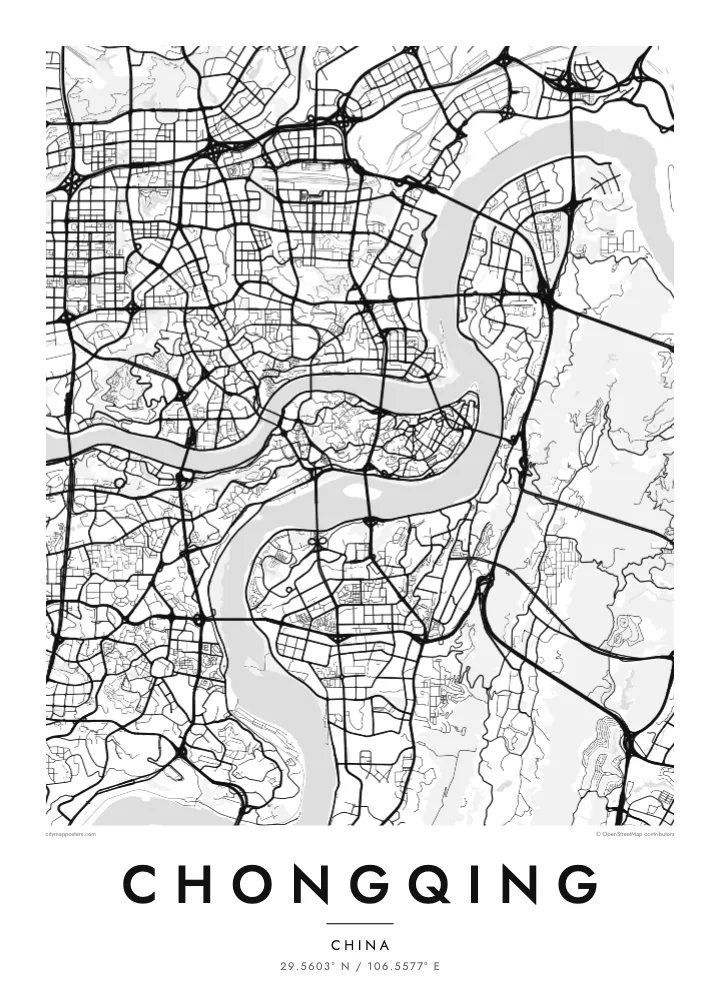
The old centre fills a slender finger of land between the Jialing and Yangtze, ending at Chaotianmen, where the two rivers meet and continue east as one.
Pōhita mape faigofie · China
29.5603° N / 106.5577° E
A mountain city folded around the meeting of two rivers, its streets climbing hillsides and bridges stitching every bank together


Taone e tahi, lagona e lima
Pa'i se ata ke va'ai ai i luga o te pā. E tutusa te tau o ata uma — i lomiga, fakapipi'i i faleata, pe ko faila HD.
 Pixels mo'i · Faila lomiga 24 × 36″
Manino mo te lomiga
Ko se kupega 100% mai te faila lomiga mo'i. Poster uma — pe lomiina, fakapipi'i i faleata, pe download-ina — e fakaatagia i luga o a matou setula i te 300 DPI, e oo atu ki te 7,200 × 10,800 pixels, ina ia mautinoa e ma'ai pea auala tuai foki i luga o se lomiga 24 × 36″.
I luga o te pa


Te mape
Chongqing is built where the Jialing River flows into the Yangtze, and the map makes that meeting point unmistakable. The historic core of Yuzhong occupies a narrow, rocky peninsula between the two rivers, tapering to a point at Chaotianmen, where the waters join. From there the city spreads across both banks and up into the surrounding ridges, filling valleys and hilltops alike.
Few large cities are this uneven. Streets here do not follow a grid; they curve along contour lines, switch back up slopes and stop abruptly at cliffs, so the pattern on paper looks more like a set of branching veins than a planned plan. Roads sit at different levels, and a building's ground floor on one side may be several storeys up on the other.
A Chongqing map poster turns this terrain into an intricate drawing. Its many bridges, which have earned it the nickname of China's bridge city, cross the Yangtze and Jialing again and again, linking districts that the rivers and hills would otherwise keep apart. The result is one of the most distinctive urban outlines in the world.
The old centre fills a slender finger of land between the Jialing and Yangtze, ending at Chaotianmen, where the two rivers meet and continue east as one.
Roads wind around hills rather than cutting through them, so neighbourhoods appear as curling clusters of streets separated by steep slopes and gaps where the ground falls away.
Dozens of bridges span the two rivers, and on the map they appear as a series of straight lines stitching the curving banks together at regular intervals.
Fai mo koe
Fakaopoopo he aho, he igoa pe he upu a koe, hui te faiga, te lahi pe te tūlaga.
Ko te va'aiga e leai se totogi e maualalo tona resolution ma iai se fakailoga vai. E fakaatagia lomiga ma faila HD i te 300 DPI, e oo atu ki te 7,200 × 10,800 px, e aunoa ma se fakailoga vai.
Aiheā Chongqing
For anyone who has climbed Chongqing's stairways, ridden the monorail through its hills or looked out over the rivers at night, this map is an unmistakable reminder of the city. It works as a piece for a home there, a keepsake from a trip or a gift for someone who grew up among its slopes.
Add a title and a date that matter to you, and choose from five styles: Classic black & white, Noir, Paper, Blueprint or Sand. The layered streets and river curves read clearly in every version, from dark Noir to warm, soft Sand.
Oka te poster Chongqing| Lahi o te lomiga | Manino | Faila |
|---|---|---|
| 30 × 40 cm11.8 × 15.7″ | 3,543 × 4,724 px | PNG · PDF |
| 29.7 × 42 cm (A3)11.7 × 16.5″ | 3,508 × 4,961 px | PNG · PDF |
| 42 × 59.4 cm (A2)16.5 × 23.4″ | 4,961 × 7,016 px | PNG · PDF |
| 45.7 × 61 cm18 × 24″ | 5,400 × 7,200 px | PNG · PDF |
| 50 × 70 cm19.7 × 27.6″ | 5,906 × 8,268 px | PNG · PDF |
| 61 × 91.4 cm24 × 36″ | 7,200 × 10,800 px | PNG · PDF |
Mo te fakatatau, ko te fakaakoakoga e hē totogi e 900 px te lautele, e ihi te fakailoga ma mo te lau komipiuta. Ko nā faila HD e oko ki te 8× te manino i itū taki tahi ma e lomia lelei i te lahi kātoa o te pōhita.
Filifili se ata i te pito i luga o te itulau, ona filifili lea o te Poster Lomiina — se lapoa ma, ka manako ai koe, se faleata — pe ko Faila HD Fakaonaonaina. E tasi te laasaga o te ōkaina, ma ka fakafou loa lau itulau ōkaina pe a mae'a te totogi.
E lomiina i luga o se pepa matte kaliki maualuga e 200 gsm, i se tasi o ni lapoa e ono, mai le 30 × 40 cm ki te 24 × 36″. E kamata te tau o poster lomiina mai le $39, aofia ai te uta.
Ioe. Filifili se faleata lakau malō i te lanu uli, tea, oki masani pe lakau pouli. E aumai fakatasi mo se tioata e le gagamu ma ua sauni ke tautau. E kamata te tau o poster fakapipi'i i se faleata mai le $99, aofia ai te uta.
E tuku uma te uta ki fenua e 60+. Ko te pepa takitasi e lomi e te tasi o a matou paaga lomi i fenua e 30+, ka tae mai i aso galue e 3–7. E mafai ke e maimoa ki te tulaga mo te tulitaki i lalo o Taku Fakatonuga. E lauiti nei fenua e 2–5 wiki, ka ko nei fenua e le o tuku atu ai, e fakamatala atu e te weepisi i mua o te totogi.
Auina mai se ata pikitia i loto o te 14 aso mai te taimi na oo mai ai, ka toe lomiina e matou e leai se totogi pe toe totogi atu lau tupe.
Ioe. I te mea fakasa'o i luga o lenei itulau, sui te ulutala, te ulutala lalo ma te laina fakamaoniga tulaga ki so se mea e manako ai koe, ona filifili lea o se ata ma se lapoa. Okaina lomiina, fakapipi'i i faleata, ma fakaonaonaina e fakaaogā uma i tau ata tonu.
Mo le $9 e maua e koe ni faila PNG 300 DPI ma PDF sauni-mo-lomiga i lapoa e ono uma, e aunoa ma se fakailoga vai, ke lomiina i so se mea. E le'i mautinoa? Download muamua se va'aiga fakailoga vai e leai se totogi.
Latalata
