Contour-following streets
Residential roads bend with the hills rather than cutting across them, producing loops and crescents that trace the shape of the land underneath.
Pōhita mape faigofie · Mexico
19.5579° N / 99.2567° W
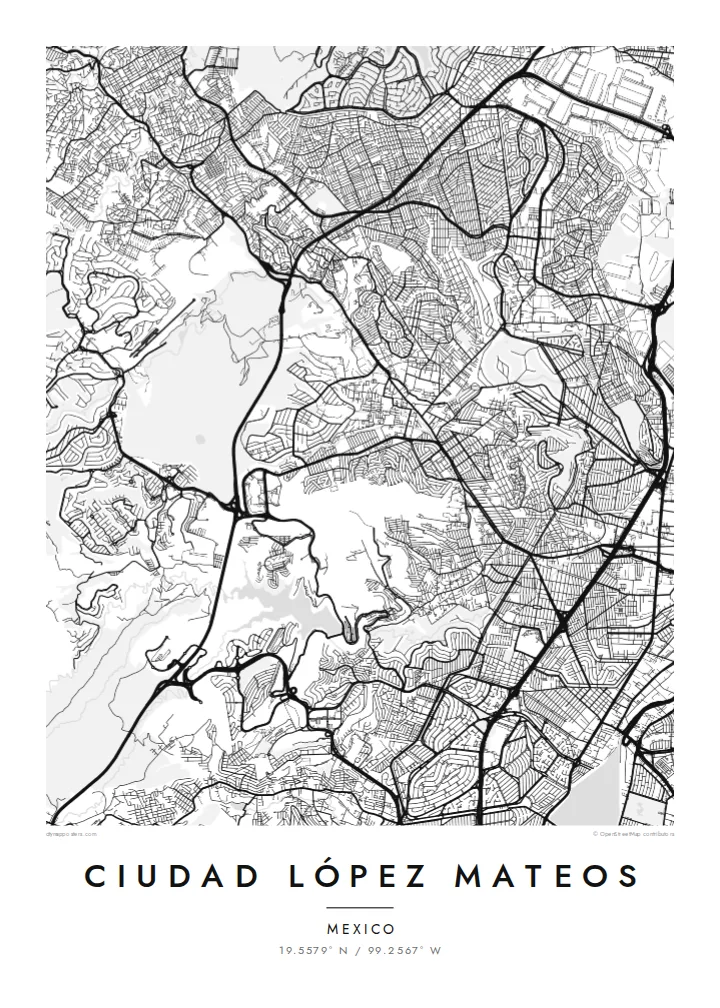
Curving residential streets draped over the hills of the northwestern metropolitan edge, far from any straight grid


Taone e tahi, lagona e lima
Pa'i se ata ke va'ai ai i luga o te pā. E tutusa te tau o ata uma — i lomiga, fakapipi'i i faleata, pe ko faila HD.
 Pixels mo'i · Faila lomiga 24 × 36″
Manino mo te lomiga
Ko se kupega 100% mai te faila lomiga mo'i. Poster uma — pe lomiina, fakapipi'i i faleata, pe download-ina — e fakaatagia i luga o a matou setula i te 300 DPI, e oo atu ki te 7,200 × 10,800 pixels, ina ia mautinoa e ma'ai pea auala tuai foki i luga o se lomiga 24 × 36″.
I luga o te pa


Te mape
Ciudad López Mateos is the urban core of Atizapán de Zaragoza, on the northwestern side of Greater Mexico City. It is named after Adolfo López Mateos, the president who governed Mexico from 1958 to 1964. From above, it looks nothing like the flat grids of the basin floor. The land folds into ridges and ravines, and the streets follow them, bending around hillsides and splitting into cul-de-sacs.
The layout comes from decades of planned subdivisions laid next to one another on uneven ground. Each has its own internal logic: loops, crescents and short spurs. Main roads thread between them along the valleys. Open ground and wooded slopes remain where the land is too steep to build on, and they read as quiet blank patches between the dense clusters.
A Ciudad López Mateos map poster shows this pattern of contoured neighbourhoods clearly. Because no single grid dominates, the page reads more like a drawing of terrain than a street plan. The lines thicken where the suburbs meet the main roads toward the rest of the metropolitan area, and they thin toward the greener, higher ground at the edges.
Residential roads bend with the hills rather than cutting across them, producing loops and crescents that trace the shape of the land underneath.
The main roads run along the lower ground between ridges and connect the separate subdivisions to the wider metropolitan network to the south and east.
Slopes too steep to build on remain open and show up as pale, irregular spaces that break up the dense clusters of housing.
Fai mo koe
Fakaopoopo he aho, he igoa pe he upu a koe, hui te faiga, te lahi pe te tūlaga.
Ko te va'aiga e leai se totogi e maualalo tona resolution ma iai se fakailoga vai. E fakaatagia lomiga ma faila HD i te 300 DPI, e oo atu ki te 7,200 × 10,800 px, e aunoa ma se fakailoga vai.
Aiheā Ciudad López Mateos
This is a poster for people who grew up or settled in the hills northwest of the capital, where every neighbourhood has its own shape. The curving streets make a quiet, almost organic composition that suits a hallway or study.
Add a family name, a street or the year you moved in as the title, and keep or edit the coordinates. Each of the five styles, from Classic black & white and Noir to Paper, Blueprint and Sand, gives the hills a different tone.
Oka te poster Ciudad López Mateos| Lahi o te lomiga | Manino | Faila |
|---|---|---|
| 30 × 40 cm11.8 × 15.7″ | 3,543 × 4,724 px | PNG · PDF |
| 29.7 × 42 cm (A3)11.7 × 16.5″ | 3,508 × 4,961 px | PNG · PDF |
| 42 × 59.4 cm (A2)16.5 × 23.4″ | 4,961 × 7,016 px | PNG · PDF |
| 45.7 × 61 cm18 × 24″ | 5,400 × 7,200 px | PNG · PDF |
| 50 × 70 cm19.7 × 27.6″ | 5,906 × 8,268 px | PNG · PDF |
| 61 × 91.4 cm24 × 36″ | 7,200 × 10,800 px | PNG · PDF |
Mo te fakatatau, ko te fakaakoakoga e hē totogi e 900 px te lautele, e ihi te fakailoga ma mo te lau komipiuta. Ko nā faila HD e oko ki te 8× te manino i itū taki tahi ma e lomia lelei i te lahi kātoa o te pōhita.
Filifili se ata i te pito i luga o te itulau, ona filifili lea o te Poster Lomiina — se lapoa ma, ka manako ai koe, se faleata — pe ko Faila HD Fakaonaonaina. E tasi te laasaga o te ōkaina, ma ka fakafou loa lau itulau ōkaina pe a mae'a te totogi.
E lomiina i luga o se pepa matte kaliki maualuga e 200 gsm, i se tasi o ni lapoa e ono, mai le 30 × 40 cm ki te 24 × 36″. E kamata te tau o poster lomiina mai le $39, aofia ai te uta.
Ioe. Filifili se faleata lakau malō i te lanu uli, tea, oki masani pe lakau pouli. E aumai fakatasi mo se tioata e le gagamu ma ua sauni ke tautau. E kamata te tau o poster fakapipi'i i se faleata mai le $99, aofia ai te uta.
E tuku uma te uta ki fenua e 60+. Ko te pepa takitasi e lomi e te tasi o a matou paaga lomi i fenua e 30+, ka tae mai i aso galue e 3–7. E mafai ke e maimoa ki te tulaga mo te tulitaki i lalo o Taku Fakatonuga. E lauiti nei fenua e 2–5 wiki, ka ko nei fenua e le o tuku atu ai, e fakamatala atu e te weepisi i mua o te totogi.
Auina mai se ata pikitia i loto o te 14 aso mai te taimi na oo mai ai, ka toe lomiina e matou e leai se totogi pe toe totogi atu lau tupe.
Ioe. I te mea fakasa'o i luga o lenei itulau, sui te ulutala, te ulutala lalo ma te laina fakamaoniga tulaga ki so se mea e manako ai koe, ona filifili lea o se ata ma se lapoa. Okaina lomiina, fakapipi'i i faleata, ma fakaonaonaina e fakaaogā uma i tau ata tonu.
Mo le $9 e maua e koe ni faila PNG 300 DPI ma PDF sauni-mo-lomiga i lapoa e ono uma, e aunoa ma se fakailoga vai, ke lomiina i so se mea. E le'i mautinoa? Download muamua se va'aiga fakailoga vai e leai se totogi.
Latalata
