Continuous block grid
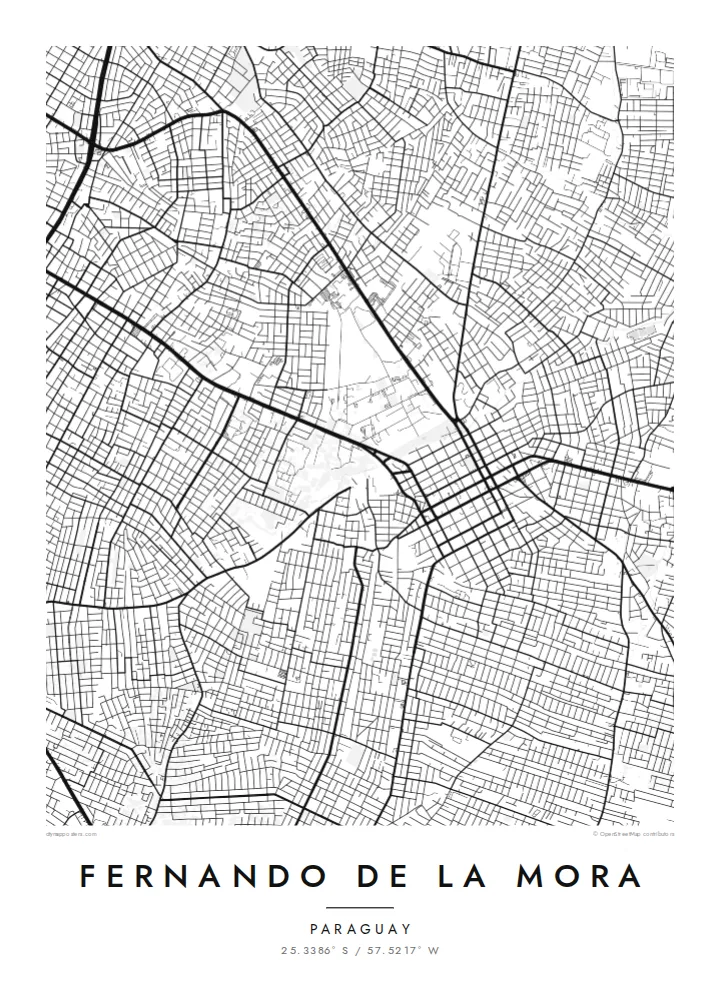
Small rectangular blocks repeat across the whole municipality. In thin black line they produce a fine, even texture that looks almost like woven fabric.
Pōhita mape faigofie · Paraguay
25.3386° S / 57.5217° W
A dense residential grid on Asunción's eastern edge, where city blocks run straight on into the capital and its neighbours


Taone e tahi, lagona e lima
Pa'i se ata ke va'ai ai i luga o te pā. E tutusa te tau o ata uma — i lomiga, fakapipi'i i faleata, pe ko faila HD.
 Pixels mo'i · Faila lomiga 24 × 36″
Manino mo te lomiga
Ko se kupega 100% mai te faila lomiga mo'i. Poster uma — pe lomiina, fakapipi'i i faleata, pe download-ina — e fakaatagia i luga o a matou setula i te 300 DPI, e oo atu ki te 7,200 × 10,800 pixels, ina ia mautinoa e ma'ai pea auala tuai foki i luga o se lomiga 24 × 36″.
I luga o te pa


Te mape
Fernando de la Mora is part of the continuous urban area around Asunción, bordering the capital on one side and San Lorenzo on another. From above, nothing marks where one municipality ends and the next begins, because the block pattern simply carries on. The streets form a mostly regular grid of small, near-square blocks, broken here and there by diagonal avenues and the long straight main roads heading east.
The city is named after Fernando de la Mora, a figure from Paraguay's early independence period. It grew quickly in the twentieth century as Asunción expanded, and it is now one of the most densely built municipalities in the country. The map shows that growth as an almost uniform fabric of housing, schools, shops and small plazas, with few large gaps between them.
Because its streets are so regular, a Fernando de la Mora map poster has a strong graphic rhythm. The grid fills the frame from edge to edge, and the few roads that break it stand out as bold diagonals. The composition looks structured and modern in print, even though it records an ordinary, lived-in suburb rather than a planned showpiece.
Small rectangular blocks repeat across the whole municipality. In thin black line they produce a fine, even texture that looks almost like woven fabric.
Wide roads linking Asunción with San Lorenzo and the interior cut through the grid in long, confident strokes. They are the main directional lines of the map.
On the ground you cannot see the borders with Asunción and the neighbouring towns, so the map shows one urban fabric that runs past the frame on every side.
Fai mo koe
Fakaopoopo he aho, he igoa pe he upu a koe, hui te faiga, te lahi pe te tūlaga.
Ko te va'aiga e leai se totogi e maualalo tona resolution ma iai se fakailoga vai. E fakaatagia lomiga ma faila HD i te 300 DPI, e oo atu ki te 7,200 × 10,800 px, e aunoa ma se fakailoga vai.
Aiheā Fernando de la Mora
For anyone who lives in Greater Asunción or grew up in these streets, the map captures the everyday geography of home: the corner where the bus stops, the block of a first apartment, the route to school or work.
Personalise it with your own title, subtitle and coordinates line, and pick one of five styles: Classic black & white, Noir, Paper, Blueprint or Sand. HD files cost $9 and come in six print sizes, or you can order a printed poster from a partner near you.
Oka te poster Fernando de la Mora| Lahi o te lomiga | Manino | Faila |
|---|---|---|
| 30 × 40 cm11.8 × 15.7″ | 3,543 × 4,724 px | PNG · PDF |
| 29.7 × 42 cm (A3)11.7 × 16.5″ | 3,508 × 4,961 px | PNG · PDF |
| 42 × 59.4 cm (A2)16.5 × 23.4″ | 4,961 × 7,016 px | PNG · PDF |
| 45.7 × 61 cm18 × 24″ | 5,400 × 7,200 px | PNG · PDF |
| 50 × 70 cm19.7 × 27.6″ | 5,906 × 8,268 px | PNG · PDF |
| 61 × 91.4 cm24 × 36″ | 7,200 × 10,800 px | PNG · PDF |
Mo te fakatatau, ko te fakaakoakoga e hē totogi e 900 px te lautele, e ihi te fakailoga ma mo te lau komipiuta. Ko nā faila HD e oko ki te 8× te manino i itū taki tahi ma e lomia lelei i te lahi kātoa o te pōhita.
Filifili se ata i te pito i luga o te itulau, ona filifili lea o te Poster Lomiina — se lapoa ma, ka manako ai koe, se faleata — pe ko Faila HD Fakaonaonaina. E tasi te laasaga o te ōkaina, ma ka fakafou loa lau itulau ōkaina pe a mae'a te totogi.
E lomiina i luga o se pepa matte kaliki maualuga e 200 gsm, i se tasi o ni lapoa e ono, mai le 30 × 40 cm ki te 24 × 36″. E kamata te tau o poster lomiina mai le $39, aofia ai te uta.
Ioe. Filifili se faleata lakau malō i te lanu uli, tea, oki masani pe lakau pouli. E aumai fakatasi mo se tioata e le gagamu ma ua sauni ke tautau. E kamata te tau o poster fakapipi'i i se faleata mai le $99, aofia ai te uta.
E tuku uma te uta ki fenua e 60+. Ko te pepa takitasi e lomi e te tasi o a matou paaga lomi i fenua e 30+, ka tae mai i aso galue e 3–7. E mafai ke e maimoa ki te tulaga mo te tulitaki i lalo o Taku Fakatonuga. E lauiti nei fenua e 2–5 wiki, ka ko nei fenua e le o tuku atu ai, e fakamatala atu e te weepisi i mua o te totogi.
Auina mai se ata pikitia i loto o te 14 aso mai te taimi na oo mai ai, ka toe lomiina e matou e leai se totogi pe toe totogi atu lau tupe.
Ioe. I te mea fakasa'o i luga o lenei itulau, sui te ulutala, te ulutala lalo ma te laina fakamaoniga tulaga ki so se mea e manako ai koe, ona filifili lea o se ata ma se lapoa. Okaina lomiina, fakapipi'i i faleata, ma fakaonaonaina e fakaaogā uma i tau ata tonu.
Mo le $9 e maua e koe ni faila PNG 300 DPI ma PDF sauni-mo-lomiga i lapoa e ono uma, e aunoa ma se fakailoga vai, ke lomiina i so se mea. E le'i mautinoa? Download muamua se va'aiga fakailoga vai e leai se totogi.
Latalata
