Two rivers meeting
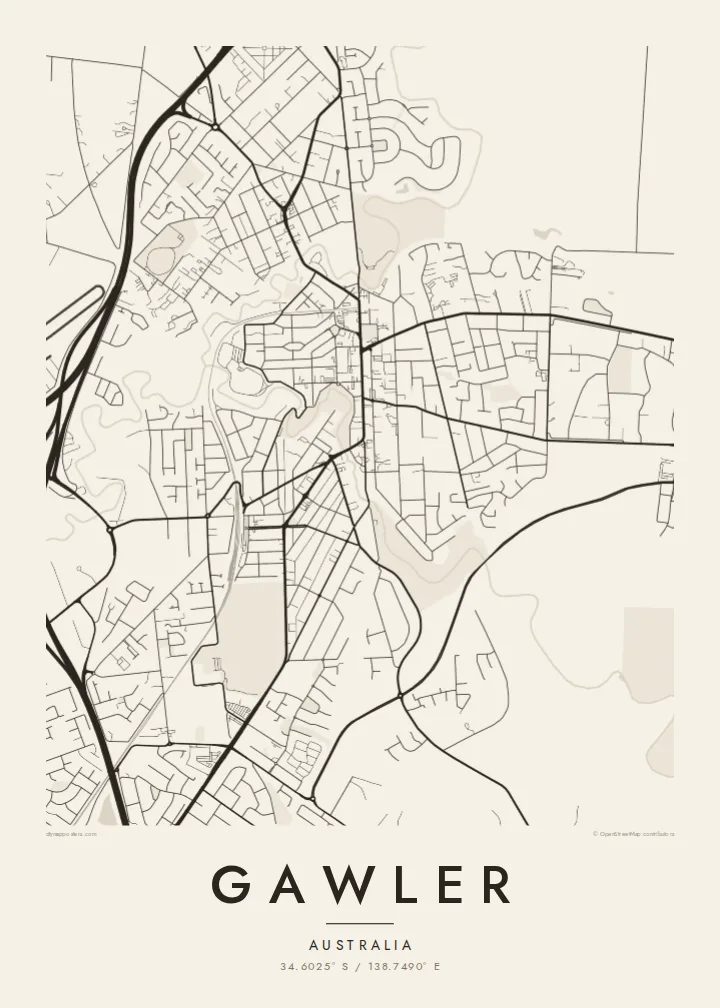
The North Para and South Para curve around the old town and meet to form the Gawler River, which gives the plan a natural frame on two sides.
Pōhita mape faigofie · Australia
34.6025° S / 138.7490° E
A colonial town plan set in the fork where the North and South Para rivers meet to form the Gawler River




Taone e tahi, lagona e lima
Pa'i se ata ke va'ai ai i luga o te pā. E tutusa te tau o ata uma — i lomiga, fakapipi'i i faleata, pe ko faila HD.
 Pixels mo'i · Faila lomiga 24 × 36″
Manino mo te lomiga
Ko se kupega 100% mai te faila lomiga mo'i. Poster uma — pe lomiina, fakapipi'i i faleata, pe download-ina — e fakaatagia i luga o a matou setula i te 300 DPI, e oo atu ki te 7,200 × 10,800 pixels, ina ia mautinoa e ma'ai pea auala tuai foki i luga o se lomiga 24 × 36″.
I luga o te pa


Te mape
Gawler, north of Adelaide, was laid out in 1839 and is usually credited to Colonel William Light, the surveyor of Adelaide itself. Its plan still shows clearly from above. A formal grid with squares and a long main street sits on the tongue of land between two rivers. It is one of the most legible nineteenth-century town layouts in South Australia and draws cleanly in black and white.
The North Para and South Para rivers bend around the old town and join on its western side to form the Gawler River. Their tree-lined courses appear on the map as soft, winding bands against the straight streets. Murray Street, the historic main street, runs through the centre, and the railway and newer suburbs spread outward across the surrounding plain and low hills.
Gawler is also a gateway to the Barossa Valley, which starts just to the northeast, so vineyards and farmland lie close to the town's edges. A Gawler map poster captures the planned grid, the enclosing rivers and the looser suburban growth beyond them. It is a clear record of how a surveyed colonial town fitted itself to a river fork.
The North Para and South Para curve around the old town and meet to form the Gawler River, which gives the plan a natural frame on two sides.
The 1839 survey laid out regular streets and open squares on the land between the rivers. It is still the clear, ordered core of the modern map.
The historic main street runs through the centre of town. It is the line the rest of the old grid organises itself around.
Fai mo koe
Fakaopoopo he aho, he igoa pe he upu a koe, hui te faiga, te lahi pe te tūlaga.
Ko te va'aiga e leai se totogi e maualalo tona resolution ma iai se fakailoga vai. E fakaatagia lomiga ma faila HD i te 300 DPI, e oo atu ki te 7,200 × 10,800 px, e aunoa ma se fakailoga vai.
Aiheā Gawler
Gawler has a plan with a clear intention behind it, and that comes through well in a minimalist print. It suits people who live in the town or commute from it, and anyone with ties to the Barossa or to South Australian history.
You can personalise the title, the subtitle and the coordinates line, whether that means a street address or the year you moved in. Choose from Classic, Noir, Paper, Blueprint and Sand. The HD files cost $9, and printed posters ship from print partners in more than 30 countries.
Oka te poster Gawler| Lahi o te lomiga | Manino | Faila |
|---|---|---|
| 30 × 40 cm11.8 × 15.7″ | 3,543 × 4,724 px | PNG · PDF |
| 29.7 × 42 cm (A3)11.7 × 16.5″ | 3,508 × 4,961 px | PNG · PDF |
| 42 × 59.4 cm (A2)16.5 × 23.4″ | 4,961 × 7,016 px | PNG · PDF |
| 45.7 × 61 cm18 × 24″ | 5,400 × 7,200 px | PNG · PDF |
| 50 × 70 cm19.7 × 27.6″ | 5,906 × 8,268 px | PNG · PDF |
| 61 × 91.4 cm24 × 36″ | 7,200 × 10,800 px | PNG · PDF |
Mo te fakatatau, ko te fakaakoakoga e hē totogi e 900 px te lautele, e ihi te fakailoga ma mo te lau komipiuta. Ko nā faila HD e oko ki te 8× te manino i itū taki tahi ma e lomia lelei i te lahi kātoa o te pōhita.
Filifili se ata i te pito i luga o te itulau, ona filifili lea o te Poster Lomiina — se lapoa ma, ka manako ai koe, se faleata — pe ko Faila HD Fakaonaonaina. E tasi te laasaga o te ōkaina, ma ka fakafou loa lau itulau ōkaina pe a mae'a te totogi.
E lomiina i luga o se pepa matte kaliki maualuga e 200 gsm, i se tasi o ni lapoa e ono, mai le 30 × 40 cm ki te 24 × 36″. E kamata te tau o poster lomiina mai le $39, aofia ai te uta.
Ioe. Filifili se faleata lakau malō i te lanu uli, tea, oki masani pe lakau pouli. E aumai fakatasi mo se tioata e le gagamu ma ua sauni ke tautau. E kamata te tau o poster fakapipi'i i se faleata mai le $99, aofia ai te uta.
E tuku uma te uta ki fenua e 60+. Ko te pepa takitasi e lomi e te tasi o a matou paaga lomi i fenua e 30+, ka tae mai i aso galue e 3–7. E mafai ke e maimoa ki te tulaga mo te tulitaki i lalo o Taku Fakatonuga. E lauiti nei fenua e 2–5 wiki, ka ko nei fenua e le o tuku atu ai, e fakamatala atu e te weepisi i mua o te totogi.
Auina mai se ata pikitia i loto o te 14 aso mai te taimi na oo mai ai, ka toe lomiina e matou e leai se totogi pe toe totogi atu lau tupe.
Ioe. I te mea fakasa'o i luga o lenei itulau, sui te ulutala, te ulutala lalo ma te laina fakamaoniga tulaga ki so se mea e manako ai koe, ona filifili lea o se ata ma se lapoa. Okaina lomiina, fakapipi'i i faleata, ma fakaonaonaina e fakaaogā uma i tau ata tonu.
Mo le $9 e maua e koe ni faila PNG 300 DPI ma PDF sauni-mo-lomiga i lapoa e ono uma, e aunoa ma se fakailoga vai, ke lomiina i so se mea. E le'i mautinoa? Download muamua se va'aiga fakailoga vai e leai se totogi.
