Mount Kinka
A forested peak rising straight out of the city's northeastern edge, left almost untouched by roads. On the map it forms a large open shape, with the castle at its summit.
Pōhita mape faigofie · Japan
35.4229° N / 136.7604° E
A flat city on the Nobi Plain, pinned between the curving Nagara River and the steep wooded mass of Mount Kinka.



Taone e tahi, lagona e lima
Pa'i se ata ke va'ai ai i luga o te pā. E tutusa te tau o ata uma — i lomiga, fakapipi'i i faleata, pe ko faila HD.
 Pixels mo'i · Faila lomiga 24 × 36″
Manino mo te lomiga
Ko se kupega 100% mai te faila lomiga mo'i. Poster uma — pe lomiina, fakapipi'i i faleata, pe download-ina — e fakaatagia i luga o a matou setula i te 300 DPI, e oo atu ki te 7,200 × 10,800 pixels, ina ia mautinoa e ma'ai pea auala tuai foki i luga o se lomiga 24 × 36″.
I luga o te pa


Te mape
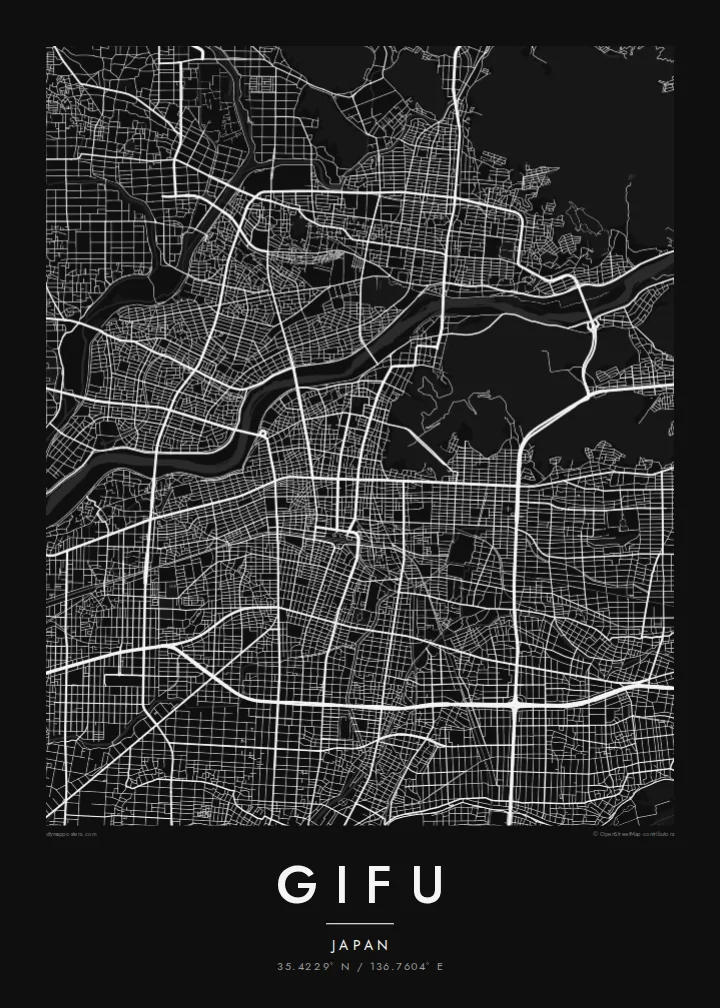
Gifu sits where the mountains of central Japan give way to the Nobi Plain, and the map shows that edge clearly. To the north, the Nagara River sweeps past in a clean, wide arc, and Mount Kinka rises abruptly beside it as a dark, almost roadless island of forest. South of the river, the city spreads in a regular grid of streets toward the main railway station.
Gifu Castle stands on the summit of Mount Kinka, reached by ropeway, and the name of the city itself is traditionally credited to Oda Nobunaga, who took the castle in the sixteenth century. On summer nights the Nagara hosts ukai, cormorant fishing by torchlight from wooden boats, a practice the city has kept alive for well over a thousand years.
A Gifu map poster captures the contrast between two textures: the precise, even grid of the lowland city and the blank, organic outline of the mountain and river on its northern edge. Smaller streams and channels thread through the southern districts, and the whole composition reads as a meeting of plain, water and hill in a single frame.
A forested peak rising straight out of the city's northeastern edge, left almost untouched by roads. On the map it forms a large open shape, with the castle at its summit.
The river runs clear and wide along the north of the centre and is known for its summer cormorant fishing. Its long curve gives the poster a natural upper boundary.
Around JR Gifu Station the streets settle into an orderly grid, the densest part of the map and the commercial core of the city.
Fai mo koe
Fakaopoopo he aho, he igoa pe he upu a koe, hui te faiga, te lahi pe te tūlaga.
Ko te va'aiga e leai se totogi e maualalo tona resolution ma iai se fakailoga vai. E fakaatagia lomiga ma faila HD i te 300 DPI, e oo atu ki te 7,200 × 10,800 px, e aunoa ma se fakailoga vai.
Aiheā Gifu
For many, Gifu means summers by the river and the ropeway ride up to the castle. A map of the city holds that geography in one view and suits anyone with family ties to the prefecture or good memories of a trip through central Japan.
You can personalise the title, subtitle and coordinates line, for example with a home address or the date of a visit. The poster comes in five styles, from Classic black & white and Noir to Paper, Blueprint and Sand, as a digital file or printed on matte paper.
Oka te poster Gifu| Lahi o te lomiga | Manino | Faila |
|---|---|---|
| 30 × 40 cm11.8 × 15.7″ | 3,543 × 4,724 px | PNG · PDF |
| 29.7 × 42 cm (A3)11.7 × 16.5″ | 3,508 × 4,961 px | PNG · PDF |
| 42 × 59.4 cm (A2)16.5 × 23.4″ | 4,961 × 7,016 px | PNG · PDF |
| 45.7 × 61 cm18 × 24″ | 5,400 × 7,200 px | PNG · PDF |
| 50 × 70 cm19.7 × 27.6″ | 5,906 × 8,268 px | PNG · PDF |
| 61 × 91.4 cm24 × 36″ | 7,200 × 10,800 px | PNG · PDF |
Mo te fakatatau, ko te fakaakoakoga e hē totogi e 900 px te lautele, e ihi te fakailoga ma mo te lau komipiuta. Ko nā faila HD e oko ki te 8× te manino i itū taki tahi ma e lomia lelei i te lahi kātoa o te pōhita.
Filifili se ata i te pito i luga o te itulau, ona filifili lea o te Poster Lomiina — se lapoa ma, ka manako ai koe, se faleata — pe ko Faila HD Fakaonaonaina. E tasi te laasaga o te ōkaina, ma ka fakafou loa lau itulau ōkaina pe a mae'a te totogi.
E lomiina i luga o se pepa matte kaliki maualuga e 200 gsm, i se tasi o ni lapoa e ono, mai le 30 × 40 cm ki te 24 × 36″. E kamata te tau o poster lomiina mai le $39, aofia ai te uta.
Ioe. Filifili se faleata lakau malō i te lanu uli, tea, oki masani pe lakau pouli. E aumai fakatasi mo se tioata e le gagamu ma ua sauni ke tautau. E kamata te tau o poster fakapipi'i i se faleata mai le $99, aofia ai te uta.
E tuku uma te uta ki fenua e 60+. Ko te pepa takitasi e lomi e te tasi o a matou paaga lomi i fenua e 30+, ka tae mai i aso galue e 3–7. E mafai ke e maimoa ki te tulaga mo te tulitaki i lalo o Taku Fakatonuga. E lauiti nei fenua e 2–5 wiki, ka ko nei fenua e le o tuku atu ai, e fakamatala atu e te weepisi i mua o te totogi.
Auina mai se ata pikitia i loto o te 14 aso mai te taimi na oo mai ai, ka toe lomiina e matou e leai se totogi pe toe totogi atu lau tupe.
Ioe. I te mea fakasa'o i luga o lenei itulau, sui te ulutala, te ulutala lalo ma te laina fakamaoniga tulaga ki so se mea e manako ai koe, ona filifili lea o se ata ma se lapoa. Okaina lomiina, fakapipi'i i faleata, ma fakaonaonaina e fakaaogā uma i tau ata tonu.
Mo le $9 e maua e koe ni faila PNG 300 DPI ma PDF sauni-mo-lomiga i lapoa e ono uma, e aunoa ma se fakailoga vai, ke lomiina i so se mea. E le'i mautinoa? Download muamua se va'aiga fakailoga vai e leai se totogi.
Latalata
