Sullivans Cove
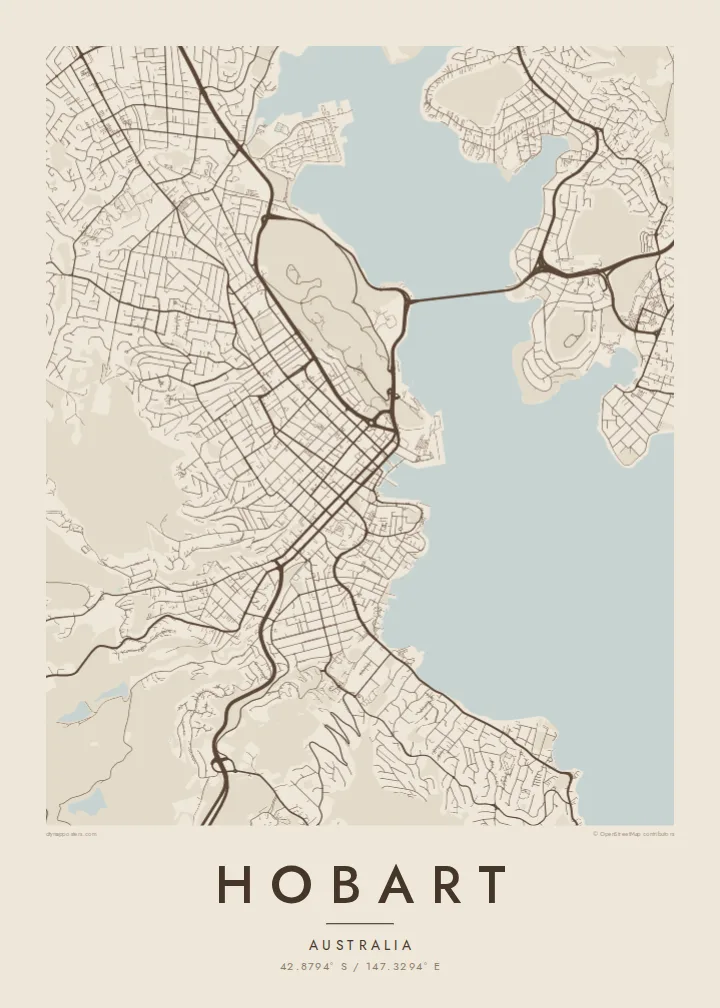
The harbour where Hobart began. On the map, its docks and wharves form a small, precise shape at the foot of the central grid, next to Salamanca Place and Battery Point.
Pōhita mape faigofie · Australia
42.8794° S / 147.3294° E
Streets climbing from the Derwent estuary toward kunanyi, with a long bridge and a small historic harbour at the centre


Taone e tahi, lagona e lima
Pa'i se ata ke va'ai ai i luga o te pā. E tutusa te tau o ata uma — i lomiga, fakapipi'i i faleata, pe ko faila HD.
 Pixels mo'i · Faila lomiga 24 × 36″
Manino mo te lomiga
Ko se kupega 100% mai te faila lomiga mo'i. Poster uma — pe lomiina, fakapipi'i i faleata, pe download-ina — e fakaatagia i luga o a matou setula i te 300 DPI, e oo atu ki te 7,200 × 10,800 pixels, ina ia mautinoa e ma'ai pea auala tuai foki i luga o se lomiga 24 × 36″.
I luga o te pa


Te mape
Hobart occupies the western shore of the Derwent River estuary, below the mass of kunanyi / Mount Wellington, which rises to about 1,270 metres. From above, the city is squeezed into a band between water and mountain. Streets start at the harbour in a regular grid, then bend and thin out as they climb into the steep, wooded slopes behind.
Founded in 1804, Hobart is Australia's second-oldest capital city. The early town grew around Sullivans Cove, where Salamanca Place still keeps a row of sandstone warehouses, and the small streets of Battery Point climb the headland beside it. Across the estuary, the eastern shore is linked by the Tasman Bridge, a long, slender line on the map.
A Hobart map poster makes the geography unusually legible. The estuary opens wide to the south, the mountain leaves a large quiet space to the west, and the city fits between them. Suburbs follow the river north toward Glenorchy and beyond, while the headlands and bays along the shore give the edge of the map a detailed, irregular outline.
The harbour where Hobart began. On the map, its docks and wharves form a small, precise shape at the foot of the central grid, next to Salamanca Place and Battery Point.
A long bridge crossing the Derwent to the eastern shore. Its straight line over the wide estuary is one of the clearest single features of the whole composition.
The mountain west of the city leaves a broad area with few streets. Roads wind up toward it, and the grid fades into curving lines as the terrain steepens.
Fai mo koe
Fakaopoopo he aho, he igoa pe he upu a koe, hui te faiga, te lahi pe te tūlaga.
Ko te va'aiga e leai se totogi e maualalo tona resolution ma iai se fakailoga vai. E fakaatagia lomiga ma faila HD i te 300 DPI, e oo atu ki te 7,200 × 10,800 px, e aunoa ma se fakailoga vai.
Aiheā Hobart
Hobart tends to leave a strong impression, whether you grew up there, studied there or passed through on the way to the rest of Tasmania. The combination of water, mountain and small historic core is easy to recognise on a wall.
Add a title, a subtitle and the coordinates of a particular address or the city centre. Blueprint suits the estuary and harbour well, while Paper or Classic black & white keep the focus on the fine street pattern.
Oka te poster Hobart| Lahi o te lomiga | Manino | Faila |
|---|---|---|
| 30 × 40 cm11.8 × 15.7″ | 3,543 × 4,724 px | PNG · PDF |
| 29.7 × 42 cm (A3)11.7 × 16.5″ | 3,508 × 4,961 px | PNG · PDF |
| 42 × 59.4 cm (A2)16.5 × 23.4″ | 4,961 × 7,016 px | PNG · PDF |
| 45.7 × 61 cm18 × 24″ | 5,400 × 7,200 px | PNG · PDF |
| 50 × 70 cm19.7 × 27.6″ | 5,906 × 8,268 px | PNG · PDF |
| 61 × 91.4 cm24 × 36″ | 7,200 × 10,800 px | PNG · PDF |
Mo te fakatatau, ko te fakaakoakoga e hē totogi e 900 px te lautele, e ihi te fakailoga ma mo te lau komipiuta. Ko nā faila HD e oko ki te 8× te manino i itū taki tahi ma e lomia lelei i te lahi kātoa o te pōhita.
Filifili se ata i te pito i luga o te itulau, ona filifili lea o te Poster Lomiina — se lapoa ma, ka manako ai koe, se faleata — pe ko Faila HD Fakaonaonaina. E tasi te laasaga o te ōkaina, ma ka fakafou loa lau itulau ōkaina pe a mae'a te totogi.
E lomiina i luga o se pepa matte kaliki maualuga e 200 gsm, i se tasi o ni lapoa e ono, mai le 30 × 40 cm ki te 24 × 36″. E kamata te tau o poster lomiina mai le $39, aofia ai te uta.
Ioe. Filifili se faleata lakau malō i te lanu uli, tea, oki masani pe lakau pouli. E aumai fakatasi mo se tioata e le gagamu ma ua sauni ke tautau. E kamata te tau o poster fakapipi'i i se faleata mai le $99, aofia ai te uta.
E tuku uma te uta ki fenua e 60+. Ko te pepa takitasi e lomi e te tasi o a matou paaga lomi i fenua e 30+, ka tae mai i aso galue e 3–7. E mafai ke e maimoa ki te tulaga mo te tulitaki i lalo o Taku Fakatonuga. E lauiti nei fenua e 2–5 wiki, ka ko nei fenua e le o tuku atu ai, e fakamatala atu e te weepisi i mua o te totogi.
Auina mai se ata pikitia i loto o te 14 aso mai te taimi na oo mai ai, ka toe lomiina e matou e leai se totogi pe toe totogi atu lau tupe.
Ioe. I te mea fakasa'o i luga o lenei itulau, sui te ulutala, te ulutala lalo ma te laina fakamaoniga tulaga ki so se mea e manako ai koe, ona filifili lea o se ata ma se lapoa. Okaina lomiina, fakapipi'i i faleata, ma fakaonaonaina e fakaaogā uma i tau ata tonu.
Mo le $9 e maua e koe ni faila PNG 300 DPI ma PDF sauni-mo-lomiga i lapoa e ono uma, e aunoa ma se fakailoga vai, ke lomiina i so se mea. E le'i mautinoa? Download muamua se va'aiga fakailoga vai e leai se totogi.
Latalata
