Regular street grid
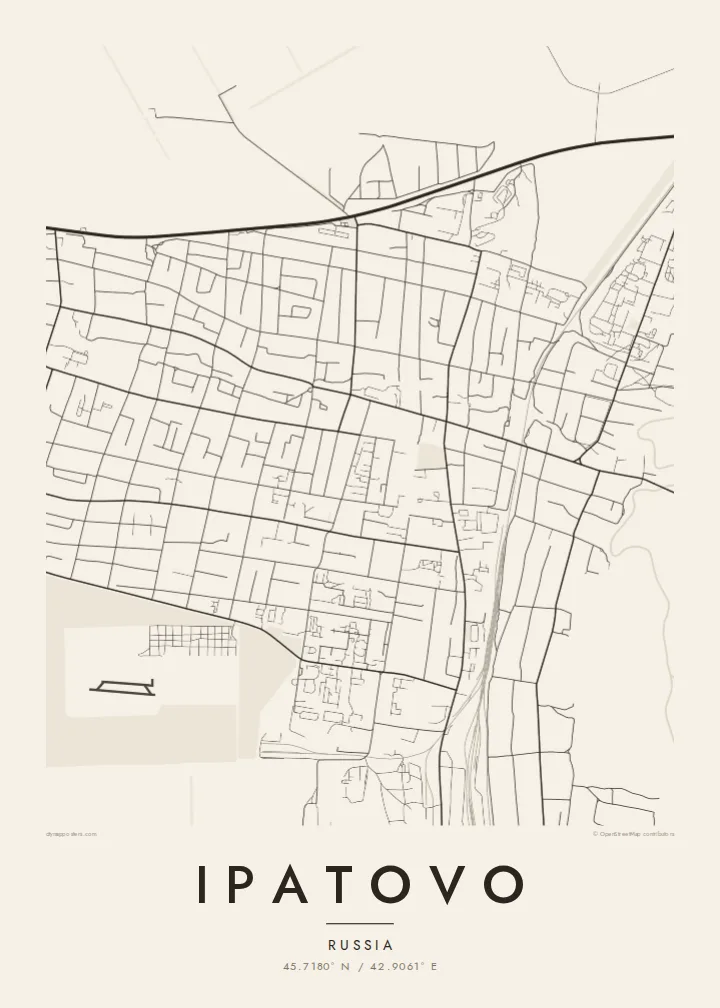
Long parallel streets and evenly spaced cross streets give the town its orderly look, a common pattern in steppe settlements of southern Russia that prints as a clean lattice of lines.
Pōhita mape faigofie · Russia
45.7180° N / 42.9061° E
A steppe town of straight streets and long blocks beside the Kalaus River, set in open farmland in Stavropol Kray




Taone e tahi, lagona e lima
Pa'i se ata ke va'ai ai i luga o te pā. E tutusa te tau o ata uma — i lomiga, fakapipi'i i faleata, pe ko faila HD.
 Pixels mo'i · Faila lomiga 24 × 36″
Manino mo te lomiga
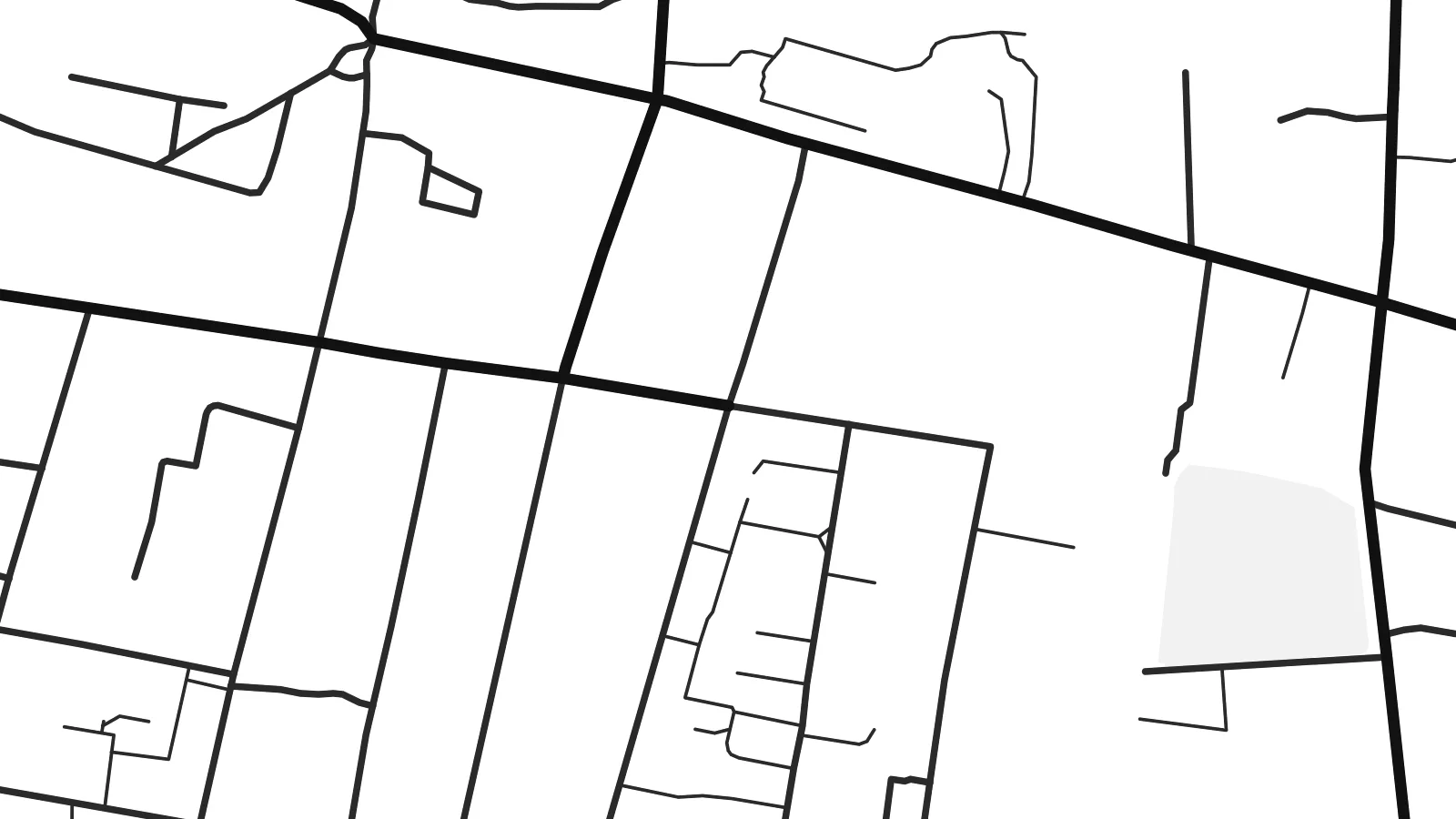
Ko se kupega 100% mai te faila lomiga mo'i. Poster uma — pe lomiina, fakapipi'i i faleata, pe download-ina — e fakaatagia i luga o a matou setula i te 300 DPI, e oo atu ki te 7,200 × 10,800 pixels, ina ia mautinoa e ma'ai pea auala tuai foki i luga o se lomiga 24 × 36″.
I luga o te pa


Te mape
Ipatovo sits in the dry steppe of northeastern Stavropol Kray, and from above it reads as a planned place. Streets run in long parallel lines and cross at regular intervals, producing a grid of wide blocks that loosens toward the edges, where houses give way to gardens and then to fields. The town is the administrative centre of its district, and the map shows that role quietly, in a denser core.
The Kalaus River passes by the town, and its bends make the one irregular line in an otherwise measured layout. On a black-and-white print the water and its low banks set up a soft counterpoint to the ruled streets. Beyond the edges, field boundaries and country roads carry the geometry out into the surrounding plain, so the town seems to sit inside a much larger pattern of cultivated land.
An Ipatovo map poster works through restraint. The farmland around it is mostly blank space, so the street pattern becomes the subject: tight near the centre, more open toward the outskirts, with a few main roads leading out across the steppe. For anyone who grew up here or has family roots in the district, the layout is instantly recognisable even without a single street name.
Long parallel streets and evenly spaced cross streets give the town its orderly look, a common pattern in steppe settlements of southern Russia that prints as a clean lattice of lines.
The river follows its own loose course past the town, adding the only natural curve to the composition and marking the low ground that edges the built-up area.
Farmland stretches in every direction, crossed by straight field roads. On the poster this reads as generous empty space that frames the compact town at the centre.
Fai mo koe
Fakaopoopo he aho, he igoa pe he upu a koe, hui te faiga, te lahi pe te tūlaga.
Ko te va'aiga e leai se totogi e maualalo tona resolution ma iai se fakailoga vai. E fakaatagia lomiga ma faila HD i te 300 DPI, e oo atu ki te 7,200 × 10,800 px, e aunoa ma se fakailoga vai.
Aiheā Ipatovo
People hang a map of Ipatovo because it is personal. It marks a childhood home, a family origin in the Stavropol countryside, or a place that is hard to explain to people who have never stood in the open steppe. The street grid says it without words.
You can set your own title, subtitle and coordinates line, adding a family name, a year or a date that matters. Choose Classic black & white, Noir, Paper, Blueprint or Sand, and order a $9 digital file or a printed poster, framed or unframed.
Oka te poster Ipatovo| Lahi o te lomiga | Manino | Faila |
|---|---|---|
| 30 × 40 cm11.8 × 15.7″ | 3,543 × 4,724 px | PNG · PDF |
| 29.7 × 42 cm (A3)11.7 × 16.5″ | 3,508 × 4,961 px | PNG · PDF |
| 42 × 59.4 cm (A2)16.5 × 23.4″ | 4,961 × 7,016 px | PNG · PDF |
| 45.7 × 61 cm18 × 24″ | 5,400 × 7,200 px | PNG · PDF |
| 50 × 70 cm19.7 × 27.6″ | 5,906 × 8,268 px | PNG · PDF |
| 61 × 91.4 cm24 × 36″ | 7,200 × 10,800 px | PNG · PDF |
Mo te fakatatau, ko te fakaakoakoga e hē totogi e 900 px te lautele, e ihi te fakailoga ma mo te lau komipiuta. Ko nā faila HD e oko ki te 8× te manino i itū taki tahi ma e lomia lelei i te lahi kātoa o te pōhita.
Filifili se ata i te pito i luga o te itulau, ona filifili lea o te Poster Lomiina — se lapoa ma, ka manako ai koe, se faleata — pe ko Faila HD Fakaonaonaina. E tasi te laasaga o te ōkaina, ma ka fakafou loa lau itulau ōkaina pe a mae'a te totogi.
E lomiina i luga o se pepa matte kaliki maualuga e 200 gsm, i se tasi o ni lapoa e ono, mai le 30 × 40 cm ki te 24 × 36″. E kamata te tau o poster lomiina mai le $39, aofia ai te uta.
Ioe. Filifili se faleata lakau malō i te lanu uli, tea, oki masani pe lakau pouli. E aumai fakatasi mo se tioata e le gagamu ma ua sauni ke tautau. E kamata te tau o poster fakapipi'i i se faleata mai le $99, aofia ai te uta.
E tuku uma te uta ki fenua e 60+. Ko te pepa takitasi e lomi e te tasi o a matou paaga lomi i fenua e 30+, ka tae mai i aso galue e 3–7. E mafai ke e maimoa ki te tulaga mo te tulitaki i lalo o Taku Fakatonuga. E lauiti nei fenua e 2–5 wiki, ka ko nei fenua e le o tuku atu ai, e fakamatala atu e te weepisi i mua o te totogi.
Auina mai se ata pikitia i loto o te 14 aso mai te taimi na oo mai ai, ka toe lomiina e matou e leai se totogi pe toe totogi atu lau tupe.
Ioe. I te mea fakasa'o i luga o lenei itulau, sui te ulutala, te ulutala lalo ma te laina fakamaoniga tulaga ki so se mea e manako ai koe, ona filifili lea o se ata ma se lapoa. Okaina lomiina, fakapipi'i i faleata, ma fakaonaonaina e fakaaogā uma i tau ata tonu.
Mo le $9 e maua e koe ni faila PNG 300 DPI ma PDF sauni-mo-lomiga i lapoa e ono uma, e aunoa ma se fakailoga vai, ke lomiina i so se mea. E le'i mautinoa? Download muamua se va'aiga fakailoga vai e leai se totogi.
