Naqsh-e Jahan Square
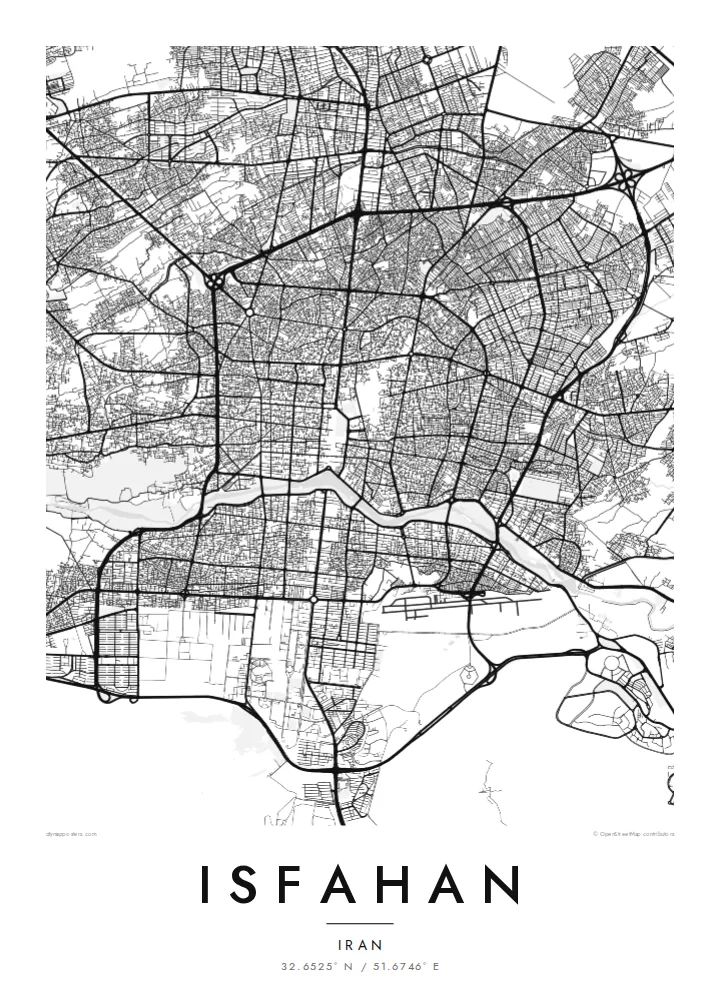
One of the largest city squares in the world forms a clean, elongated rectangle in the centre, the bazaar spreading north from its end in a dense web of covered lanes.
Pōhita mape faigofie · Iran
32.6525° N / 51.6746° E
A Safavid garden city along the Zayanderud, with a vast rectangular square and historic bridges spanning the riverbed.


Taone e tahi, lagona e lima
Pa'i se ata ke va'ai ai i luga o te pā. E tutusa te tau o ata uma — i lomiga, fakapipi'i i faleata, pe ko faila HD.
 Pixels mo'i · Faila lomiga 24 × 36″
Manino mo te lomiga
Ko se kupega 100% mai te faila lomiga mo'i. Poster uma — pe lomiina, fakapipi'i i faleata, pe download-ina — e fakaatagia i luga o a matou setula i te 300 DPI, e oo atu ki te 7,200 × 10,800 pixels, ina ia mautinoa e ma'ai pea auala tuai foki i luga o se lomiga 24 × 36″.
I luga o te pa


Te mape
Isfahan lies on the central Iranian plateau beside the Zayanderud, the river that made an oasis possible in this dry region. At the end of the sixteenth century Shah Abbas I made it the Safavid capital and reshaped it with grand public spaces, gardens and avenues, many of which still structure the city's centre and remain easy to pick out on a map.
The most striking shape is Naqsh-e Jahan Square, a long rectangle framed by arcades, with the Shah Mosque, the Sheikh Lotfollah Mosque, the Ali Qapu palace and the entrance to the Grand Bazaar on its four sides. Nearby, the Chaharbagh avenue runs south in a straight line toward the river, once lined with gardens and pavilions. The square is a UNESCO World Heritage Site.
The Zayanderud is crossed by a series of historic bridges, including Si-o-se-pol with its thirty-three arches and the Khaju Bridge, both built for lingering as much as for crossing. In recent years the river has often run dry. An Isfahan map poster brings the square, the avenue and the bridges together, the Safavid plan still visible within the modern city.
One of the largest city squares in the world forms a clean, elongated rectangle in the centre, the bazaar spreading north from its end in a dense web of covered lanes.
This straight Safavid boulevard runs from the old city toward the river, a long axis that organises the surrounding blocks and leads directly to Si-o-se-pol.
Several historic bridges cross the river in quick succession, their short spans stitching together the northern city and the southern districts, including the Armenian quarter of New Julfa.
Fai mo koe
Fakaopoopo he aho, he igoa pe he upu a koe, hui te faiga, te lahi pe te tūlaga.
Ko te va'aiga e leai se totogi e maualalo tona resolution ma iai se fakailoga vai. E fakaatagia lomiga ma faila HD i te 300 DPI, e oo atu ki te 7,200 × 10,800 px, e aunoa ma se fakailoga vai.
Aiheā Isfahan
Isfahan has been called half the world, a phrase that captures its place in Persian culture and in the memories of those who know it. A map of its square and bridges keeps that city present at home, whether you live there or far away.
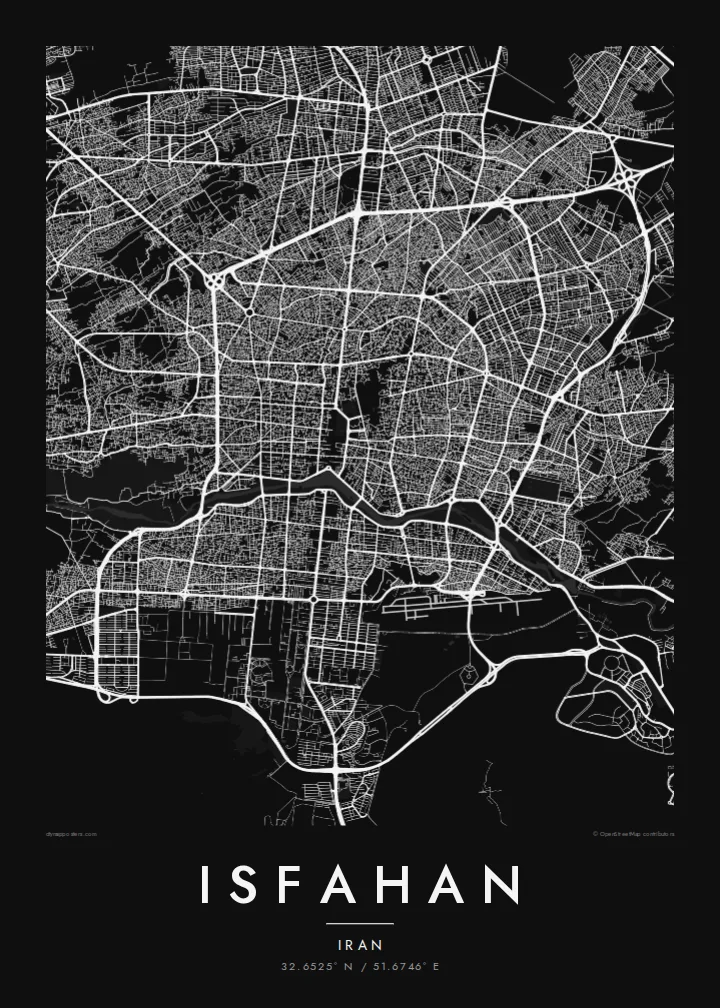
Write the title in the form that means most to you, add a date or a short phrase in the subtitle and adjust the coordinates line. Choose Classic black & white, Noir, Paper, Blueprint or Sand; Sand echoes the colour of the old brickwork.
Oka te poster Isfahan| Lahi o te lomiga | Manino | Faila |
|---|---|---|
| 30 × 40 cm11.8 × 15.7″ | 3,543 × 4,724 px | PNG · PDF |
| 29.7 × 42 cm (A3)11.7 × 16.5″ | 3,508 × 4,961 px | PNG · PDF |
| 42 × 59.4 cm (A2)16.5 × 23.4″ | 4,961 × 7,016 px | PNG · PDF |
| 45.7 × 61 cm18 × 24″ | 5,400 × 7,200 px | PNG · PDF |
| 50 × 70 cm19.7 × 27.6″ | 5,906 × 8,268 px | PNG · PDF |
| 61 × 91.4 cm24 × 36″ | 7,200 × 10,800 px | PNG · PDF |
Mo te fakatatau, ko te fakaakoakoga e hē totogi e 900 px te lautele, e ihi te fakailoga ma mo te lau komipiuta. Ko nā faila HD e oko ki te 8× te manino i itū taki tahi ma e lomia lelei i te lahi kātoa o te pōhita.
Filifili se ata i te pito i luga o te itulau, ona filifili lea o te Poster Lomiina — se lapoa ma, ka manako ai koe, se faleata — pe ko Faila HD Fakaonaonaina. E tasi te laasaga o te ōkaina, ma ka fakafou loa lau itulau ōkaina pe a mae'a te totogi.
E lomiina i luga o se pepa matte kaliki maualuga e 200 gsm, i se tasi o ni lapoa e ono, mai le 30 × 40 cm ki te 24 × 36″. E kamata te tau o poster lomiina mai le $39, aofia ai te uta.
Ioe. Filifili se faleata lakau malō i te lanu uli, tea, oki masani pe lakau pouli. E aumai fakatasi mo se tioata e le gagamu ma ua sauni ke tautau. E kamata te tau o poster fakapipi'i i se faleata mai le $99, aofia ai te uta.
E tuku uma te uta ki fenua e 60+. Ko te pepa takitasi e lomi e te tasi o a matou paaga lomi i fenua e 30+, ka tae mai i aso galue e 3–7. E mafai ke e maimoa ki te tulaga mo te tulitaki i lalo o Taku Fakatonuga. E lauiti nei fenua e 2–5 wiki, ka ko nei fenua e le o tuku atu ai, e fakamatala atu e te weepisi i mua o te totogi.
Auina mai se ata pikitia i loto o te 14 aso mai te taimi na oo mai ai, ka toe lomiina e matou e leai se totogi pe toe totogi atu lau tupe.
Ioe. I te mea fakasa'o i luga o lenei itulau, sui te ulutala, te ulutala lalo ma te laina fakamaoniga tulaga ki so se mea e manako ai koe, ona filifili lea o se ata ma se lapoa. Okaina lomiina, fakapipi'i i faleata, ma fakaonaonaina e fakaaogā uma i tau ata tonu.
Mo le $9 e maua e koe ni faila PNG 300 DPI ma PDF sauni-mo-lomiga i lapoa e ono uma, e aunoa ma se fakailoga vai, ke lomiina i so se mea. E le'i mautinoa? Download muamua se va'aiga fakailoga vai e leai se totogi.
