Neighbourhood clusters
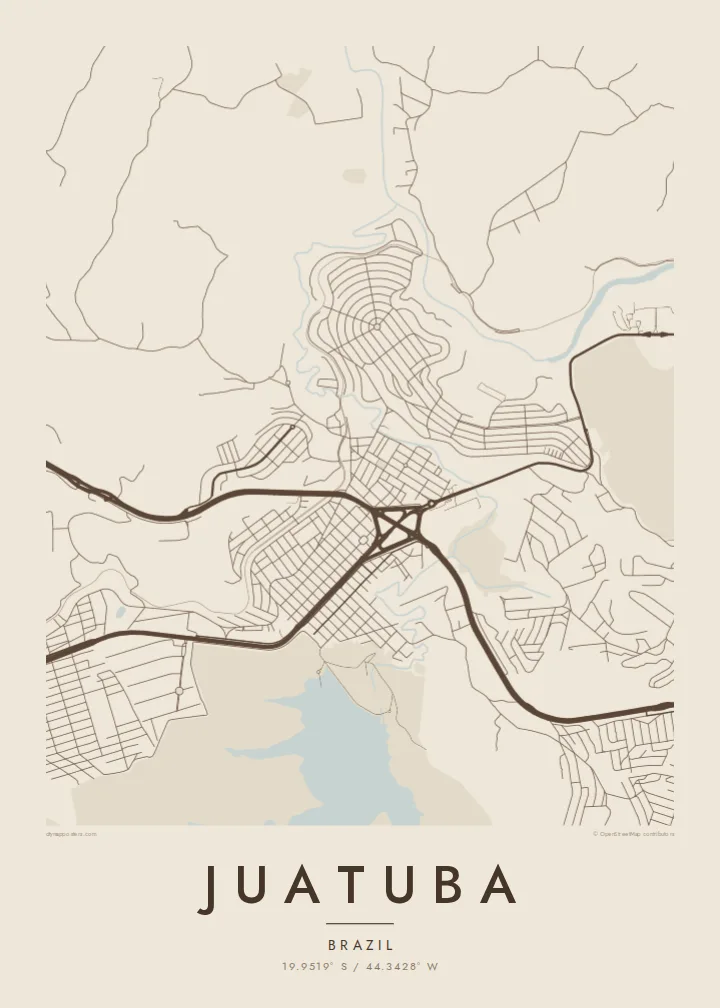
Instead of one dense centre, the map shows several separate groups of streets, each laid out in its own small grid and separated by open, undeveloped ground.
Pōhita mape faigofie · Brazil
19.9519° S / 44.3428° W
A young municipality west of Belo Horizonte, where highways and scattered neighbourhoods meet among low green hills.


Taone e tahi, lagona e lima
Pa'i se ata ke va'ai ai i luga o te pā. E tutusa te tau o ata uma — i lomiga, fakapipi'i i faleata, pe ko faila HD.
 Pixels mo'i · Faila lomiga 24 × 36″
Manino mo te lomiga
Ko se kupega 100% mai te faila lomiga mo'i. Poster uma — pe lomiina, fakapipi'i i faleata, pe download-ina — e fakaatagia i luga o a matou setula i te 300 DPI, e oo atu ki te 7,200 × 10,800 pixels, ina ia mautinoa e ma'ai pea auala tuai foki i luga o se lomiga 24 × 36″.
I luga o te pa


Te mape
Juatuba is one of the municipalities in the metropolitan region of Belo Horizonte, lying to the west of the state capital in Minas Gerais. It became an independent municipality relatively recently, and its map still shows that: rather than a single historic core, the town is a set of neighbourhoods linked by main roads, each with its own small street grid.
The landscape around it is gently hilly, typical of central Minas Gerais, with pasture, patches of woodland and small streams cutting between the built areas. Highways heading west from the capital pass nearby, and on paper these long strokes contrast with the curving local streets that follow the contours of the land, giving the plan a loose, open rhythm.
A Juatuba map poster captures that spread-out, modern layout: clusters of blocks, green gaps between them and the arteries that tie everything together. For residents it is a precise record of home, and for people who commute into Belo Horizonte it shows the place they return to each evening, reduced to line and space.
Instead of one dense centre, the map shows several separate groups of streets, each laid out in its own small grid and separated by open, undeveloped ground.
Long, straight roads running west from Belo Horizonte cross the area, giving the composition strong lines that frame the smaller residential streets.
Streets bend around low hills and small valleys, and the watercourses between them leave natural gaps that make the layout feel light and open.
Fai mo koe
Fakaopoopo he aho, he igoa pe he upu a koe, hui te faiga, te lahi pe te tūlaga.
Ko te va'aiga e leai se totogi e maualalo tona resolution ma iai se fakailoga vai. E fakaatagia lomiga ma faila HD i te 300 DPI, e oo atu ki te 7,200 × 10,800 px, e aunoa ma se fakailoga vai.
Aiheā Juatuba
Juatuba has grown as families have settled on the edge of the metropolitan area, and many of them feel a strong attachment to their particular neighbourhood. A map of the town is a straightforward way to mark a first home, a move or a place where children grew up.
The title, subtitle and coordinates line are editable, so the poster can name a street, a family or a year. Choose Classic black & white for a clean look or Sand for a warmer one, and download six print sizes as 300 DPI PNG and PDF files for $9.
Oka te poster Juatuba| Lahi o te lomiga | Manino | Faila |
|---|---|---|
| 30 × 40 cm (11.8 × 15.7″) | 3,543 × 4,724 px | PNG · PDF |
| 29.7 × 42 cm (A3, 11.7 × 16.5″) | 3,508 × 4,961 px | PNG · PDF |
| 42 × 59.4 cm (A2, 16.5 × 23.4″) | 4,961 × 7,016 px | PNG · PDF |
| 45.7 × 61 cm (18 × 24″) | 5,400 × 7,200 px | PNG · PDF |
| 50 × 70 cm (19.7 × 27.6″) | 5,906 × 8,268 px | PNG · PDF |
| 61 × 91.4 cm (24 × 36″) | 7,200 × 10,800 px | PNG · PDF |
Mo te fakatatau, ko te fakaakoakoga e hē totogi e 900 px te lautele, e ihi te fakailoga ma mo te lau komipiuta. Ko nā faila HD e oko ki te 8× te manino i itū taki tahi ma e lomia lelei i te lahi kātoa o te pōhita.
Filifili se ata i te pito i luga o te itulau, ona filifili lea o te Poster Lomiina — se lapoa ma, ka manako ai koe, se faleata — pe ko Faila HD Fakaonaonaina. E tasi te laasaga o te ōkaina, ma ka fakafou loa lau itulau ōkaina pe a mae'a te totogi.
E lomiina i luga o se pepa matte kaliki maualuga e 200 gsm, i se tasi o ni lapoa e ono, mai le 30 × 40 cm ki te 24 × 36″. E kamata te tau o poster lomiina mai le $39, aofia ai te uta.
Ioe. Filifili se faleata lakau malō i te lanu uli, tea, oki masani pe lakau pouli. E aumai fakatasi mo se tioata e le gagamu ma ua sauni ke tautau. E kamata te tau o poster fakapipi'i i se faleata mai le $99, aofia ai te uta.
E leai se totogi o te ave i te lalolagi katoa. Ko te pepa ata taki tasi e lomi e te hoa lomi e latalata mai ki a matou i atunuku e 30+, ma e masani ona aulia i aso galuega e 3–7. E mafai ke e mulimuli i te tulaga ma te ala o tau poloaiga i lalo o Aku Poloaiga. E nai atunuku e 2–5 vaiaso te umi, ma i te mea e le i ave ai matou, e fakailoa atu e te initeneti a e le i totogi koe.
Auina mai se ata pikitia i loto o te 14 aso mai te taimi na oo mai ai, ka toe lomiina e matou e leai se totogi pe toe totogi atu lau tupe.
Ioe. I te mea fakasa'o i luga o lenei itulau, sui te ulutala, te ulutala lalo ma te laina fakamaoniga tulaga ki so se mea e manako ai koe, ona filifili lea o se ata ma se lapoa. Okaina lomiina, fakapipi'i i faleata, ma fakaonaonaina e fakaaogā uma i tau ata tonu.
Mo le $9 e maua e koe ni faila PNG 300 DPI ma PDF sauni-mo-lomiga i lapoa e ono uma, e aunoa ma se fakailoga vai, ke lomiina i so se mea. E le'i mautinoa? Download muamua se va'aiga fakailoga vai e leai se totogi.
Latalata
