The railway junction
Long rail lines come into town from several directions and meet near the centre. On paper they are the strongest straight strokes, cutting across the finer grid of residential streets.
Pōhita mape faigofie · India
21.8243° N / 76.3509° E
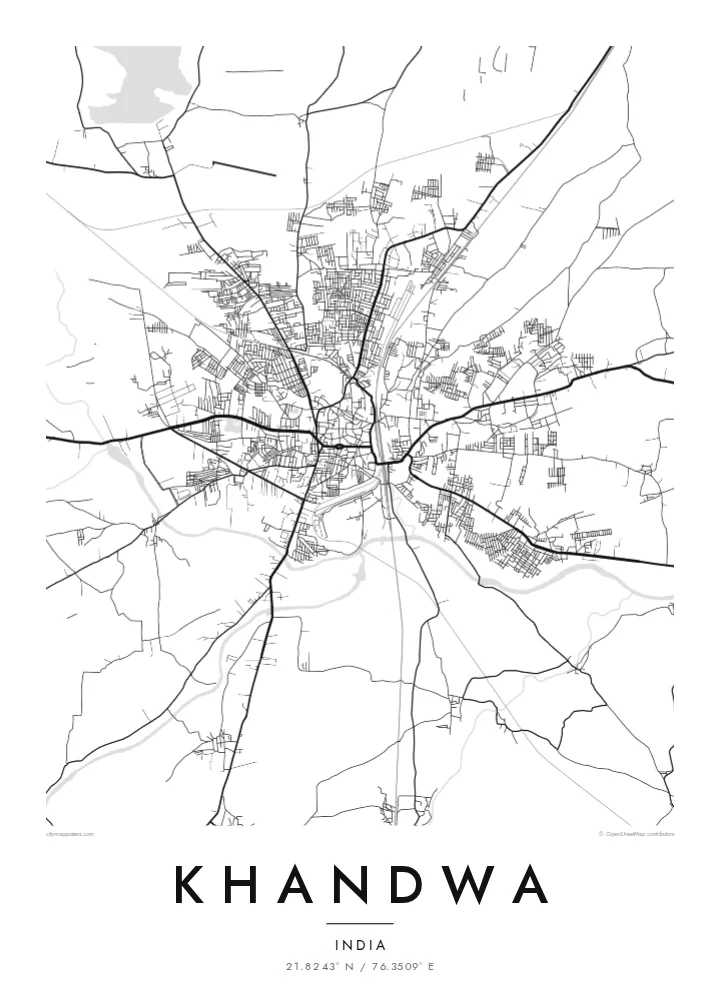
A compact Nimar town seen from above, where railway lines meet, the streets stay close together and open farmland starts right at the edges


Taone e tahi, lagona e lima
Pa'i se ata ke va'ai ai i luga o te pā. E tutusa te tau o ata uma — i lomiga, fakapipi'i i faleata, pe ko faila HD.
 Pixels mo'i · Faila lomiga 24 × 36″
Manino mo te lomiga
Ko se kupega 100% mai te faila lomiga mo'i. Poster uma — pe lomiina, fakapipi'i i faleata, pe download-ina — e fakaatagia i luga o a matou setula i te 300 DPI, e oo atu ki te 7,200 × 10,800 pixels, ina ia mautinoa e ma'ai pea auala tuai foki i luga o se lomiga 24 × 36″.
I luga o te pa


Te mape
Khandwa sits in the Nimar region of southwestern Madhya Pradesh, between the Satpura hills and the broad valley of the Narmada. From above it looks like a working inland town. The dense older quarters sit close to the railway, newer neighbourhoods spread out along the main roads, and a patchwork of fields surrounds it all. The town ends quickly and farmland takes over.
The railway is what shapes Khandwa most clearly on the map. For a long time the town has been a junction on the main line between Mumbai and central India, and the tracks cut through the street pattern in long, confident lines. Sidings, yards and level crossings make the town's rail-shaped layout clear, which you rarely see so plainly in a place of this size.
Khandwa is also known as the birthplace of the singer Kishore Kumar, and many people outside the region know it through that connection. The Khandwa map poster shows the place without any decoration: the tangle of lanes near the old centre, the straighter roads further out, and the rail corridor that ties it to the rest of the country.
Long rail lines come into town from several directions and meet near the centre. On paper they are the strongest straight strokes, cutting across the finer grid of residential streets.
Close to the station the streets tighten into a dense, irregular web of short lanes. It is the busiest part of the drawing and shows where the town first grew.
At the edges the built-up area thins out quickly into open ground and scattered roads. The empty space frames the town and gives the poster a calm, balanced border.
Fai mo koe
Fakaopoopo he aho, he igoa pe he upu a koe, hui te faiga, te lahi pe te tūlaga.
Ko te va'aiga e leai se totogi e maualalo tona resolution ma iai se fakailoga vai. E fakaatagia lomiga ma faila HD i te 300 DPI, e oo atu ki te 7,200 × 10,800 px, e aunoa ma se fakailoga vai.
Aiheā Khandwa
For people from the Nimar region, or anyone who has changed trains here on a long journey across India, Khandwa is a very specific place. A map of it keeps that memory in simple lines, without needing a photograph to explain it.
You can add your own title, a subtitle such as a family name or a year, and the coordinates line. Choose from five styles: Classic black & white, Noir, Paper, Blueprint or Sand. Then download the HD files or order a printed poster.
Oka te poster Khandwa| Lahi o te lomiga | Manino | Faila |
|---|---|---|
| 30 × 40 cm11.8 × 15.7″ | 3,543 × 4,724 px | PNG · PDF |
| 29.7 × 42 cm (A3)11.7 × 16.5″ | 3,508 × 4,961 px | PNG · PDF |
| 42 × 59.4 cm (A2)16.5 × 23.4″ | 4,961 × 7,016 px | PNG · PDF |
| 45.7 × 61 cm18 × 24″ | 5,400 × 7,200 px | PNG · PDF |
| 50 × 70 cm19.7 × 27.6″ | 5,906 × 8,268 px | PNG · PDF |
| 61 × 91.4 cm24 × 36″ | 7,200 × 10,800 px | PNG · PDF |
Mo te fakatatau, ko te fakaakoakoga e hē totogi e 900 px te lautele, e ihi te fakailoga ma mo te lau komipiuta. Ko nā faila HD e oko ki te 8× te manino i itū taki tahi ma e lomia lelei i te lahi kātoa o te pōhita.
Filifili se ata i te pito i luga o te itulau, ona filifili lea o te Poster Lomiina — se lapoa ma, ka manako ai koe, se faleata — pe ko Faila HD Fakaonaonaina. E tasi te laasaga o te ōkaina, ma ka fakafou loa lau itulau ōkaina pe a mae'a te totogi.
E lomiina i luga o se pepa matte kaliki maualuga e 200 gsm, i se tasi o ni lapoa e ono, mai le 30 × 40 cm ki te 24 × 36″. E kamata te tau o poster lomiina mai le $39, aofia ai te uta.
Ioe. Filifili se faleata lakau malō i te lanu uli, tea, oki masani pe lakau pouli. E aumai fakatasi mo se tioata e le gagamu ma ua sauni ke tautau. E kamata te tau o poster fakapipi'i i se faleata mai le $99, aofia ai te uta.
E tuku uma te uta ki fenua e 60+. Ko te pepa takitasi e lomi e te tasi o a matou paaga lomi i fenua e 30+, ka tae mai i aso galue e 3–7. E mafai ke e maimoa ki te tulaga mo te tulitaki i lalo o Taku Fakatonuga. E lauiti nei fenua e 2–5 wiki, ka ko nei fenua e le o tuku atu ai, e fakamatala atu e te weepisi i mua o te totogi.
Auina mai se ata pikitia i loto o te 14 aso mai te taimi na oo mai ai, ka toe lomiina e matou e leai se totogi pe toe totogi atu lau tupe.
Ioe. I te mea fakasa'o i luga o lenei itulau, sui te ulutala, te ulutala lalo ma te laina fakamaoniga tulaga ki so se mea e manako ai koe, ona filifili lea o se ata ma se lapoa. Okaina lomiina, fakapipi'i i faleata, ma fakaonaonaina e fakaaogā uma i tau ata tonu.
Mo le $9 e maua e koe ni faila PNG 300 DPI ma PDF sauni-mo-lomiga i lapoa e ono uma, e aunoa ma se fakailoga vai, ke lomiina i so se mea. E le'i mautinoa? Download muamua se va'aiga fakailoga vai e leai se totogi.
Latalata
