Plain-country setting
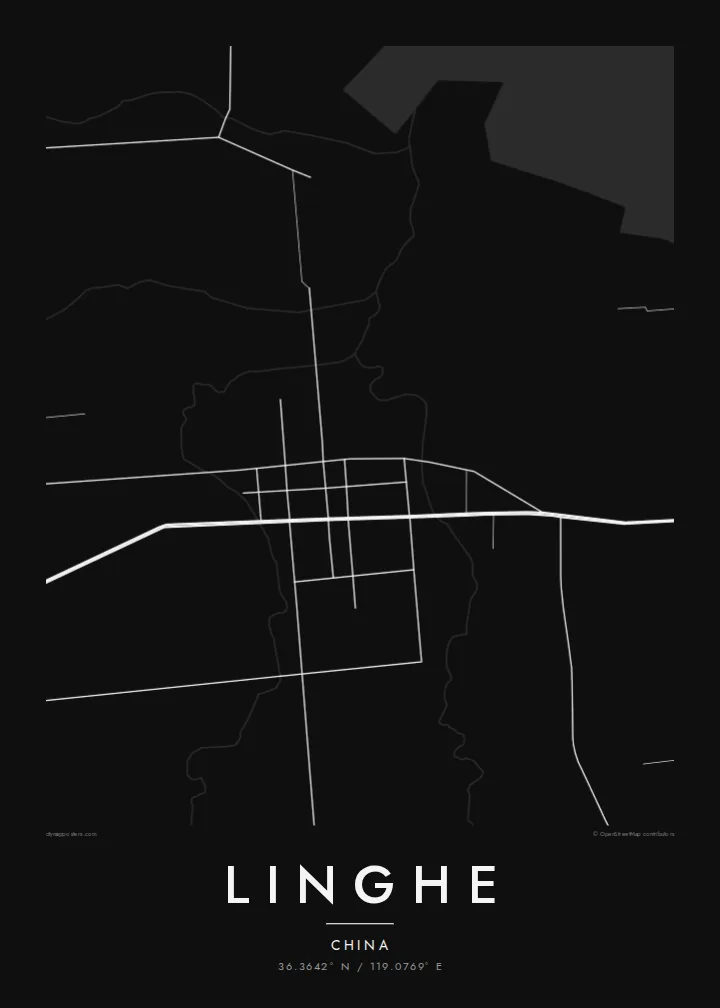
The town sits on level agricultural land, so the map has no steep terrain to bend the roads. Streets run long and straight, and the outline of the fields repeats evenly around the built-up area.
Pōhita mape faigofie · China
36.3642° N / 119.0769° E
A compact inland town on the Shandong plain, its street grid set among the regular pattern of surrounding farmland.



Taone e tahi, lagona e lima
Pa'i se ata ke va'ai ai i luga o te pā. E tutusa te tau o ata uma — i lomiga, fakapipi'i i faleata, pe ko faila HD.
 Pixels mo'i · Faila lomiga 24 × 36″
Manino mo te lomiga
Ko se kupega 100% mai te faila lomiga mo'i. Poster uma — pe lomiina, fakapipi'i i faleata, pe download-ina — e fakaatagia i luga o a matou setula i te 300 DPI, e oo atu ki te 7,200 × 10,800 pixels, ina ia mautinoa e ma'ai pea auala tuai foki i luga o se lomiga 24 × 36″.
I luga o te pa


Te mape
Linghe sits in the interior of Shandong province, away from the peninsula's coastline, on the broad agricultural plain that covers much of the region. From above, the town is a dense cluster of streets and blocks surrounded by a patchwork of fields, village settlements and rural roads. The contrast between the built-up core and the open land around it is what gives the map its structure.
As with many towns in this part of China, the layout is mostly practical. Main roads cross the town in straight lines, and housing blocks, workshops and markets fill the spaces between them. Beyond the edge of town, narrow lanes link smaller villages across the farmland, so the network thins out gradually rather than stopping at a clear boundary. In black and white, this reads as a dense centre that loosens towards the edges.
A Linghe map poster keeps things simple: streets, blocks and the lines of nearby waterways, with no labels crowding the image. For people who grew up here or have family in the area, it is a quiet way to keep an ordinary place in view. For anyone else, it is an example of how a Shandong plain town fits into the countryside around it.
The town sits on level agricultural land, so the map has no steep terrain to bend the roads. Streets run long and straight, and the outline of the fields repeats evenly around the built-up area.
At the centre, closely packed blocks and short connecting lanes form the darkest part of the poster. This is where the town's everyday business and older housing are concentrated.
Thin rural roads leave the town in several directions and link it to nearby villages. On paper they look like fine threads tying small clusters of buildings back to the centre.
Fai mo koe
Fakaopoopo he aho, he igoa pe he upu a koe, hui te faiga, te lahi pe te tūlaga.
Ko te va'aiga e leai se totogi e maualalo tona resolution ma iai se fakailoga vai. E fakaatagia lomiga ma faila HD i te 300 DPI, e oo atu ki te 7,200 × 10,800 px, e aunoa ma se fakailoga vai.
Aiheā Linghe
People hang a map of Linghe because it is where they come from, where relatives still live, or where something important happened to them. A town this size rarely gets a poster of its own, which makes an accurate, carefully drawn map of its streets feel personal.
You can change the title, subtitle and coordinates line, so the poster can carry a family name, a year or a short note. There are five styles: Classic black & white, Noir, Paper, Blueprint and Sand. Choose the one that suits your room best.
Oka te poster Linghe| Lahi o te lomiga | Manino | Faila |
|---|---|---|
| 30 × 40 cm (11.8 × 15.7″) | 3,543 × 4,724 px | PNG · PDF |
| 29.7 × 42 cm (A3, 11.7 × 16.5″) | 3,508 × 4,961 px | PNG · PDF |
| 42 × 59.4 cm (A2, 16.5 × 23.4″) | 4,961 × 7,016 px | PNG · PDF |
| 45.7 × 61 cm (18 × 24″) | 5,400 × 7,200 px | PNG · PDF |
| 50 × 70 cm (19.7 × 27.6″) | 5,906 × 8,268 px | PNG · PDF |
| 61 × 91.4 cm (24 × 36″) | 7,200 × 10,800 px | PNG · PDF |
Mo te fakatatau, ko te fakaakoakoga e hē totogi e 900 px te lautele, e ihi te fakailoga ma mo te lau komipiuta. Ko nā faila HD e oko ki te 8× te manino i itū taki tahi ma e lomia lelei i te lahi kātoa o te pōhita.
Filifili se ata i te pito i luga o te itulau, ona filifili lea o te Poster Lomiina — se lapoa ma, ka manako ai koe, se faleata — pe ko Faila HD Fakaonaonaina. E tasi te laasaga o te ōkaina, ma ka fakafou loa lau itulau ōkaina pe a mae'a te totogi.
E lomiina i luga o se pepa matte kaliki maualuga e 200 gsm, i se tasi o ni lapoa e ono, mai le 30 × 40 cm ki te 24 × 36″. E kamata te tau o poster lomiina mai le {printFrom}, aofia ai te uta.
Ioe. Filifili se faleata lakau malō i te lanu uli, tea, oki masani pe lakau pouli. E aumai fakatasi mo se tioata e le gagamu ma ua sauni ke tautau. E kamata te tau o poster fakapipi'i i se faleata mai le {framedFrom}, aofia ai te uta.
E leai se totogi o te ave i te lalolagi katoa. Ko te pepa ata taki tasi e lomi e te hoa lomi e latalata mai ki a matou i atunuku e 30+, ma e masani ona aulia i aso galuega e 3–7. E mafai ke e mulimuli i te tulaga ma te ala o tau poloaiga i lalo o Aku Poloaiga. E nai atunuku e 2–5 vaiaso te umi, ma i te mea e le i ave ai matou, e fakailoa atu e te initeneti a e le i totogi koe.
Auina mai se ata pikitia i loto o te 14 aso mai te taimi na oo mai ai, ka toe lomiina e matou e leai se totogi pe toe totogi atu lau tupe.
Ioe. I te mea fakasa'o i luga o lenei itulau, sui te ulutala, te ulutala lalo ma te laina fakamaoniga tulaga ki so se mea e manako ai koe, ona filifili lea o se ata ma se lapoa. Okaina lomiina, fakapipi'i i faleata, ma fakaonaonaina e fakaaogā uma i tau ata tonu.
Mo le $9 e maua e koe ni faila PNG 300 DPI ma PDF sauni-mo-lomiga i lapoa e ono uma, e aunoa ma se fakailoga vai, ke lomiina i so se mea. E le'i mautinoa? Download muamua se va'aiga fakailoga vai e leai se totogi.
Latalata
