Yellow River edge
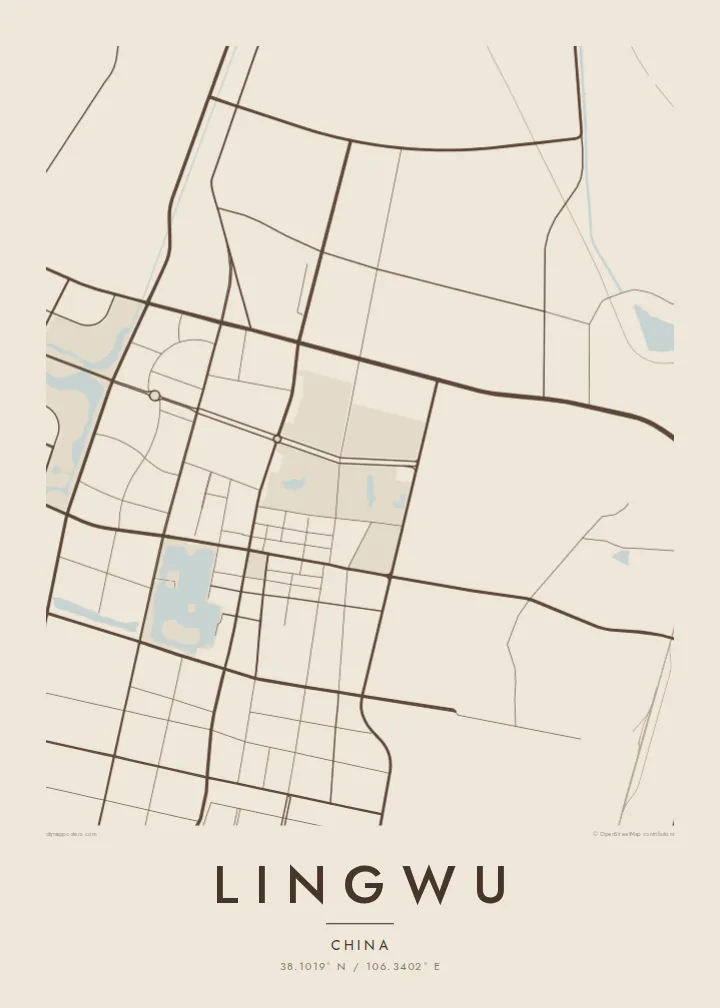
The river's wide channel, with its sandbars and shifting braids, forms the western edge of the map. It is the natural counterweight to the straight lines of the city.
Pōhita mape faigofie · China
38.1019° N / 106.3402° E
A city on the eastern bank of the Yellow River, where irrigated fields meet the edge of dry uplands


Taone e tahi, lagona e lima
Pa'i se ata ke va'ai ai i luga o te pā. E tutusa te tau o ata uma — i lomiga, fakapipi'i i faleata, pe ko faila HD.
 Pixels mo'i · Faila lomiga 24 × 36″
Manino mo te lomiga
Ko se kupega 100% mai te faila lomiga mo'i. Poster uma — pe lomiina, fakapipi'i i faleata, pe download-ina — e fakaatagia i luga o a matou setula i te 300 DPI, e oo atu ki te 7,200 × 10,800 pixels, ina ia mautinoa e ma'ai pea auala tuai foki i luga o se lomiga 24 × 36″.
I luga o te pa


Te mape
Lingwu is a county-level city under Yinchuan in Ningxia. It lies on the eastern side of the Yellow River, facing the regional capital across the water. On a map the river's broad, braided channel runs along one side. Irrigation canals and field boundaries fill the flat land beside it, and the urban core sits within that pattern as a tidy grid of wide avenues.
The contrast between wet and dry ground is what gives Lingwu its shape. The irrigated strip near the river is finely divided, while the land to the east becomes more open and arid. Industrial zones linked to the large Ningdong energy base add further straight roads there. The city is also known for its long jujubes, grown in orchards across the district.
A Lingwu map poster brings out this layering: the river edge, the ruled lines of canals and farmland, and the ordered streets of the centre. The district also contains Shuidonggou, one of China's best-known Paleolithic sites, and Lingwu's name appears in Tang dynasty history. That makes it a place with deep roots under a modern street plan.
The river's wide channel, with its sandbars and shifting braids, forms the western edge of the map. It is the natural counterweight to the straight lines of the city.
Irrigation channels and long field plots cover the land between the river and the town. In monochrome they produce a fine striped texture that is distinctly Ningxia.
The city centre is laid out on broad, evenly spaced avenues. The result is a clear rectangular pattern that reads cleanly at any print size.
Fai mo koe
Fakaopoopo he aho, he igoa pe he upu a koe, hui te faiga, te lahi pe te tūlaga.
Ko te va'aiga e leai se totogi e maualalo tona resolution ma iai se fakailoga vai. E fakaatagia lomiga ma faila HD i te 300 DPI, e oo atu ki te 7,200 × 10,800 px, e aunoa ma se fakailoga vai.
Aiheā Lingwu
A map of Lingwu suits anyone connected to Ningxia or to the Yinchuan area: people who grew up here, who work in the energy industry, or who studied the region's early history. The river, the canals and the grid together make a composition that feels calm and considered on a wall.
The title, subtitle and coordinates line can all be personalised, whether you want the city's name in your own words, a family name or a meaningful date. There are five styles to choose from: Classic black & white, Noir, Paper, Blueprint and Sand.
Oka te poster Lingwu| Lahi o te lomiga | Manino | Faila |
|---|---|---|
| 30 × 40 cm (11.8 × 15.7″) | 3,543 × 4,724 px | PNG · PDF |
| 29.7 × 42 cm (A3, 11.7 × 16.5″) | 3,508 × 4,961 px | PNG · PDF |
| 42 × 59.4 cm (A2, 16.5 × 23.4″) | 4,961 × 7,016 px | PNG · PDF |
| 45.7 × 61 cm (18 × 24″) | 5,400 × 7,200 px | PNG · PDF |
| 50 × 70 cm (19.7 × 27.6″) | 5,906 × 8,268 px | PNG · PDF |
| 61 × 91.4 cm (24 × 36″) | 7,200 × 10,800 px | PNG · PDF |
Mo te fakatatau, ko te fakaakoakoga e hē totogi e 900 px te lautele, e ihi te fakailoga ma mo te lau komipiuta. Ko nā faila HD e oko ki te 8× te manino i itū taki tahi ma e lomia lelei i te lahi kātoa o te pōhita.
Filifili se ata i te pito i luga o te itulau, ona filifili lea o te Poster Lomiina — se lapoa ma, ka manako ai koe, se faleata — pe ko Faila HD Fakaonaonaina. E tasi te laasaga o te ōkaina, ma ka fakafou loa lau itulau ōkaina pe a mae'a te totogi.
E lomiina i luga o se pepa matte kaliki maualuga e 200 gsm, i se tasi o ni lapoa e ono, mai le 30 × 40 cm ki te 24 × 36″. E kamata te tau o poster lomiina mai le {printFrom}, aofia ai te uta.
Ioe. Filifili se faleata lakau malō i te lanu uli, tea, oki masani pe lakau pouli. E aumai fakatasi mo se tioata e le gagamu ma ua sauni ke tautau. E kamata te tau o poster fakapipi'i i se faleata mai le {framedFrom}, aofia ai te uta.
E leai se totogi o te ave i te lalolagi katoa. Ko te pepa ata taki tasi e lomi e te hoa lomi e latalata mai ki a matou i atunuku e 30+, ma e masani ona aulia i aso galuega e 3–7. E mafai ke e mulimuli i te tulaga ma te ala o tau poloaiga i lalo o Aku Poloaiga. E nai atunuku e 2–5 vaiaso te umi, ma i te mea e le i ave ai matou, e fakailoa atu e te initeneti a e le i totogi koe.
Auina mai se ata pikitia i loto o te 14 aso mai te taimi na oo mai ai, ka toe lomiina e matou e leai se totogi pe toe totogi atu lau tupe.
Ioe. I te mea fakasa'o i luga o lenei itulau, sui te ulutala, te ulutala lalo ma te laina fakamaoniga tulaga ki so se mea e manako ai koe, ona filifili lea o se ata ma se lapoa. Okaina lomiina, fakapipi'i i faleata, ma fakaonaonaina e fakaaogā uma i tau ata tonu.
Mo le $9 e maua e koe ni faila PNG 300 DPI ma PDF sauni-mo-lomiga i lapoa e ono uma, e aunoa ma se fakailoga vai, ke lomiina i so se mea. E le'i mautinoa? Download muamua se va'aiga fakailoga vai e leai se totogi.
