Central grid
The historic core is laid out in regular rectangular blocks around a main plaza. This structure stays crisp and easy to read even at the smallest print sizes.
Pōhita mape faigofie · Mexico
20.0708° N / 97.0608° W
A compact grid town on the Bobos River, surrounded by the citrus orchards of northern Veracruz's coastal plain.


Taone e tahi, lagona e lima
Pa'i se ata ke va'ai ai i luga o te pā. E tutusa te tau o ata uma — i lomiga, fakapipi'i i faleata, pe ko faila HD.
 Pixels mo'i · Faila lomiga 24 × 36″
Manino mo te lomiga
Ko se kupega 100% mai te faila lomiga mo'i. Poster uma — pe lomiina, fakapipi'i i faleata, pe download-ina — e fakaatagia i luga o a matou setula i te 300 DPI, e oo atu ki te 7,200 × 10,800 pixels, ina ia mautinoa e ma'ai pea auala tuai foki i luga o se lomiga 24 × 36″.
I luga o te pa


Te mape
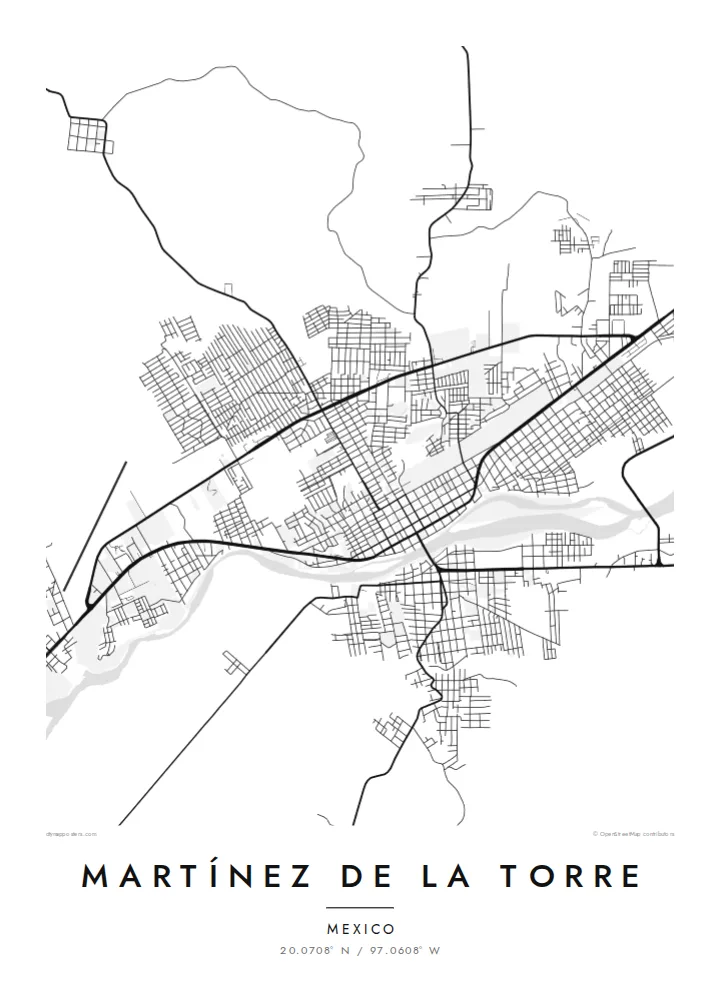
Martínez de la Torre lies in the north of Veracruz, in the warm lowlands between the Sierra Madre Oriental and the Gulf coast. Its centre follows the usual Mexican pattern, a regular grid of blocks spreading out from a main square. Toward the edges the grid loosens into irregular roads that head out into farmland. The Bobos River passes the town and adds a winding line to the straight streets.
The region is best known for citrus. Oranges and especially limes are grown across the surrounding plain, and the town has long been a market and packing centre for the harvest. On a map this shows as a sharp contrast. A dense knot of streets sits in open land that is broken only by rural roads, field boundaries and the curve of the river.
A Martínez de la Torre map poster suits anyone with roots in this part of Veracruz, whether they still live among the orchards or have moved to Mexico City or the United States. In black and white the grid reads clearly, and the river runs diagonally across the composition, so it never feels static.
The historic core is laid out in regular rectangular blocks around a main plaza. This structure stays crisp and easy to read even at the smallest print sizes.
The river curves past the town on its way toward the Gulf of Mexico. Its soft, meandering line balances the straight streets of the centre and gives the design a sense of movement.
Beyond the built-up area, rural roads fan out into a farming plain known for limes and oranges. This leaves open space around the dense centre of the map.
Fai mo koe
Fakaopoopo he aho, he igoa pe he upu a koe, hui te faiga, te lahi pe te tūlaga.
Ko te va'aiga e leai se totogi e maualalo tona resolution ma iai se fakailoga vai. E fakaatagia lomiga ma faila HD i te 300 DPI, e oo atu ki te 7,200 × 10,800 px, e aunoa ma se fakailoga vai.
Aiheā Martínez de la Torre
For families from Martínez de la Torre, the town is tied to harvest seasons, evenings at the plaza and the river beside the streets. A map poster captures that familiar layout in a way a photograph cannot, because it shows the whole town at once, from the centre to the orchards.
Personalise the title, subtitle and coordinates line, perhaps with a family name or an important date. Then pick Classic black & white, Noir, Paper, Blueprint or Sand. HD files in six sizes cost $9, and printed posters ship from partners in more than 30 countries.
Oka te poster Martínez de la Torre| Lahi o te lomiga | Manino | Faila |
|---|---|---|
| 30 × 40 cm11.8 × 15.7″ | 3,543 × 4,724 px | PNG · PDF |
| 29.7 × 42 cm (A3)11.7 × 16.5″ | 3,508 × 4,961 px | PNG · PDF |
| 42 × 59.4 cm (A2)16.5 × 23.4″ | 4,961 × 7,016 px | PNG · PDF |
| 45.7 × 61 cm18 × 24″ | 5,400 × 7,200 px | PNG · PDF |
| 50 × 70 cm19.7 × 27.6″ | 5,906 × 8,268 px | PNG · PDF |
| 61 × 91.4 cm24 × 36″ | 7,200 × 10,800 px | PNG · PDF |
Mo te fakatatau, ko te fakaakoakoga e hē totogi e 900 px te lautele, e ihi te fakailoga ma mo te lau komipiuta. Ko nā faila HD e oko ki te 8× te manino i itū taki tahi ma e lomia lelei i te lahi kātoa o te pōhita.
Filifili se ata i te pito i luga o te itulau, ona filifili lea o te Poster Lomiina — se lapoa ma, ka manako ai koe, se faleata — pe ko Faila HD Fakaonaonaina. E tasi te laasaga o te ōkaina, ma ka fakafou loa lau itulau ōkaina pe a mae'a te totogi.
E lomiina i luga o se pepa matte kaliki maualuga e 200 gsm, i se tasi o ni lapoa e ono, mai le 30 × 40 cm ki te 24 × 36″. E kamata te tau o poster lomiina mai le $39, aofia ai te uta.
Ioe. Filifili se faleata lakau malō i te lanu uli, tea, oki masani pe lakau pouli. E aumai fakatasi mo se tioata e le gagamu ma ua sauni ke tautau. E kamata te tau o poster fakapipi'i i se faleata mai le $99, aofia ai te uta.
E tuku uma te uta ki fenua e 60+. Ko te pepa takitasi e lomi e te tasi o a matou paaga lomi i fenua e 30+, ka tae mai i aso galue e 3–7. E mafai ke e maimoa ki te tulaga mo te tulitaki i lalo o Taku Fakatonuga. E lauiti nei fenua e 2–5 wiki, ka ko nei fenua e le o tuku atu ai, e fakamatala atu e te weepisi i mua o te totogi.
Auina mai se ata pikitia i loto o te 14 aso mai te taimi na oo mai ai, ka toe lomiina e matou e leai se totogi pe toe totogi atu lau tupe.
Ioe. I te mea fakasa'o i luga o lenei itulau, sui te ulutala, te ulutala lalo ma te laina fakamaoniga tulaga ki so se mea e manako ai koe, ona filifili lea o se ata ma se lapoa. Okaina lomiina, fakapipi'i i faleata, ma fakaonaonaina e fakaaogā uma i tau ata tonu.
Mo le $9 e maua e koe ni faila PNG 300 DPI ma PDF sauni-mo-lomiga i lapoa e ono uma, e aunoa ma se fakailoga vai, ke lomiina i so se mea. E le'i mautinoa? Download muamua se va'aiga fakailoga vai e leai se totogi.
Latalata
