Oka–Orlik confluence
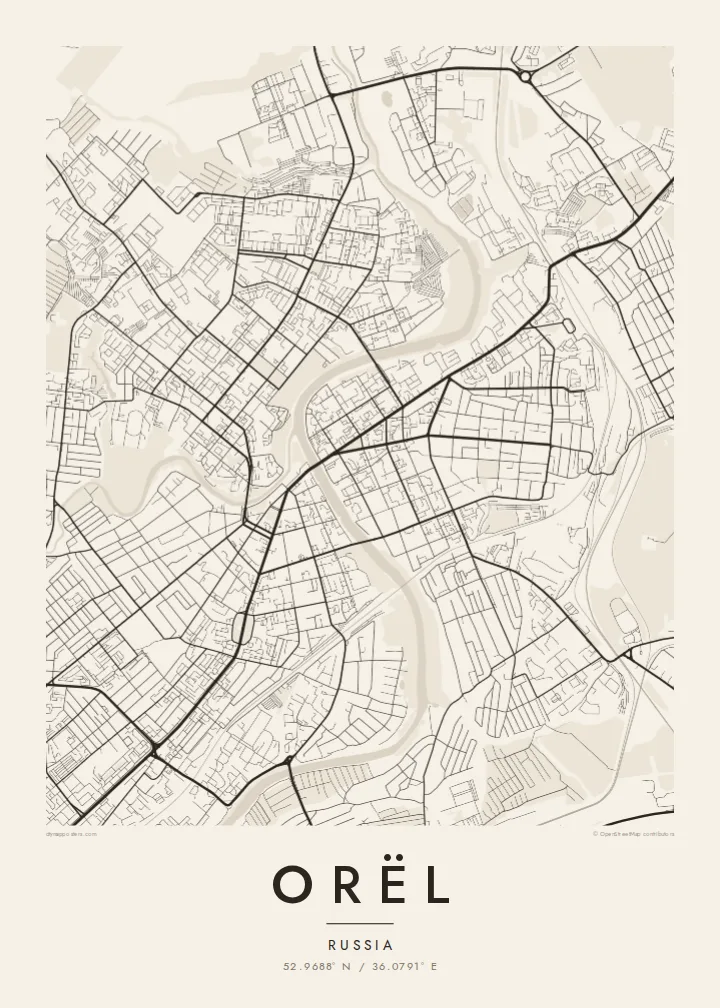
The two rivers meet close to the historic centre, where the city's first fortress stood. Their junction forms a clear Y shape that gives the whole map a natural focal point.
Pōhita mape faigofie · Russia
52.9688° N / 36.0791° E
Two rivers, the Oka and the Orlik, meet at the heart of Orël and divide it into bridge-linked quarters.




Taone e tahi, lagona e lima
Pa'i se ata ke va'ai ai i luga o te pā. E tutusa te tau o ata uma — i lomiga, fakapipi'i i faleata, pe ko faila HD.
 Pixels mo'i · Faila lomiga 24 × 36″
Manino mo te lomiga
Ko se kupega 100% mai te faila lomiga mo'i. Poster uma — pe lomiina, fakapipi'i i faleata, pe download-ina — e fakaatagia i luga o a matou setula i te 300 DPI, e oo atu ki te 7,200 × 10,800 pixels, ina ia mautinoa e ma'ai pea auala tuai foki i luga o se lomiga 24 × 36″.
I luga o te pa


Te mape
Orël grew from a fortress raised in 1566 on the point where the Orlik flows into the Oka. That confluence still organises the whole map. The Oka runs north through the middle of town, the smaller Orlik curls in from the east, and the old centre sits on the tongue of land between them. Bridges carry the street pattern across both rivers in short, regular steps.
In the late eighteenth century the centre was given a regular plan, and the result reads clearly from above. Straight streets lead away from the river crossings, blocks are broad and even, and green strips follow the embankments. Further out, the grid loosens into later districts with larger courtyards and wide arterial roads that lead away toward Moscow in the north and Kursk in the south.
The city is closely tied to Russian literature. Ivan Turgenev was born here, and Nikolai Leskov spent his youth in the town, so for many readers the name already feels familiar. An Orël map poster renders the rivers, embankments and street blocks in clean black lines, leaving out traffic and labels so that the shape of the confluence is the first thing you notice on the wall.
The two rivers meet close to the historic centre, where the city's first fortress stood. Their junction forms a clear Y shape that gives the whole map a natural focal point.
The eighteenth-century replanning left the centre with straight streets and even blocks, a calm, ordered pattern that contrasts with the soft curves of the two rivers running through it.
Several bridges cross the Oka within a short distance of the centre, giving the map a ladder-like rhythm where the river separates the eastern and western halves of the city.
Fai mo koe
Fakaopoopo he aho, he igoa pe he upu a koe, hui te faiga, te lahi pe te tūlaga.
Ko te va'aiga e leai se totogi e maualalo tona resolution ma iai se fakailoga vai. E fakaatagia lomiga ma faila HD i te 300 DPI, e oo atu ki te 7,200 × 10,800 px, e aunoa ma se fakailoga vai.
Aiheā Orël
Orël suits anyone with roots in the city, student years spent there, or a fondness for Turgenev and the landscapes he wrote about. The confluence gives the print a strong centre, and the regular blocks keep it restful on a wall, whether in a study, a hallway or above a desk.
You can set your own title, subtitle and coordinates line, adding a family name or a date that matters, and choose among five styles: Classic black & white, Noir, Paper, Blueprint and Sand. HD files cost $9 and cover six print sizes, or you can order a printed poster with an optional wooden frame.
Oka te poster Orël| Lahi o te lomiga | Manino | Faila |
|---|---|---|
| 30 × 40 cm (11.8 × 15.7″) | 3,543 × 4,724 px | PNG · PDF |
| 29.7 × 42 cm (A3, 11.7 × 16.5″) | 3,508 × 4,961 px | PNG · PDF |
| 42 × 59.4 cm (A2, 16.5 × 23.4″) | 4,961 × 7,016 px | PNG · PDF |
| 45.7 × 61 cm (18 × 24″) | 5,400 × 7,200 px | PNG · PDF |
| 50 × 70 cm (19.7 × 27.6″) | 5,906 × 8,268 px | PNG · PDF |
| 61 × 91.4 cm (24 × 36″) | 7,200 × 10,800 px | PNG · PDF |
Mo te fakatatau, ko te fakaakoakoga e hē totogi e 900 px te lautele, e ihi te fakailoga ma mo te lau komipiuta. Ko nā faila HD e oko ki te 8× te manino i itū taki tahi ma e lomia lelei i te lahi kātoa o te pōhita.
Filifili se ata i te pito i luga o te itulau, ona filifili lea o te Poster Lomiina — se lapoa ma, ka manako ai koe, se faleata — pe ko Faila HD Fakaonaonaina. E tasi te laasaga o te ōkaina, ma ka fakafou loa lau itulau ōkaina pe a mae'a te totogi.
E lomiina i luga o se pepa matte kaliki maualuga e 200 gsm, i se tasi o ni lapoa e ono, mai le 30 × 40 cm ki te 24 × 36″. E kamata te tau o poster lomiina mai le {printFrom}, aofia ai te uta.
Ioe. Filifili se faleata lakau malō i te lanu uli, tea, oki masani pe lakau pouli. E aumai fakatasi mo se tioata e le gagamu ma ua sauni ke tautau. E kamata te tau o poster fakapipi'i i se faleata mai le {framedFrom}, aofia ai te uta.
E leai se totogi o te ave i te lalolagi katoa. Ko te pepa ata taki tasi e lomi e te hoa lomi e latalata mai ki a matou i atunuku e 30+, ma e masani ona aulia i aso galuega e 3–7. E mafai ke e mulimuli i te tulaga ma te ala o tau poloaiga i lalo o Aku Poloaiga. E nai atunuku e 2–5 vaiaso te umi, ma i te mea e le i ave ai matou, e fakailoa atu e te initeneti a e le i totogi koe.
Auina mai se ata pikitia i loto o te 14 aso mai te taimi na oo mai ai, ka toe lomiina e matou e leai se totogi pe toe totogi atu lau tupe.
Ioe. I te mea fakasa'o i luga o lenei itulau, sui te ulutala, te ulutala lalo ma te laina fakamaoniga tulaga ki so se mea e manako ai koe, ona filifili lea o se ata ma se lapoa. Okaina lomiina, fakapipi'i i faleata, ma fakaonaonaina e fakaaogā uma i tau ata tonu.
Mo le $9 e maua e koe ni faila PNG 300 DPI ma PDF sauni-mo-lomiga i lapoa e ono uma, e aunoa ma se fakailoga vai, ke lomiina i so se mea. E le'i mautinoa? Download muamua se va'aiga fakailoga vai e leai se totogi.
