Curving street plan
Looping roads and cul-de-sacs from the 1960s give the suburb a flowing, organic look. They differ clearly from Auckland's older straight-street districts.
Pōhita mape faigofie · New Zealand
36.9482° S / 174.8702° E
A planned South Auckland suburb, its curving 1960s streets bordered by the creek arms of the Tāmaki estuary


Taone e tahi, lagona e lima
Pa'i se ata ke va'ai ai i luga o te pā. E tutusa te tau o ata uma — i lomiga, fakapipi'i i faleata, pe ko faila HD.
 Pixels mo'i · Faila lomiga 24 × 36″
Manino mo te lomiga
Ko se kupega 100% mai te faila lomiga mo'i. Poster uma — pe lomiina, fakapipi'i i faleata, pe download-ina — e fakaatagia i luga o a matou setula i te 300 DPI, e oo atu ki te 7,200 × 10,800 pixels, ina ia mautinoa e ma'ai pea auala tuai foki i luga o se lomiga 24 × 36″.
I luga o te pa
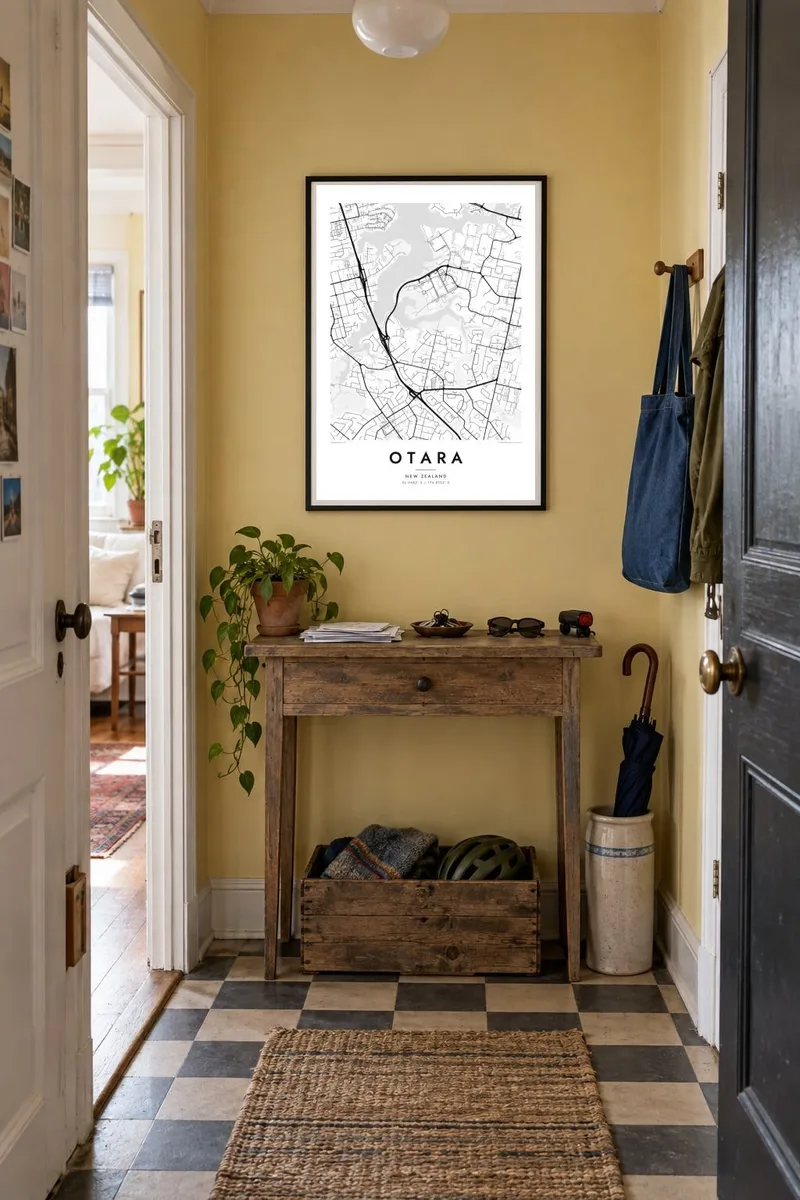


Te mape
Otara is a suburb in South Auckland, developed mostly in the 1960s as a large planned state housing area. Today it is home to one of the largest Pacific communities in New Zealand. It is best known for the Otara Markets, a Saturday market in the town centre car park that has been running for decades.
From above, Otara looks very different from a city grid. Streets curve and loop in the style of mid-century suburban planning, cul-de-sacs branch off longer collector roads, and reserves and school grounds open up green spaces between the housing blocks. The Ōtara Creek, an arm of the Tāmaki River estuary, cuts in from the north.
An Otara map poster shows that post-war layout in precise detail. The winding streets form a soft, flowing pattern, the town centre sits where the main roads meet, and the creek's irregular tidal edge contrasts with the planned curves. The motorway runs along the southern side and gives the composition a firm boundary.
Looping roads and cul-de-sacs from the 1960s give the suburb a flowing, organic look. They differ clearly from Auckland's older straight-street districts.
A tidal arm of the Tāmaki estuary reaches into the suburb from the north. Its winding, irregular banks are edged with reserves.
The shopping centre and market area sit where the main roads converge. It is the focal point of the map and of weekend life.
Fai mo koe
Fakaopoopo he aho, he igoa pe he upu a koe, hui te faiga, te lahi pe te tūlaga.
Ko te va'aiga e leai se totogi e maualalo tona resolution ma iai se fakailoga vai. E fakaatagia lomiga ma faila HD i te 300 DPI, e oo atu ki te 7,200 × 10,800 px, e aunoa ma se fakailoga vai.
Aiheā Otara
Otara has a strong sense of identity, shaped by its Pacific families and its community life. For people who grew up there, a map of its streets is as much about belonging as about geography.
Personalise the title, add a family name or a year in the subtitle, and keep the coordinates line. Choose from Classic black & white, Noir, Paper, Blueprint and Sand. Printed posters ship from partners in 30+ countries.
Oka te poster Otara| Lahi o te lomiga | Manino | Faila |
|---|---|---|
| 30 × 40 cm11.8 × 15.7″ | 3,543 × 4,724 px | PNG · PDF |
| 29.7 × 42 cm (A3)11.7 × 16.5″ | 3,508 × 4,961 px | PNG · PDF |
| 42 × 59.4 cm (A2)16.5 × 23.4″ | 4,961 × 7,016 px | PNG · PDF |
| 45.7 × 61 cm18 × 24″ | 5,400 × 7,200 px | PNG · PDF |
| 50 × 70 cm19.7 × 27.6″ | 5,906 × 8,268 px | PNG · PDF |
| 61 × 91.4 cm24 × 36″ | 7,200 × 10,800 px | PNG · PDF |
Mo te fakatatau, ko te fakaakoakoga e hē totogi e 900 px te lautele, e ihi te fakailoga ma mo te lau komipiuta. Ko nā faila HD e oko ki te 8× te manino i itū taki tahi ma e lomia lelei i te lahi kātoa o te pōhita.
Filifili se ata i te pito i luga o te itulau, ona filifili lea o te Poster Lomiina — se lapoa ma, ka manako ai koe, se faleata — pe ko Faila HD Fakaonaonaina. E tasi te laasaga o te ōkaina, ma ka fakafou loa lau itulau ōkaina pe a mae'a te totogi.
E lomiina i luga o se pepa matte kaliki maualuga e 200 gsm, i se tasi o ni lapoa e ono, mai le 30 × 40 cm ki te 24 × 36″. E kamata te tau o poster lomiina mai le $39, aofia ai te uta.
Ioe. Filifili se faleata lakau malō i te lanu uli, tea, oki masani pe lakau pouli. E aumai fakatasi mo se tioata e le gagamu ma ua sauni ke tautau. E kamata te tau o poster fakapipi'i i se faleata mai le $99, aofia ai te uta.
E tuku uma te uta ki fenua e 60+. Ko te pepa takitasi e lomi e te tasi o a matou paaga lomi i fenua e 30+, ka tae mai i aso galue e 3–7. E mafai ke e maimoa ki te tulaga mo te tulitaki i lalo o Taku Fakatonuga. E lauiti nei fenua e 2–5 wiki, ka ko nei fenua e le o tuku atu ai, e fakamatala atu e te weepisi i mua o te totogi.
Auina mai se ata pikitia i loto o te 14 aso mai te taimi na oo mai ai, ka toe lomiina e matou e leai se totogi pe toe totogi atu lau tupe.
Ioe. I te mea fakasa'o i luga o lenei itulau, sui te ulutala, te ulutala lalo ma te laina fakamaoniga tulaga ki so se mea e manako ai koe, ona filifili lea o se ata ma se lapoa. Okaina lomiina, fakapipi'i i faleata, ma fakaonaonaina e fakaaogā uma i tau ata tonu.
Mo le $9 e maua e koe ni faila PNG 300 DPI ma PDF sauni-mo-lomiga i lapoa e ono uma, e aunoa ma se fakailoga vai, ke lomiina i so se mea. E le'i mautinoa? Download muamua se va'aiga fakailoga vai e leai se totogi.
