Valley core
The central districts follow the course of the local river, giving the city a stretched, winding outline rather than a neat grid. Bridges and embankments mark its route through town.
Pōhita mape faigofie · China
27.6167° N / 113.8535° E
A hill-ringed industrial city strung along a winding valley in western Jiangxi, a short distance from the Hunan border.


Taone e tahi, lagona e lima
Pa'i se ata ke va'ai ai i luga o te pā. E tutusa te tau o ata uma — i lomiga, fakapipi'i i faleata, pe ko faila HD.
 Pixels mo'i · Faila lomiga 24 × 36″
Manino mo te lomiga
Ko se kupega 100% mai te faila lomiga mo'i. Poster uma — pe lomiina, fakapipi'i i faleata, pe download-ina — e fakaatagia i luga o a matou setula i te 300 DPI, e oo atu ki te 7,200 × 10,800 pixels, ina ia mautinoa e ma'ai pea auala tuai foki i luga o se lomiga 24 × 36″.
I luga o te pa


Te mape
Pingxiang lies in the far west of Jiangxi province, where low hills close in around the valley floor and the border with Hunan is close by. The urban area follows the river and the flatter ground, so from above it looks less like a compact circle and more like a series of built-up pockets linked by roads and railway lines.
The city grew around coal. The Anyuan mines, in the district that still carries the name, were among the early modern collieries in China, and the 1922 Anyuan miners' strike is a well-known episode in the country's labour history. A railway towards Hunan was first built to move that coal, and the tracks remain clear lines on the map today.
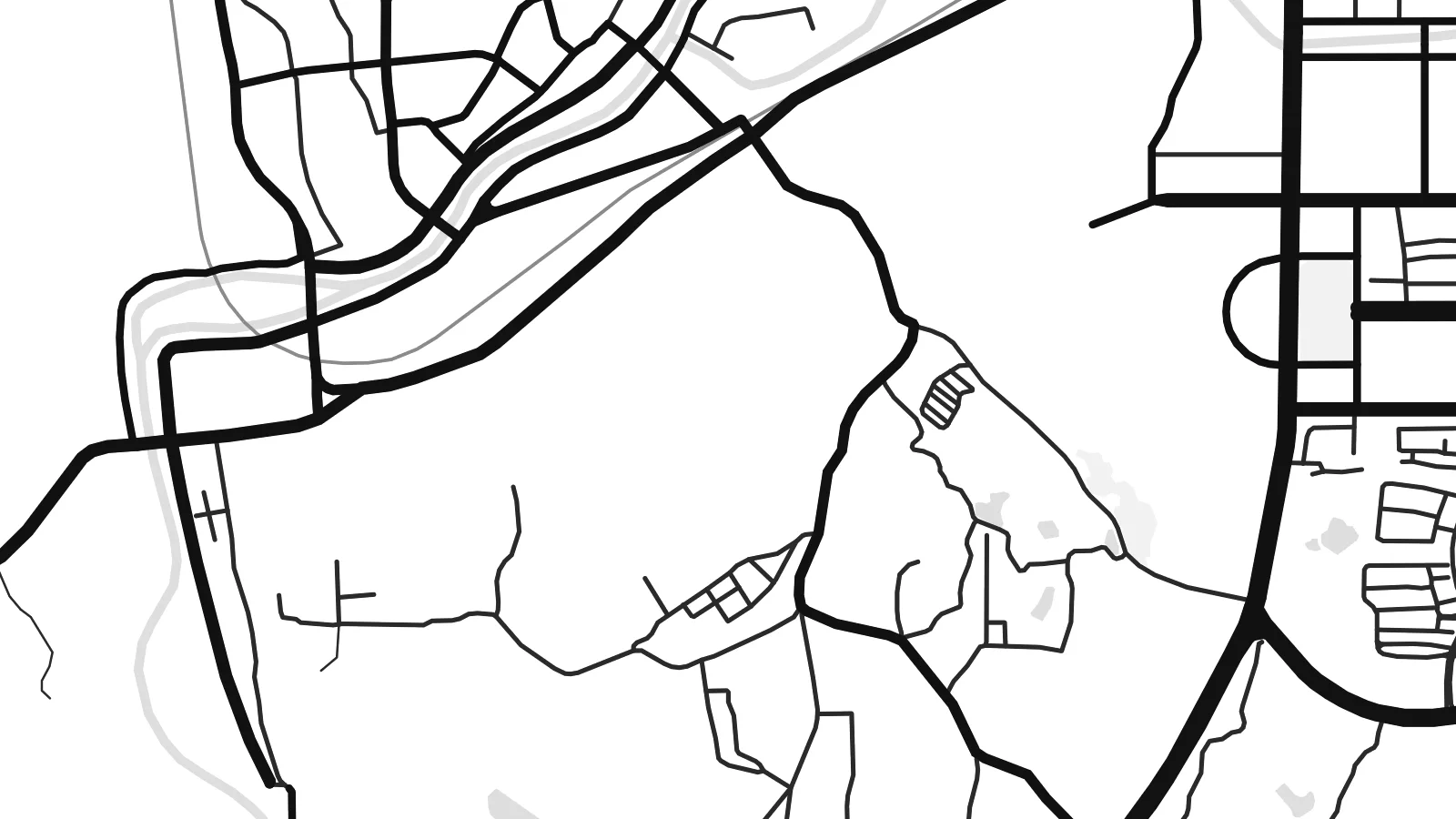
Away from the centre, the street pattern thins quickly into slopes, fields and village roads, and the hills leave irregular gaps between districts. A Pingxiang map poster reflects that uneven shape: dense clusters of streets along the valley, broken by green ridges that turn into quiet open space in the design.
The central districts follow the course of the local river, giving the city a stretched, winding outline rather than a neat grid. Bridges and embankments mark its route through town.
The historic mining area that gave the city its industrial start. Its streets and rail connections are a reminder of how Pingxiang first grew, and they sit apart from the newer central districts.
Wooded ridges break the urban area into separate pieces. On the poster they read as calm unprinted space, which gives the composition air and an irregular rhythm.
Fai mo koe
Fakaopoopo he aho, he igoa pe he upu a koe, hui te faiga, te lahi pe te tūlaga.
Ko te va'aiga e leai se totogi e maualalo tona resolution ma iai se fakailoga vai. E fakaatagia lomiga ma faila HD i te 300 DPI, e oo atu ki te 7,200 × 10,800 px, e aunoa ma se fakailoga vai.
Aiheā Pingxiang
For anyone who grew up in Pingxiang and has since moved to a larger city or abroad, a map of home is a quiet reminder of where things began. The fragmented, hill-shaped layout makes an unusual and personal piece for a living room or office wall.
The title and subtitle can be changed, so you can add a family name, a district or a year, and the coordinates line can be kept or rewritten. There are five styles to choose from, and the $9 download includes six print sizes as 300 DPI PNG and print-ready PDF files.
Oka te poster Pingxiang| Lahi o te lomiga | Manino | Faila |
|---|---|---|
| 30 × 40 cm (11.8 × 15.7″) | 3,543 × 4,724 px | PNG · PDF |
| 29.7 × 42 cm (A3, 11.7 × 16.5″) | 3,508 × 4,961 px | PNG · PDF |
| 42 × 59.4 cm (A2, 16.5 × 23.4″) | 4,961 × 7,016 px | PNG · PDF |
| 45.7 × 61 cm (18 × 24″) | 5,400 × 7,200 px | PNG · PDF |
| 50 × 70 cm (19.7 × 27.6″) | 5,906 × 8,268 px | PNG · PDF |
| 61 × 91.4 cm (24 × 36″) | 7,200 × 10,800 px | PNG · PDF |
Mo te fakatatau, ko te fakaakoakoga e hē totogi e 900 px te lautele, e ihi te fakailoga ma mo te lau komipiuta. Ko nā faila HD e oko ki te 8× te manino i itū taki tahi ma e lomia lelei i te lahi kātoa o te pōhita.
Filifili se ata i te pito i luga o te itulau, ona filifili lea o te Poster Lomiina — se lapoa ma, ka manako ai koe, se faleata — pe ko Faila HD Fakaonaonaina. E tasi te laasaga o te ōkaina, ma ka fakafou loa lau itulau ōkaina pe a mae'a te totogi.
E lomiina i luga o se pepa matte kaliki maualuga e 200 gsm, i se tasi o ni lapoa e ono, mai le 30 × 40 cm ki te 24 × 36″. E kamata te tau o poster lomiina mai le $39, aofia ai te uta.
Ioe. Filifili se faleata lakau malō i te lanu uli, tea, oki masani pe lakau pouli. E aumai fakatasi mo se tioata e le gagamu ma ua sauni ke tautau. E kamata te tau o poster fakapipi'i i se faleata mai le $99, aofia ai te uta.
E leai se totogi o te ave i te lalolagi katoa. Ko te pepa ata taki tasi e lomi e te hoa lomi e latalata mai ki a matou i atunuku e 30+, ma e masani ona aulia i aso galuega e 3–7. E mafai ke e mulimuli i te tulaga ma te ala o tau poloaiga i lalo o Aku Poloaiga. E nai atunuku e 2–5 vaiaso te umi, ma i te mea e le i ave ai matou, e fakailoa atu e te initeneti a e le i totogi koe.
Auina mai se ata pikitia i loto o te 14 aso mai te taimi na oo mai ai, ka toe lomiina e matou e leai se totogi pe toe totogi atu lau tupe.
Ioe. I te mea fakasa'o i luga o lenei itulau, sui te ulutala, te ulutala lalo ma te laina fakamaoniga tulaga ki so se mea e manako ai koe, ona filifili lea o se ata ma se lapoa. Okaina lomiina, fakapipi'i i faleata, ma fakaonaonaina e fakaaogā uma i tau ata tonu.
Mo le $9 e maua e koe ni faila PNG 300 DPI ma PDF sauni-mo-lomiga i lapoa e ono uma, e aunoa ma se fakailoga vai, ke lomiina i so se mea. E le'i mautinoa? Download muamua se va'aiga fakailoga vai e leai se totogi.
Latalata
