The Kosi riverbed
The Kosi runs past the town in a wide, shifting bed of channels and gravel bars. It makes a broad pale band that sets the frame for everything around it.
Pōhita mape faigofie · India
29.3925° N / 79.1283° E
A foothill town beside the wide braided bed of the Kosi, where the plains stop and forested Kumaon ridges begin



Taone e tahi, lagona e lima
Pa'i se ata ke va'ai ai i luga o te pā. E tutusa te tau o ata uma — i lomiga, fakapipi'i i faleata, pe ko faila HD.
 Pixels mo'i · Faila lomiga 24 × 36″
Manino mo te lomiga
Ko se kupega 100% mai te faila lomiga mo'i. Poster uma — pe lomiina, fakapipi'i i faleata, pe download-ina — e fakaatagia i luga o a matou setula i te 300 DPI, e oo atu ki te 7,200 × 10,800 pixels, ina ia mautinoa e ma'ai pea auala tuai foki i luga o se lomiga 24 × 36″.
I luga o te pa


Te mape
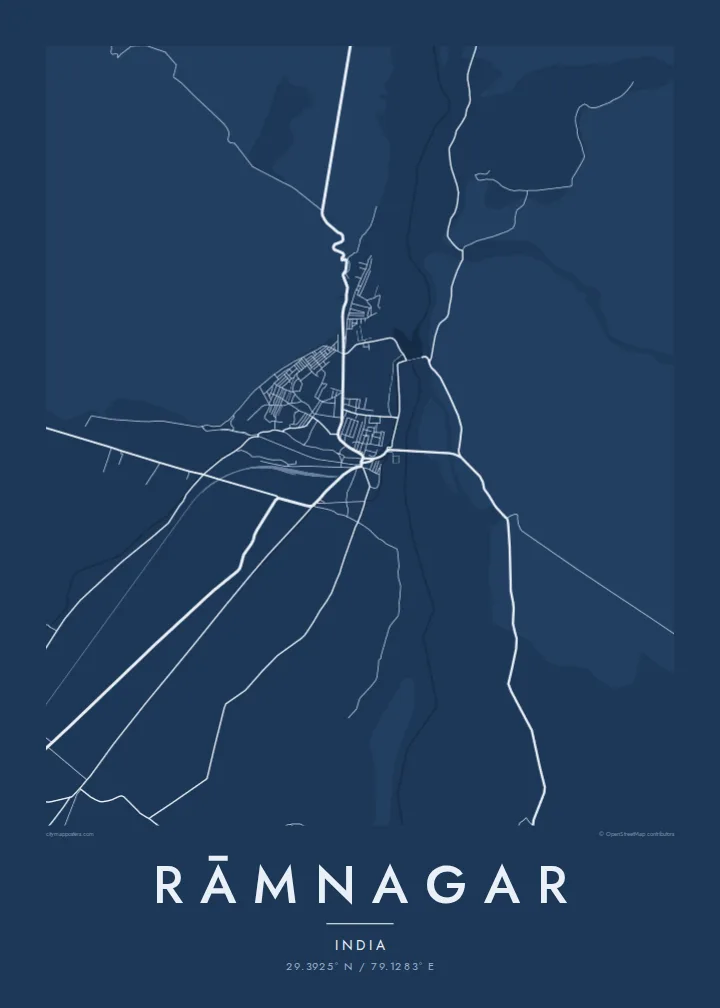
Rāmnagar sits right where the Gangetic plain meets the first ridges of the Kumaon Himalaya. On a map, the town's compact streets gather on the flat ground near the Kosi River. To the north and west the drawing turns almost empty, because forest takes over and roads become rare. The river's broad, braided channel is the strongest line on the sheet, curving down from the hills and spreading out as it reaches the plain.
The town is best known as the main gateway to Jim Corbett National Park, India's oldest national park, established in 1936. That explains the pattern of roads leaving town. A few routes head into the reserve and the hills, while others run south and east across farmland towards the plains. The contrast between a dense core and the open edges gives the layout a clear sense of place.
A Rāmnagar map poster shows that threshold in black and white. On one side there are the lanes and markets of a working town. On the other are the long pale spaces of river gravel and forest, crossed by only a few thin lines. It suits someone who has passed through on the way to Corbett, or who grew up in the town, where the mountains are always close.
The Kosi runs past the town in a wide, shifting bed of channels and gravel bars. It makes a broad pale band that sets the frame for everything around it.
Roads leave the compact centre in several directions, some towards the protected forest and hill country, others out across the plains. The town reads as a junction between two landscapes.
North and west of town the street network thins out quickly, marking where the Corbett landscape begins. On the poster that open space is as expressive as the streets.
Fai mo koe
Fakaopoopo he aho, he igoa pe he upu a koe, hui te faiga, te lahi pe te tūlaga.
Ko te va'aiga e leai se totogi e maualalo tona resolution ma iai se fakailoga vai. E fakaatagia lomiga ma faila HD i te 300 DPI, e oo atu ki te 7,200 × 10,800 px, e aunoa ma se fakailoga vai.
Aiheā Rāmnagar
For many people Rāmnagar is where a journey into the hills or a first safari began. A map of it keeps that moment in a quieter form. The river, the town and the edge of the forest sit on one sheet, which suits a hallway, a study or a cabin wall.
You can add your own title, a subtitle such as a trip date, and a coordinates line. Then choose one of five styles: Classic black & white, Noir, Paper, Blueprint or Sand. Sand and Paper suit the dry riverbed especially well.
Oka te poster Rāmnagar| Lahi o te lomiga | Manino | Faila |
|---|---|---|
| 30 × 40 cm (11.8 × 15.7″) | 3,543 × 4,724 px | PNG · PDF |
| 29.7 × 42 cm (A3, 11.7 × 16.5″) | 3,508 × 4,961 px | PNG · PDF |
| 42 × 59.4 cm (A2, 16.5 × 23.4″) | 4,961 × 7,016 px | PNG · PDF |
| 45.7 × 61 cm (18 × 24″) | 5,400 × 7,200 px | PNG · PDF |
| 50 × 70 cm (19.7 × 27.6″) | 5,906 × 8,268 px | PNG · PDF |
| 61 × 91.4 cm (24 × 36″) | 7,200 × 10,800 px | PNG · PDF |
Mo te fakatatau, ko te fakaakoakoga e hē totogi e 900 px te lautele, e ihi te fakailoga ma mo te lau komipiuta. Ko nā faila HD e oko ki te 8× te manino i itū taki tahi ma e lomia lelei i te lahi kātoa o te pōhita.
Filifili se ata i te pito i luga o te itulau, ona filifili lea o te Poster Lomiina — se lapoa ma, ka manako ai koe, se faleata — pe ko Faila HD Fakaonaonaina. E tasi te laasaga o te ōkaina, ma ka fakafou loa lau itulau ōkaina pe a mae'a te totogi.
E lomiina i luga o se pepa matte kaliki maualuga e 200 gsm, i se tasi o ni lapoa e ono, mai le 30 × 40 cm ki te 24 × 36″. E kamata te tau o poster lomiina mai le {printFrom}, aofia ai te uta.
Ioe. Filifili se faleata lakau malō i te lanu uli, tea, oki masani pe lakau pouli. E aumai fakatasi mo se tioata e le gagamu ma ua sauni ke tautau. E kamata te tau o poster fakapipi'i i se faleata mai le {framedFrom}, aofia ai te uta.
E fua noa te uta i te lalolagi katoa. Poster ta'itasi e lomiina e te pāketiha lomiga pili mai i lo matou 30+ atunu'u, ma e masani ona oo mai i loto i te 3–7 aso gāluega. E mafai ona ke va'aiina te tulaga o lau okaina i lalo ifo o My Orders.
Auina mai se ata pikitia i loto o te 14 aso mai te taimi na oo mai ai, ka toe lomiina e matou e leai se totogi pe toe totogi atu lau tupe.
Ioe. I te mea fakasa'o i luga o lenei itulau, sui te ulutala, te ulutala lalo ma te laina fakamaoniga tulaga ki so se mea e manako ai koe, ona filifili lea o se ata ma se lapoa. Okaina lomiina, fakapipi'i i faleata, ma fakaonaonaina e fakaaogā uma i tau ata tonu.
Mo le $9 e maua e koe ni faila PNG 300 DPI ma PDF sauni-mo-lomiga i lapoa e ono uma, e aunoa ma se fakailoga vai, ke lomiina i so se mea. E le'i mautinoa? Download muamua se va'aiga fakailoga vai e leai se totogi.
