The Váh river
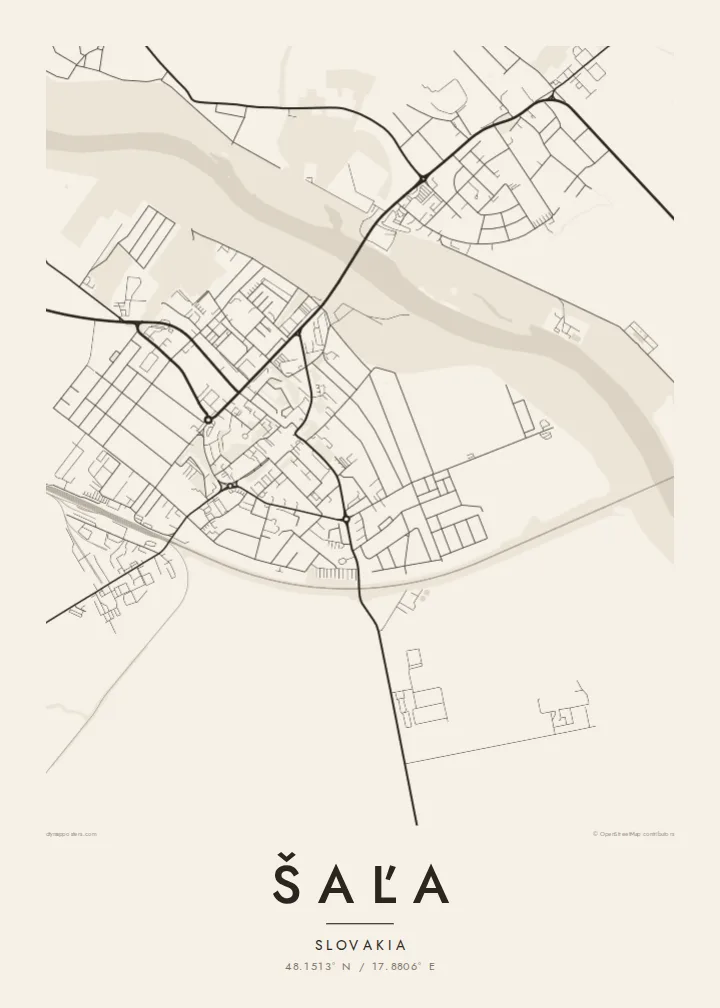
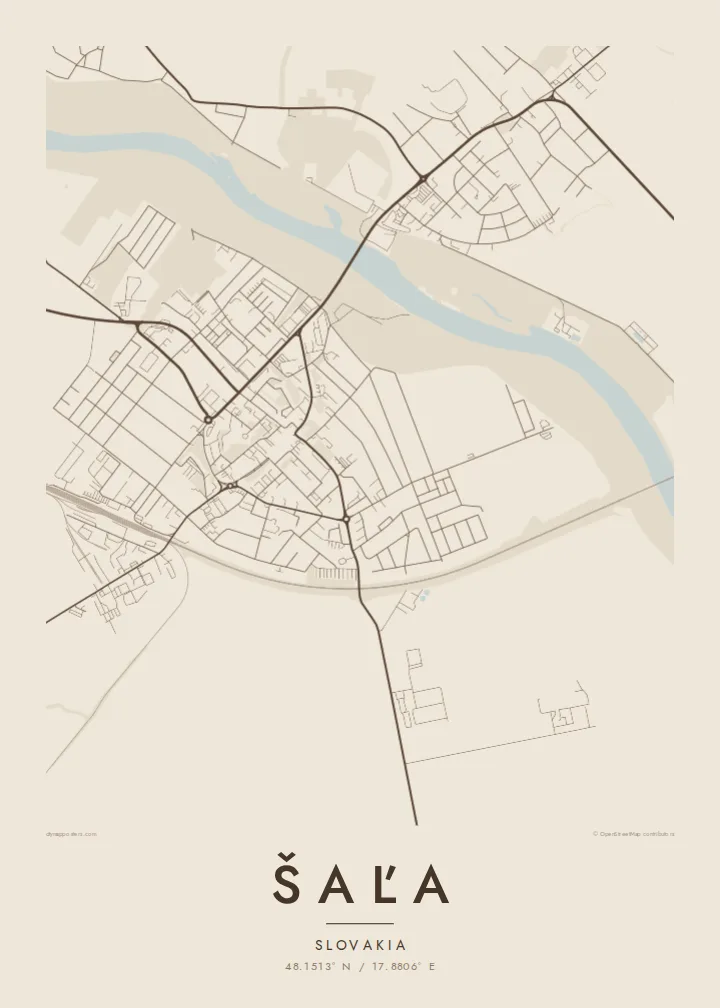
The Váh curves through the lowland and divides Šaľa in two. Its wide channel and the bridges across it form the strongest line on the poster, dark against the pale street pattern.
Pōhita mape faigofie · Slovakia
48.1513° N / 17.8806° E
A compact lowland town drawn along the curve of the Váh, with bridges tying the centre to Veča on the opposite bank.



Taone e tahi, lagona e lima
Pa'i se ata ke va'ai ai i luga o te pā. E tutusa te tau o ata uma — i lomiga, fakapipi'i i faleata, pe ko faila HD.
 Pixels mo'i · Faila lomiga 24 × 36″
Manino mo te lomiga
Ko se kupega 100% mai te faila lomiga mo'i. Poster uma — pe lomiina, fakapipi'i i faleata, pe download-ina — e fakaatagia i luga o a matou setula i te 300 DPI, e oo atu ki te 7,200 × 10,800 pixels, ina ia mautinoa e ma'ai pea auala tuai foki i luga o se lomiga 24 × 36″.
I luga o te pa


Te mape
Šaľa sits on the flat Danubian Lowland in the Nitra Region, and on a map the Váh is the first thing the eye follows. The river bends past the town in a broad, unhurried line and splits the built-up area in two: the main centre on one bank and the district of Veča on the other. Around them the land opens into large rectangular fields that run almost to the horizon.
Šaľa has one of the oldest written records of any town in Slovakia, with a first mention in a charter dated 1002. That long timeline is not obvious in the street pattern, which was mostly shaped in the twentieth century: housing estates, straight avenues and a railway line crossing the plain. The contrast between the river's curve and the geometry of the streets gives the map its character.
Šaľa is also home to Duslo, one of the largest chemical producers in the country, and its industrial site shows on the map as a block of large, regular shapes at the edge of town. A Šaľa map poster keeps all of this in black and white, so the river, the estates, the plant and the fields read together as one clean drawing.
The Váh curves through the lowland and divides Šaľa in two. Its wide channel and the bridges across it form the strongest line on the poster, dark against the pale street pattern.
On the opposite bank, Veča forms a second cluster of streets. Seen from above it balances the main centre, so the town reads as a pair rather than a single block.
Beyond the last houses the Danubian Lowland stretches out in long, rectangular plots. Their straight edges frame the town and give the composition a quiet, measured border.
Fai mo koe
Fakaopoopo he aho, he igoa pe he upu a koe, hui te faiga, te lahi pe te tūlaga.
Ko te va'aiga e leai se totogi e maualalo tona resolution ma iai se fakailoga vai. E fakaatagia lomiga ma faila HD i te 300 DPI, e oo atu ki te 7,200 × 10,800 px, e aunoa ma se fakailoga vai.
Aiheā Šaľa
People who grew up in Šaľa, or who crossed the Váh every day on the way to school or work, often want a map that shows the whole town at once. The river's curve makes a strong central motif for a wall above a desk or in a hallway.
You can set your own title, subtitle and coordinates line, adding a family name or a meaningful date, and choose from five styles: Classic black & white, Noir, Paper, Blueprint or Sand. The $9 digital files include six print sizes as 300 DPI PNG and print-ready PDF.
Oka te poster Šaľa| Lahi o te lomiga | Manino | Faila |
|---|---|---|
| 30 × 40 cm (11.8 × 15.7″) | 3,543 × 4,724 px | PNG · PDF |
| 29.7 × 42 cm (A3, 11.7 × 16.5″) | 3,508 × 4,961 px | PNG · PDF |
| 42 × 59.4 cm (A2, 16.5 × 23.4″) | 4,961 × 7,016 px | PNG · PDF |
| 45.7 × 61 cm (18 × 24″) | 5,400 × 7,200 px | PNG · PDF |
| 50 × 70 cm (19.7 × 27.6″) | 5,906 × 8,268 px | PNG · PDF |
| 61 × 91.4 cm (24 × 36″) | 7,200 × 10,800 px | PNG · PDF |
Mo te fakatatau, ko te fakaakoakoga e hē totogi e 900 px te lautele, e ihi te fakailoga ma mo te lau komipiuta. Ko nā faila HD e oko ki te 8× te manino i itū taki tahi ma e lomia lelei i te lahi kātoa o te pōhita.
Filifili se ata i te pito i luga o te itulau, ona filifili lea o te Poster Lomiina — se lapoa ma, ka manako ai koe, se faleata — pe ko Faila HD Fakaonaonaina. E tasi te laasaga o te ōkaina, ma ka fakafou loa lau itulau ōkaina pe a mae'a te totogi.
E lomiina i luga o se pepa matte kaliki maualuga e 200 gsm, i se tasi o ni lapoa e ono, mai le 30 × 40 cm ki te 24 × 36″. E kamata te tau o poster lomiina mai le {printFrom}, aofia ai te uta.
Ioe. Filifili se faleata lakau malō i te lanu uli, tea, oki masani pe lakau pouli. E aumai fakatasi mo se tioata e le gagamu ma ua sauni ke tautau. E kamata te tau o poster fakapipi'i i se faleata mai le {framedFrom}, aofia ai te uta.
E leai se totogi o te ave i te lalolagi katoa. Ko te pepa ata taki tasi e lomi e te hoa lomi e latalata mai ki a matou i atunuku e 30+, ma e masani ona aulia i aso galuega e 3–7. E mafai ke e mulimuli i te tulaga ma te ala o tau poloaiga i lalo o Aku Poloaiga. E nai atunuku e 2–5 vaiaso te umi, ma i te mea e le i ave ai matou, e fakailoa atu e te initeneti a e le i totogi koe.
Auina mai se ata pikitia i loto o te 14 aso mai te taimi na oo mai ai, ka toe lomiina e matou e leai se totogi pe toe totogi atu lau tupe.
Ioe. I te mea fakasa'o i luga o lenei itulau, sui te ulutala, te ulutala lalo ma te laina fakamaoniga tulaga ki so se mea e manako ai koe, ona filifili lea o se ata ma se lapoa. Okaina lomiina, fakapipi'i i faleata, ma fakaonaonaina e fakaaogā uma i tau ata tonu.
Mo le $9 e maua e koe ni faila PNG 300 DPI ma PDF sauni-mo-lomiga i lapoa e ono uma, e aunoa ma se fakailoga vai, ke lomiina i so se mea. E le'i mautinoa? Download muamua se va'aiga fakailoga vai e leai se totogi.
