Patchwork developments
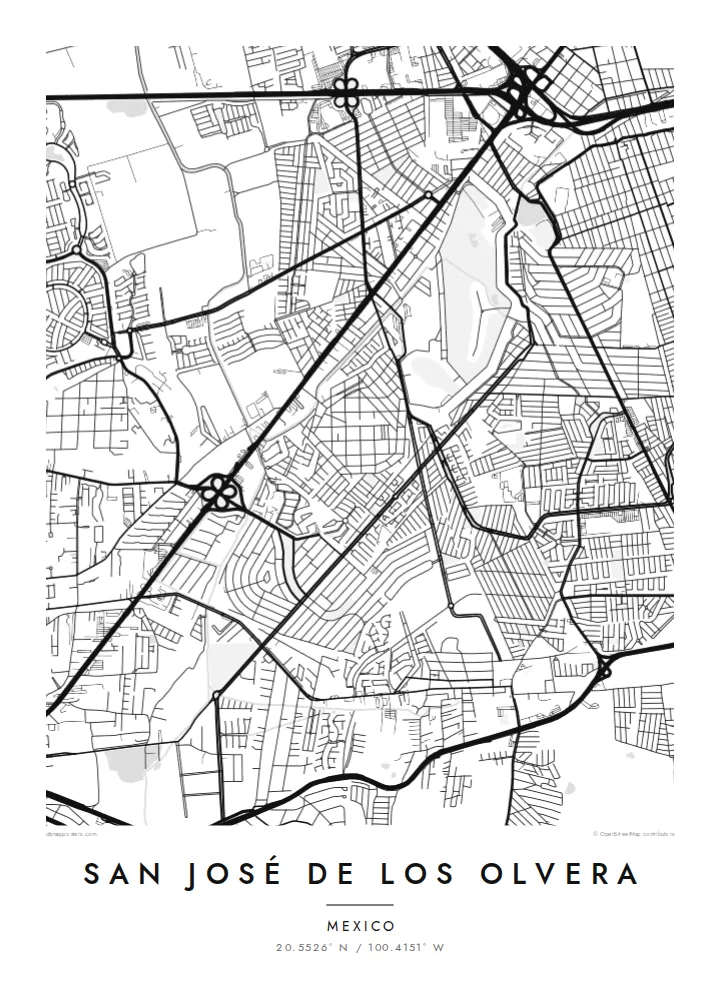
Distinct residential areas sit side by side, each with its own street pattern, from curving loops to straighter blocks, creating a varied and detailed map surface.
Pōhita mape faigofie · Mexico
20.5526° N / 100.4151° W
A fast-growing suburb south of Querétaro, where new residential streets fill the land between highways


Taone e tahi, lagona e lima
Pa'i se ata ke va'ai ai i luga o te pā. E tutusa te tau o ata uma — i lomiga, fakapipi'i i faleata, pe ko faila HD.
 Pixels mo'i · Faila lomiga 24 × 36″
Manino mo te lomiga
Ko se kupega 100% mai te faila lomiga mo'i. Poster uma — pe lomiina, fakapipi'i i faleata, pe download-ina — e fakaatagia i luga o a matou setula i te 300 DPI, e oo atu ki te 7,200 × 10,800 pixels, ina ia mautinoa e ma'ai pea auala tuai foki i luga o se lomiga 24 × 36″.
I luga o te pa


Te mape
San José de los Olvera lies in the municipality of Corregidora, just south of the city of Querétaro, and its map reflects the region's rapid growth. From above it shows a mix of older street patterns and newer residential developments, each with its own internal layout. The result is a patchwork, with distinct neighbourhoods fitting together around the main roads that link them.
The newer developments tend to follow curving streets and closed loops, while older parts keep simpler, straighter lines. Larger roads cut across the area and connect it with central Querétaro and the surrounding metropolitan area. A San José de los Olvera map poster shows that layered composition, where each piece of the pattern records a different stage of the town's expansion.
Corregidora and its communities have become part of the wider Querétaro metropolitan area, one of the fastest-growing urban regions in central Mexico. San José de los Olvera is largely residential, a place many people chose to build a life in recent years. For them, its map is less about history than about a neighbourhood that is still taking shape.
Distinct residential areas sit side by side, each with its own street pattern, from curving loops to straighter blocks, creating a varied and detailed map surface.
Main routes run through the area and connect it to the city of Querétaro, forming strong lines that hold the different neighbourhoods together on the poster.
At the margins, streets meet open or developing land, showing where the suburb is still extending outward into the landscape of the Querétaro valley.
Fai mo koe
Fakaopoopo he aho, he igoa pe he upu a koe, hui te faiga, te lahi pe te tūlaga.
Ko te va'aiga e leai se totogi e maualalo tona resolution ma iai se fakailoga vai. E fakaatagia lomiga ma faila HD i te 300 DPI, e oo atu ki te 7,200 × 10,800 px, e aunoa ma se fakailoga vai.
Aiheā San José de los Olvera
For families who moved into a new home in San José de los Olvera, the map marks a beginning: the street, the neighbourhood, the place they chose. It makes a thoughtful housewarming gift or a record of a first home.
Set your own title and subtitle, such as a family name, an address or a moving-in date, and personalise the coordinates line. Choose one of five styles, Classic black and white, Noir, Paper, Blueprint or Sand.
Oka te poster San José de los Olvera| Lahi o te lomiga | Manino | Faila |
|---|---|---|
| 30 × 40 cm11.8 × 15.7″ | 3,543 × 4,724 px | PNG · PDF |
| 29.7 × 42 cm (A3)11.7 × 16.5″ | 3,508 × 4,961 px | PNG · PDF |
| 42 × 59.4 cm (A2)16.5 × 23.4″ | 4,961 × 7,016 px | PNG · PDF |
| 45.7 × 61 cm18 × 24″ | 5,400 × 7,200 px | PNG · PDF |
| 50 × 70 cm19.7 × 27.6″ | 5,906 × 8,268 px | PNG · PDF |
| 61 × 91.4 cm24 × 36″ | 7,200 × 10,800 px | PNG · PDF |
Mo te fakatatau, ko te fakaakoakoga e hē totogi e 900 px te lautele, e ihi te fakailoga ma mo te lau komipiuta. Ko nā faila HD e oko ki te 8× te manino i itū taki tahi ma e lomia lelei i te lahi kātoa o te pōhita.
Filifili se ata i te pito i luga o te itulau, ona filifili lea o te Poster Lomiina — se lapoa ma, ka manako ai koe, se faleata — pe ko Faila HD Fakaonaonaina. E tasi te laasaga o te ōkaina, ma ka fakafou loa lau itulau ōkaina pe a mae'a te totogi.
E lomiina i luga o se pepa matte kaliki maualuga e 200 gsm, i se tasi o ni lapoa e ono, mai le 30 × 40 cm ki te 24 × 36″. E kamata te tau o poster lomiina mai le $39, aofia ai te uta.
Ioe. Filifili se faleata lakau malō i te lanu uli, tea, oki masani pe lakau pouli. E aumai fakatasi mo se tioata e le gagamu ma ua sauni ke tautau. E kamata te tau o poster fakapipi'i i se faleata mai le $99, aofia ai te uta.
E tuku uma te uta ki fenua e 60+. Ko te pepa takitasi e lomi e te tasi o a matou paaga lomi i fenua e 30+, ka tae mai i aso galue e 3–7. E mafai ke e maimoa ki te tulaga mo te tulitaki i lalo o Taku Fakatonuga. E lauiti nei fenua e 2–5 wiki, ka ko nei fenua e le o tuku atu ai, e fakamatala atu e te weepisi i mua o te totogi.
Auina mai se ata pikitia i loto o te 14 aso mai te taimi na oo mai ai, ka toe lomiina e matou e leai se totogi pe toe totogi atu lau tupe.
Ioe. I te mea fakasa'o i luga o lenei itulau, sui te ulutala, te ulutala lalo ma te laina fakamaoniga tulaga ki so se mea e manako ai koe, ona filifili lea o se ata ma se lapoa. Okaina lomiina, fakapipi'i i faleata, ma fakaonaonaina e fakaaogā uma i tau ata tonu.
Mo le $9 e maua e koe ni faila PNG 300 DPI ma PDF sauni-mo-lomiga i lapoa e ono uma, e aunoa ma se fakailoga vai, ke lomiina i so se mea. E le'i mautinoa? Download muamua se va'aiga fakailoga vai e leai se totogi.
Latalata
