Former lakeshore
West of town the street network thins into the flat bed of Lake Texcoco. That empty band on the map traces the old waterline the city grew along.
Pōhita mape faigofie · Mexico
19.5119° N / 98.8829° W
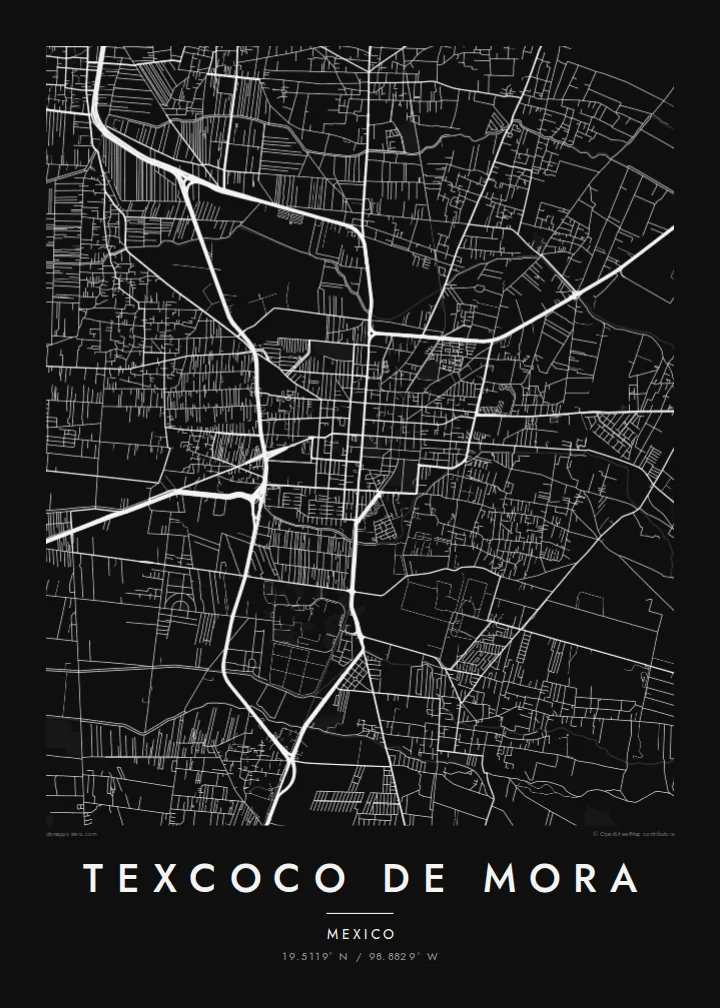
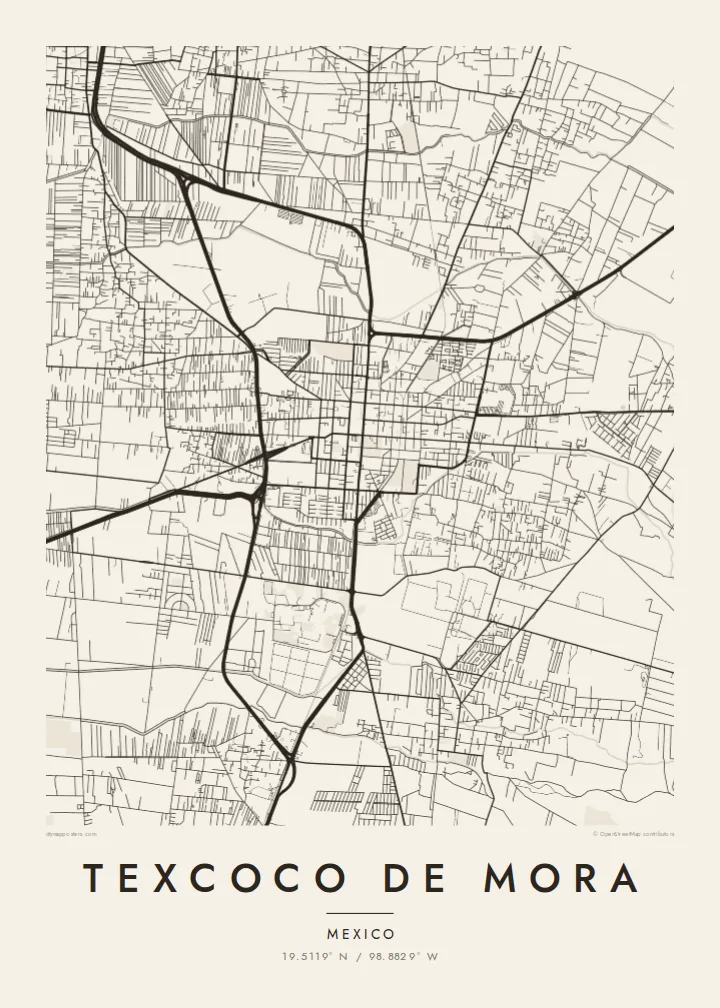
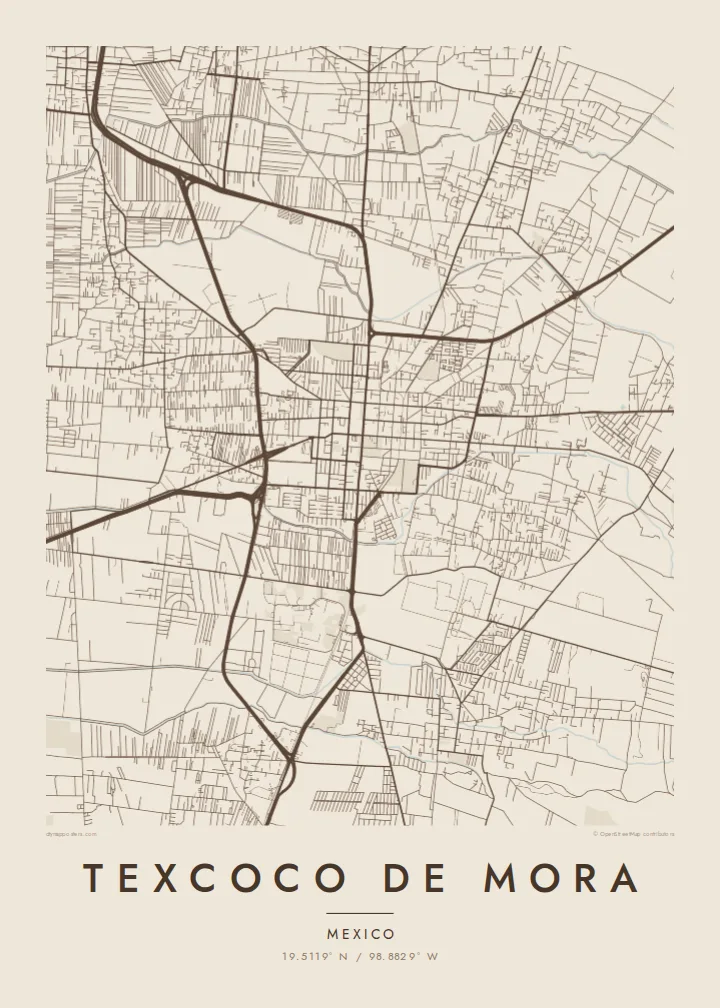
A dense colonial grid on the old eastern shore of Lake Texcoco, with the dry lakebed flat to the west and hills rising to the east.


Taone e tahi, lagona e lima
Pa'i se ata ke va'ai ai i luga o te pā. E tutusa te tau o ata uma — i lomiga, fakapipi'i i faleata, pe ko faila HD.
 Pixels mo'i · Faila lomiga 24 × 36″
Manino mo te lomiga
Ko se kupega 100% mai te faila lomiga mo'i. Poster uma — pe lomiina, fakapipi'i i faleata, pe download-ina — e fakaatagia i luga o a matou setula i te 300 DPI, e oo atu ki te 7,200 × 10,800 pixels, ina ia mautinoa e ma'ai pea auala tuai foki i luga o se lomiga 24 × 36″.
I luga o te pa


Te mape
Texcoco de Mora sits where the land starts to rise out of the Valley of Mexico. On a map the western edge is plain and open: this is the bed of the lake that once separated the town from Tenochtitlan. The town centre is a compact grid of short blocks around a main square. Past it, the streets loosen into irregular neighbourhoods that climb gently toward the Sierra Nevada foothills.
Before the Spanish conquest, Texcoco was one of the three cities of the Aztec Triple Alliance, alongside Tenochtitlan and Tlacopan. Its fifteenth-century ruler Nezahualcóyotl is still remembered as a poet and builder of waterworks. None of that shows as monumental geometry on the street plan, yet the town's position makes sense once you see the old shoreline and the long gap between it and Mexico City.
A Texcoco de Mora map poster sets the tidy colonial blocks against the looser growth around them. Highways and rail lines run out toward the capital, and the green fields of the Chapingo area lie to the south. In monochrome the drained lake reads as a quiet field of white. It frames the town the way the water once did.
West of town the street network thins into the flat bed of Lake Texcoco. That empty band on the map traces the old waterline the city grew along.
A regular grid of small blocks around the central plaza and cathedral forms the densest part of the poster. The pattern is easy to recognise from any distance.
The grounds of the agricultural university at Chapingo, known for Diego Rivera's murals, show up as a larger, more open parcel among the southern streets.
Fai mo koe
Fakaopoopo he aho, he igoa pe he upu a koe, hui te faiga, te lahi pe te tūlaga.
Ko te va'aiga e leai se totogi e maualalo tona resolution ma iai se fakailoga vai. E fakaatagia lomiga ma faila HD i te 300 DPI, e oo atu ki te 7,200 × 10,800 px, e aunoa ma se fakailoga vai.
Aiheā Texcoco de Mora
For families with roots in the eastern Valley of Mexico, or anyone drawn to its pre-Hispanic past, this map puts Texcoco back in its setting between the old lake and the mountains. It is a plain, readable portrait of a place with deep layers.
You can add your own title, subtitle and coordinates line, for example a family name or a date that matters. Choose from Classic black & white, Noir, Paper, Blueprint or Sand. The poster comes as a $9 digital download or as a printed poster, framed if you like.
Oka te poster Texcoco de Mora| Lahi o te lomiga | Manino | Faila |
|---|---|---|
| 30 × 40 cm11.8 × 15.7″ | 3,543 × 4,724 px | PNG · PDF |
| 29.7 × 42 cm (A3)11.7 × 16.5″ | 3,508 × 4,961 px | PNG · PDF |
| 42 × 59.4 cm (A2)16.5 × 23.4″ | 4,961 × 7,016 px | PNG · PDF |
| 45.7 × 61 cm18 × 24″ | 5,400 × 7,200 px | PNG · PDF |
| 50 × 70 cm19.7 × 27.6″ | 5,906 × 8,268 px | PNG · PDF |
| 61 × 91.4 cm24 × 36″ | 7,200 × 10,800 px | PNG · PDF |
Mo te fakatatau, ko te fakaakoakoga e hē totogi e 900 px te lautele, e ihi te fakailoga ma mo te lau komipiuta. Ko nā faila HD e oko ki te 8× te manino i itū taki tahi ma e lomia lelei i te lahi kātoa o te pōhita.
Filifili se ata i te pito i luga o te itulau, ona filifili lea o te Poster Lomiina — se lapoa ma, ka manako ai koe, se faleata — pe ko Faila HD Fakaonaonaina. E tasi te laasaga o te ōkaina, ma ka fakafou loa lau itulau ōkaina pe a mae'a te totogi.
E lomiina i luga o se pepa matte kaliki maualuga e 200 gsm, i se tasi o ni lapoa e ono, mai le 30 × 40 cm ki te 24 × 36″. E kamata te tau o poster lomiina mai le $39, aofia ai te uta.
Ioe. Filifili se faleata lakau malō i te lanu uli, tea, oki masani pe lakau pouli. E aumai fakatasi mo se tioata e le gagamu ma ua sauni ke tautau. E kamata te tau o poster fakapipi'i i se faleata mai le $99, aofia ai te uta.
E tuku uma te uta ki fenua e 60+. Ko te pepa takitasi e lomi e te tasi o a matou paaga lomi i fenua e 30+, ka tae mai i aso galue e 3–7. E mafai ke e maimoa ki te tulaga mo te tulitaki i lalo o Taku Fakatonuga. E lauiti nei fenua e 2–5 wiki, ka ko nei fenua e le o tuku atu ai, e fakamatala atu e te weepisi i mua o te totogi.
Auina mai se ata pikitia i loto o te 14 aso mai te taimi na oo mai ai, ka toe lomiina e matou e leai se totogi pe toe totogi atu lau tupe.
Ioe. I te mea fakasa'o i luga o lenei itulau, sui te ulutala, te ulutala lalo ma te laina fakamaoniga tulaga ki so se mea e manako ai koe, ona filifili lea o se ata ma se lapoa. Okaina lomiina, fakapipi'i i faleata, ma fakaonaonaina e fakaaogā uma i tau ata tonu.
Mo le $9 e maua e koe ni faila PNG 300 DPI ma PDF sauni-mo-lomiga i lapoa e ono uma, e aunoa ma se fakailoga vai, ke lomiina i so se mea. E le'i mautinoa? Download muamua se va'aiga fakailoga vai e leai se totogi.
