Edge of Bhuj
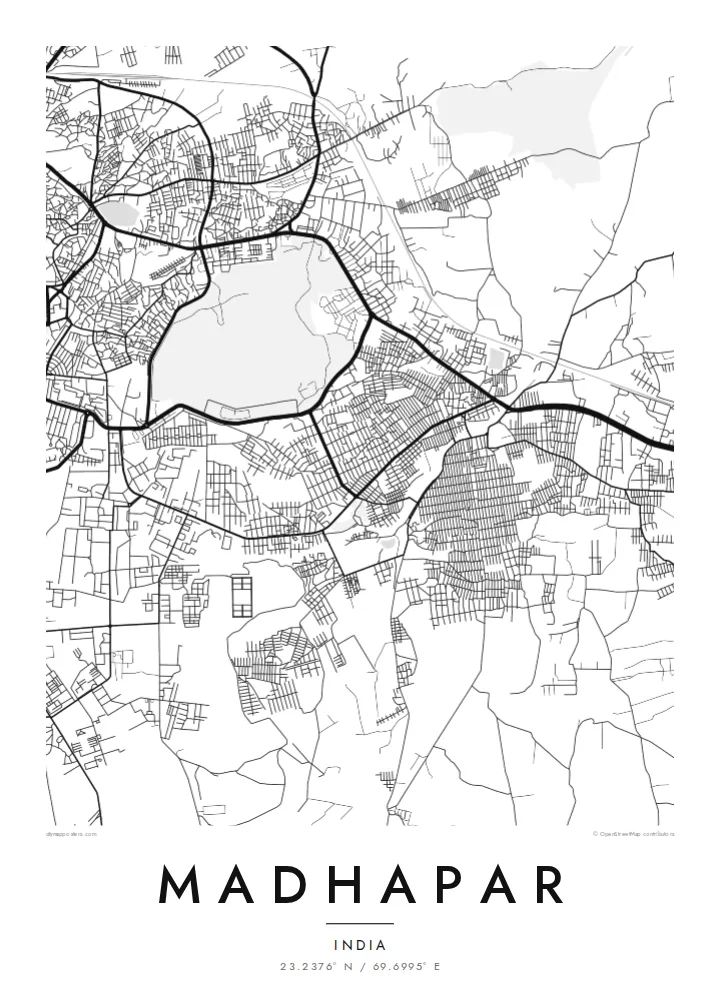
Madhapar sits right beside Bhuj. The poster shows how its streets reach toward the city while keeping their own looser pattern.
Pōsitā mape sitaila faingofua · ʻInitia
23.2376° N / 69.6995° E
A low, spreading settlement on the dry Kutch plain just outside Bhuj, with broad roads and generous open plots.


Kolo ʻe taha, ongoʻi ʻe nima
Tuki ha sitaile ke sio ai 'i ho holisi. 'Oku tatau pē 'a e totongi 'o e sitaile kotoa pē — tā pepa, fa'o, pe ko e fa'ile HD.
 Pika mo'oni · fa'ile tā 24 × 36″
Mahino ke paaki
Ko ha konga 100% eni mei he fa'ile tā mo'oni. Ko e posita kotoa pē — tā pepa, fa'o, pe download — 'oku ngaohi 'i he'emau sāvā 'i he 300 DPI, 'o a'u ki he 7,200 × 10,800 pika, koe'uhi ke mahino lelei 'a e ngaahi hala si'isi'i taha 'i ha tā 24 × 36″.
'I he pā


Ko e mape
Madhapar lies on the outskirts of Bhuj in the Kutch district of Gujarat, on the flat, dry plain of western India. From above, it reads as a loose network of roads and residential blocks that has grown gradually toward the city. Larger plots, open ground and farmland are scattered between the built-up areas instead of forming a single compact core.
The town is often described as one of the wealthiest villages in Asia, measured by bank deposits per resident. Much of that wealth comes from families who emigrated to Britain, East Africa and elsewhere while keeping close ties with home. Like much of Kutch, Madhapar was badly damaged by the 2001 earthquake, and many of its buildings date from the rebuilding that followed.
A Madhapar map poster shows a place in transition between village and suburb: road lines stretching out across the plain, clusters of houses and plenty of blank space in between. It is a quiet, open composition that suits the minimal black-and-white style and gives the town a clear, recognisable shape.
Madhapar sits right beside Bhuj. The poster shows how its streets reach toward the city while keeping their own looser pattern.
Open ground and farmland lie between the neighbourhoods. They create wide pauses on the map that contrast with the denser clusters of housing.
The land around the town is flat and dry, so the roads run long and straight across it. This gives the map a calm, horizontal rhythm.
Ke ʻaʻau pē
Tānaki ha ʻaho, ha hingoa pe ha laine ʻaʻau, pea liliu ʻa e sitaila, saisi pe tuʻunga.
Ko e sio muʻa ta'etotongi 'oku ma'ulalo hono lelei pea 'oku ai hano fakaʻilonga vai. Ko e ngaahi tā mo e fa'ile HD 'oku ngaohi 'i he 300 DPI, 'o a'u ki he 7,200 × 10,800 px, ta'e ha fakaʻilonga vai.
Ko e hā ʻa Madhapar
With so many Madhapar families spread across Britain, East Africa and beyond, a map of the home town carries real weight. It works as a gift for grandparents, a reminder for children raised abroad and a quiet link between two places.
Add a family name in the title and a date in the subtitle, and choose from five styles, including warm Sand and dark Noir. Order a matte print from one of our partners in more than 30 countries, or download the HD files for $9.
'Oda 'a e posita Madhapar| Saisi paaki | Tuʻunga mahino | Ngaahi faile |
|---|---|---|
| 30 × 40 cm (11.8 × 15.7″) | 3,543 × 4,724 px | PNG · PDF |
| 29.7 × 42 cm (A3, 11.7 × 16.5″) | 3,508 × 4,961 px | PNG · PDF |
| 42 × 59.4 cm (A2, 16.5 × 23.4″) | 4,961 × 7,016 px | PNG · PDF |
| 45.7 × 61 cm (18 × 24″) | 5,400 × 7,200 px | PNG · PDF |
| 50 × 70 cm (19.7 × 27.6″) | 5,906 × 8,268 px | PNG · PDF |
| 61 × 91.4 cm (24 × 36″) | 7,200 × 10,800 px | PNG · PDF |
Ke fakafehoanaki, ko e sio fakamuʻa taʻetotongi ʻoku fālahi ʻaki ʻa e 900 px, ʻi ai hono fakaʻilonga-vai pea ki he ngaahi screen pē. ʻOku liunga 8 hono mahino ʻo e ngaahi faile HD ʻi he tafaʻaki kotoa pea ʻoku paaki lelei ʻi he saisi kakato ʻo e pōsitā.
Fili ha sitaile 'i he tumu'aki 'o e peesi, pea fili leva ha Posita Tā — ha lahi pea, kapau 'oku ke sai'ia, ha fa'o — pe ko e ngaahi Fa'ile Digital HD. Ko e Checkout ko e sitepu pē 'e taha, pea 'e fakafo'ou leva ho'o peesi 'oda 'i he taimi 'e a'u ai 'a e totongi.
'Oku tā ia 'i ha pepa matte 200 gsm mo'oni lelei taha, 'i ha taha 'o e ngaahi lahi 'e ono, mei he 30 × 40 cm ki he 24 × 36″. 'Oku kamata 'a e ngaahi posita kuo tā 'i he {printFrom}, kuo kau ai 'a e 'ave.
'Io. Fili ha fa'o 'akau mo'oni 'i he 'uli'uli, hina, oki fakanatula pe 'akau fu'u 'uli'uli. 'Oku fakataha mai mo ha sio'ata ta'emafesi pea kuo mateuteu ke tautau. 'Oku kamata 'a e ngaahi posita kuo fa'o 'i he {framedFrom}, kuo kau ai 'a e 'ave.
'Oku ta'etotongi 'a e 'ave 'i māmani kotoa. 'Oku tā 'a e posita taki taha 'e homau kaungāfakatau tā ofi taha 'i he ngaahi fonua 'e laka hake he 30, pea 'oku a'u lelei ia 'i he 'aho ngāue 'e 3–7. 'E lava ke ke sio ki hono tu'unga mo hono 'ave 'i lalo 'i he'eku Ngaahi 'Oda.
'Ave mai ha foto kiate kimautolu 'i he lolotonga 'o e 'aho 'e 14 mei he taimi na'e a'u mai ai, pea te mau toe tā ia ta'etotongi pe toe totongi atu 'a ho'o pa'anga.
'Io. 'I he editor 'i he peesi ni, liliu 'a e kaveinga, 'a e kaveinga si'i mo e laine fakafuofua ki ha me'a pē 'oku ke sai'ia ai, pea fili ha sitaile mo ha lahi. Ko e ngaahi 'oda tā, fa'o mo digital kotoa 'oku ngāue'aki ai pē ho'o fakatātā tofu pē.
'I he totongi 'e $9 'oku ke ma'u ai 'a e ngaahi fa'ile PNG 300 DPI mo e PDF kuo mateuteu ki he tā 'i he lahi 'e ono kotoa, 'ikai ha fakaʻilonga vai, ke tā ai 'i ha feitu'u pē. Te ke kei ta'epau? Download muʻa ha sio muʻa ta'etotongi 'oku ai hano fakaʻilonga vai.
Ofi mai
