Rail corridor
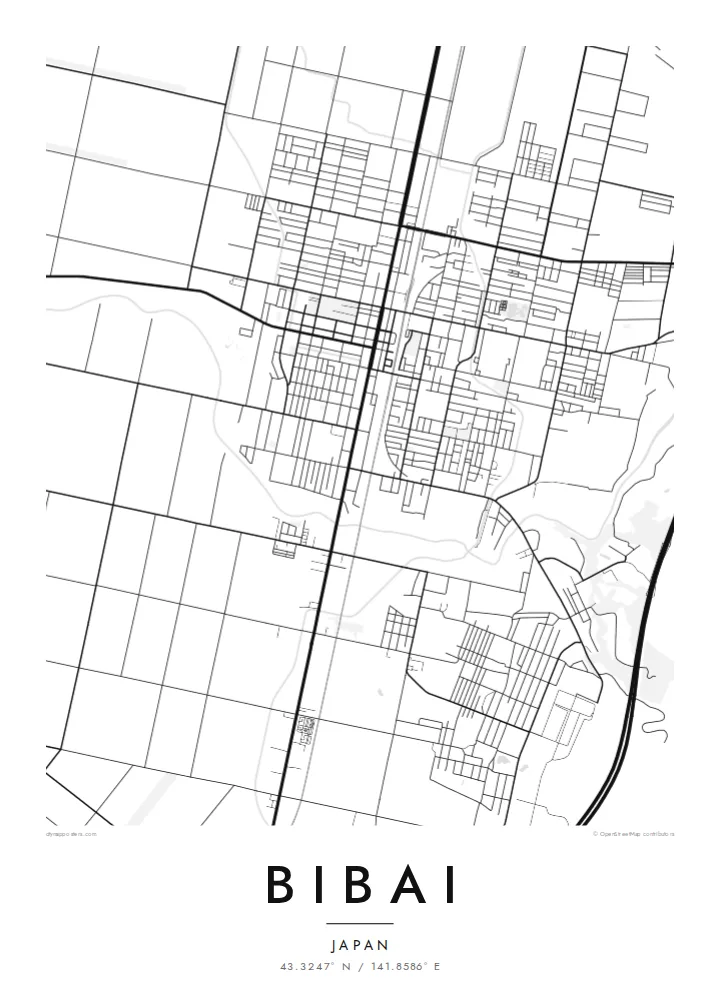
The railway and the parallel main road run through Bibai from north to south. They form the axis along which the whole city is arranged.
Pousita mape faigofie · Japan
43.3247° N / 141.8586° E
A former coal town on the Ishikari Plain, stretched along the railway between rice paddies and the wooded hills to the east.


Taone e tasi, lagona e lima
Pau te tapaki o se style ke lavea i luga i te puipui. E tutasi te tau o style takitasi — telotele mo faaki, e aunoa io me fai ki faila HD.
 Pixel tonu · faila lolomi 24 × 36″
Manino ki te lomiga
Tenei se 100% mai te faila lolomi tonu. Poster takitasi — telotele, faaki io me download — e faite i luga i a matou server i te 300 DPI, e oko atu ki 7,200 × 10,800 pixel, ko ala e maofio ei mo maiga vaega foliki i luga i te lolomi 24 × 36″.
I te pakitala


Te mape
Bibai lies in central Hokkaido, on the Ishikari Plain between Sapporo and Asahikawa. For much of the twentieth century it was a coal-mining city. The mines have since closed, and the city now depends more on farming, with rice fields covering much of the flat land to the west.
On a map Bibai forms a long, narrow band along the railway line and the main road, which run north to south through the centre. To the west the paddies make a fine, regular grid of rectangles. To the east the ground rises into forested hills, where the old mining districts once stood.
A Bibai map poster shows that division clearly: an ordered agricultural plain on one side, broken hill country on the other, and the town strung along the rail corridor in between. The city is also known for Arte Piazza Bibai, a sculpture park by Kan Yasuda set in a former school.
The railway and the parallel main road run through Bibai from north to south. They form the axis along which the whole city is arranged.
West of the centre, rice fields divide the plain into small, even rectangles, which gives the lower half of the map a delicate, textile-like pattern.
The land climbs toward wooded hills to the east. Scattered roads there trace the valleys where the mining settlements once were.
Fai ke fakatau ki a koe
Fakaopoopo se aso, se igoa io me se fuaiupu o koe, sui te sitaila, te lasi io me te tuuga.
Te preview fua e maulalo te malamalama kae iai se watermark. Poster telotele mo faila HD e faite i te 300 DPI, e oko atu ki 7,200 × 10,800 px, aunoa mo se watermark.
Kaia a Bibai
Bibai means something to families shaped by its mining years, and to anyone who has travelled the line between Sapporo and Asahikawa. The map shows how the town grew around the railway and how the plain around it has been farmed.
The title, subtitle and coordinates line can be personalised, and the map comes in Classic black & white, Noir, Paper, Blueprint or Sand. The HD files cost $9 with no watermark, or you can order a matte print with an optional wooden frame.
Otaina te poster Bibai| Lasi o te lomiga | Manino | Faila |
|---|---|---|
| 30 × 40 cm11.8 × 15.7″ | 3,543 × 4,724 px | PNG · PDF |
| 29.7 × 42 cm (A3)11.7 × 16.5″ | 3,508 × 4,961 px | PNG · PDF |
| 42 × 59.4 cm (A2)16.5 × 23.4″ | 4,961 × 7,016 px | PNG · PDF |
| 45.7 × 61 cm18 × 24″ | 5,400 × 7,200 px | PNG · PDF |
| 50 × 70 cm19.7 × 27.6″ | 5,906 × 8,268 px | PNG · PDF |
| 61 × 91.4 cm24 × 36″ | 7,200 × 10,800 px | PNG · PDF |
Ke fakatusa, a te ata fakataitai fua e 900 px te lautele, mo te fakailoga kae mo lau lavea i luga i te komipiuta. A faila HD e oko ki te 8× te manino i itu katoa kae lomi faka‵lei i te lasi katoa o te pousita.
Filifili se style i te pito i luga o te itulau, kae filifili Poster Telotele — se lasi mo se faaki manafai e manako koe — io me Faila Digital HD. E tasi te sitepu mo te checkout, kae ka fakafou te itulau o tau ota i te taimi e mafai ei te totogi.
E telotele i luga o te pepa vali gali 200 gsm i se tasi mai lasi e ono, mai te 30 × 40 cm ki te 24 × 36″. E kamata te poster telotele mai i te $39, kae aofia ei te uta.
Ioe. Filifili se faaki lakau maoli i te kulokula, tea, oak maoli io me lakau pogisa. E oo mai ki tioata e se malepe kae toka ke tautau. E kamata te poster faaki mai i te $99, kae aofia ei te uta.
E tuku fua ki fenua e 60+. A poloaiga taki tasi e ta ne te tauhaga e latalata mai i a matou tauhaga ta i fenua e 30+, kae e masani o aunoa i aso galue e 3–7. E mafai o salasala te tulaga mo te sukesuke i lalo o Aku poloaiga. I nisi fenua e 2–5 vaiaso, kae i mea e seki tuku atu ei matou, e fakailoa atu e te mea tafaoga i mua o te totogi.
Auina mai se ata i loto i te 14 aso mai te taimi e oko ei kae ka toe telotele fua ne matou io me toe totogi atu tau tupe.
Ioe. I te editor i te itulau tenei, sui te ulutala, te ulutala lalo mo te laina o coordinate ki so se mea e manako koe, kae filifili se style mo se lasi. Oga telotele, faaki mo digital e faigana katoa i tau tusiga tonu.
Mo te $9 ka maua ne koe faila PNG 300 DPI mo PDF fakatoka lolomi i lasi e ono katoa, aunoa mo se watermark, ke lolomi i so se koga. E se mautinoa koe? Download muamua se preview fua e iai te watermark.
