Mennonite campos
Numbered farm villages laid out along straight roads, each a line of farmsteads with long fields behind. They repeat across the plain in a strikingly regular pattern.
Pousita mape faigofie · Mexico
28.4063° N / 106.8667° W
A high-plains city in Chihuahua, ringed by apple orchards and the long ruled fields of the Mennonite farm colonies.


Taone e tasi, lagona e lima
Pau te tapaki o se style ke lavea i luga i te puipui. E tutasi te tau o style takitasi — telotele mo faaki, e aunoa io me fai ki faila HD.
 Pixel tonu · faila lolomi 24 × 36″
Manino ki te lomiga
Tenei se 100% mai te faila lolomi tonu. Poster takitasi — telotele, faaki io me download — e faite i luga i a matou server i te 300 DPI, e oko atu ki 7,200 × 10,800 pixel, ko ala e maofio ei mo maiga vaega foliki i luga i te lolomi 24 × 36″.
I te pakitala


Te mape
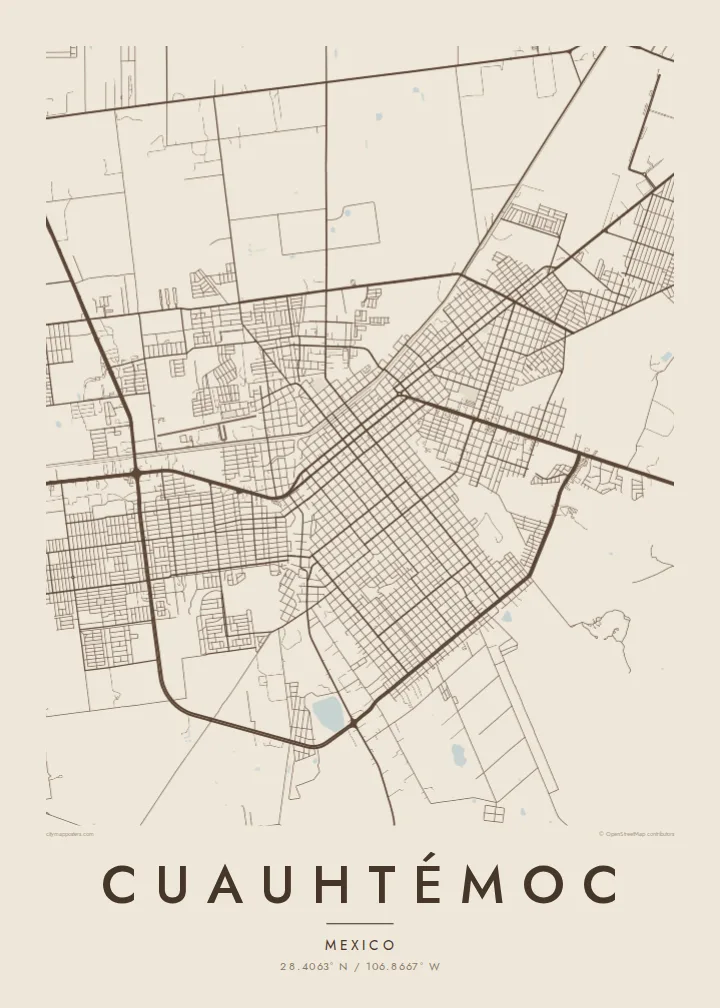
Cuauhtémoc stands in a broad valley in the high country of western Chihuahua, at the edge of the Sierra Madre Occidental. The city itself is a mostly rectilinear grid spreading from a central core, with a railway line and highways running through it. Beyond its edges the landscape turns into one of the most distinctive farm patterns in Mexico.
In the early 1920s Mennonite families arrived from Canada and settled the lands around the town. They organised them into numbered farming villages called campos. Seen from above, these are long straight roads lined with farmsteads, set in orderly strips of fields. The highway leading out of the city toward the campos, known as the Mennonite commercial corridor, is lined with their shops and workshops.
The valley is one of Mexico's most important apple-growing areas, and orchards appear as finely dotted blocks across the valley floor. A Cuauhtémoc map poster brings these layers together. It shows the city grid, the rail line, and the surrounding pattern of villages and orchards that makes this corner of Chihuahua recognisable on any map.
Numbered farm villages laid out along straight roads, each a line of farmsteads with long fields behind. They repeat across the plain in a strikingly regular pattern.
A long stretch of highway outside the city lined with Mennonite-run businesses and workshops. It forms a single strong line connecting the town to the campos around it.
The Chihuahua al Pacífico railway crosses the city on its way toward the Copper Canyon region, a clean line cutting across the street grid.
Fai ke fakatau ki a koe
Fakaopoopo se aso, se igoa io me se fuaiupu o koe, sui te sitaila, te lasi io me te tuuga.
Te preview fua e maulalo te malamalama kae iai se watermark. Poster telotele mo faila HD e faite i te 300 DPI, e oko atu ki 7,200 × 10,800 px, aunoa mo se watermark.
Kaia a Cuauhtémoc
This map has an unusual story in its lines, with a Mexican city and a century-old farming colony side by side. It makes a thoughtful gift for families from the region, with a surname, a campo number or an anniversary written into the title.
Pick Sand for the dry high-plains palette, Blueprint to emphasise the grid, or Classic, Noir or Paper. The digital download costs $9 and includes six print sizes without a watermark. You can also order a matte poster with an optional wooden frame.
Otaina te poster Cuauhtémoc| Lasi o te lomiga | Manino | Faila |
|---|---|---|
| 30 × 40 cm11.8 × 15.7″ | 3,543 × 4,724 px | PNG · PDF |
| 29.7 × 42 cm (A3)11.7 × 16.5″ | 3,508 × 4,961 px | PNG · PDF |
| 42 × 59.4 cm (A2)16.5 × 23.4″ | 4,961 × 7,016 px | PNG · PDF |
| 45.7 × 61 cm18 × 24″ | 5,400 × 7,200 px | PNG · PDF |
| 50 × 70 cm19.7 × 27.6″ | 5,906 × 8,268 px | PNG · PDF |
| 61 × 91.4 cm24 × 36″ | 7,200 × 10,800 px | PNG · PDF |
Ke fakatusa, a te ata fakataitai fua e 900 px te lautele, mo te fakailoga kae mo lau lavea i luga i te komipiuta. A faila HD e oko ki te 8× te manino i itu katoa kae lomi faka‵lei i te lasi katoa o te pousita.
Filifili se style i te pito i luga o te itulau, kae filifili Poster Telotele — se lasi mo se faaki manafai e manako koe — io me Faila Digital HD. E tasi te sitepu mo te checkout, kae ka fakafou te itulau o tau ota i te taimi e mafai ei te totogi.
E telotele i luga o te pepa vali gali 200 gsm i se tasi mai lasi e ono, mai te 30 × 40 cm ki te 24 × 36″. E kamata te poster telotele mai i te $39, kae aofia ei te uta.
Ioe. Filifili se faaki lakau maoli i te kulokula, tea, oak maoli io me lakau pogisa. E oo mai ki tioata e se malepe kae toka ke tautau. E kamata te poster faaki mai i te $99, kae aofia ei te uta.
E tuku fua ki fenua e 60+. A poloaiga taki tasi e ta ne te tauhaga e latalata mai i a matou tauhaga ta i fenua e 30+, kae e masani o aunoa i aso galue e 3–7. E mafai o salasala te tulaga mo te sukesuke i lalo o Aku poloaiga. I nisi fenua e 2–5 vaiaso, kae i mea e seki tuku atu ei matou, e fakailoa atu e te mea tafaoga i mua o te totogi.
Auina mai se ata i loto i te 14 aso mai te taimi e oko ei kae ka toe telotele fua ne matou io me toe totogi atu tau tupe.
Ioe. I te editor i te itulau tenei, sui te ulutala, te ulutala lalo mo te laina o coordinate ki so se mea e manako koe, kae filifili se style mo se lasi. Oga telotele, faaki mo digital e faigana katoa i tau tusiga tonu.
Mo te $9 ka maua ne koe faila PNG 300 DPI mo PDF fakatoka lolomi i lasi e ono katoa, aunoa mo se watermark, ke lolomi i so se koga. E se mautinoa koe? Download muamua se preview fua e iai te watermark.
