Two-part city plan
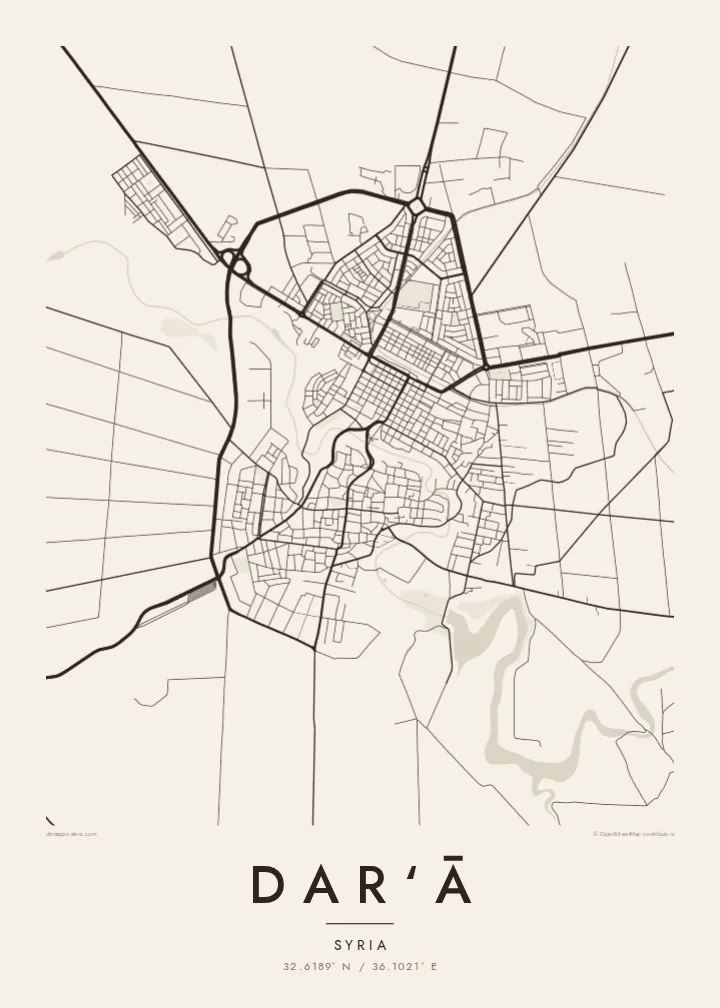
The old town and the station district sit on either side of a valley. Each has a distinct street pattern, so the map reads as two linked but separate places.
Pousita mape faigofie · Syria
32.6189° N / 36.1021° E
A Hauran city of two halves, the old town and the station quarter, divided by a valley near the Jordanian border




Taone e tasi, lagona e lima
Pau te tapaki o se style ke lavea i luga i te puipui. E tutasi te tau o style takitasi — telotele mo faaki, e aunoa io me fai ki faila HD.
 Pixel tonu · faila lolomi 24 × 36″
Manino ki te lomiga
Tenei se 100% mai te faila lolomi tonu. Poster takitasi — telotele, faaki io me download — e faite i luga i a matou server i te 300 DPI, e oko atu ki 7,200 × 10,800 pixel, ko ala e maofio ei mo maiga vaega foliki i luga i te lolomi 24 × 36″.
I te pakitala


Te mape
Dar‘ā stands on the basalt plain of the Hauran in southern Syria, a short distance from the border with Jordan. From above, the city clearly splits into two parts. Daraa al-Balad, the old town, lies on one side. Daraa al-Mahatta, the newer district that grew up around the railway station, lies on the other. Between them runs a valley that separates the two street patterns.
The site is ancient and is generally identified with biblical Edrei. The old town has the tighter, irregular lanes of a long-settled place, centred on its historic Omari Mosque. The station quarter owes its origin to the Hejaz Railway in the early twentieth century, and its streets are straighter, wider and more regular. Around both halves, open farmland of the Hauran stretches in every direction.
A Dar‘ā map poster makes this double structure its subject. Two street patterns face each other across the valley: one organic and dense, the other planned and open. Main roads to Damascus and the border cross the plain toward the edges of the sheet. In black and white, the composition is clear and balanced, a portrait of a city defined by its crossroads position.
The old town and the station district sit on either side of a valley. Each has a distinct street pattern, so the map reads as two linked but separate places.
The historic quarter keeps its dense, irregular lanes around the Omari Mosque. It is the most intricate and closely drawn part of the poster.
Daraa al-Mahatta grew around the Hejaz Railway station. Its straighter, more regular streets contrast with the older town across the valley.
Fai ke fakatau ki a koe
Fakaopoopo se aso, se igoa io me se fuaiupu o koe, sui te sitaila, te lasi io me te tuuga.
Te preview fua e maulalo te malamalama kae iai se watermark. Poster telotele mo faila HD e faite i te 300 DPI, e oko atu ki 7,200 × 10,800 px, aunoa mo se watermark.
Kaia a Dar‘ā
For people from Dar‘ā, many of them now living far away, a map of both halves of the city keeps home present on the wall. The clear two-part structure also makes a strong graphic image in its own right. It is a considered piece for a living room or study.
The title, subtitle and coordinates line are all editable, whether you want an Arabic or English name, a neighbourhood or a date. Five styles are available: Classic black & white, Noir, Paper, Blueprint and Sand. Order HD files for $9 or a printed poster with an optional wooden frame.
Otaina te poster Dar‘ā| Lasi o te lomiga | Manino | Faila |
|---|---|---|
| 30 × 40 cm11.8 × 15.7″ | 3,543 × 4,724 px | PNG · PDF |
| 29.7 × 42 cm (A3)11.7 × 16.5″ | 3,508 × 4,961 px | PNG · PDF |
| 42 × 59.4 cm (A2)16.5 × 23.4″ | 4,961 × 7,016 px | PNG · PDF |
| 45.7 × 61 cm18 × 24″ | 5,400 × 7,200 px | PNG · PDF |
| 50 × 70 cm19.7 × 27.6″ | 5,906 × 8,268 px | PNG · PDF |
| 61 × 91.4 cm24 × 36″ | 7,200 × 10,800 px | PNG · PDF |
Ke fakatusa, a te ata fakataitai fua e 900 px te lautele, mo te fakailoga kae mo lau lavea i luga i te komipiuta. A faila HD e oko ki te 8× te manino i itu katoa kae lomi faka‵lei i te lasi katoa o te pousita.
Filifili se style i te pito i luga o te itulau, kae filifili Poster Telotele — se lasi mo se faaki manafai e manako koe — io me Faila Digital HD. E tasi te sitepu mo te checkout, kae ka fakafou te itulau o tau ota i te taimi e mafai ei te totogi.
E telotele i luga o te pepa vali gali 200 gsm i se tasi mai lasi e ono, mai te 30 × 40 cm ki te 24 × 36″. E kamata te poster telotele mai i te $39, kae aofia ei te uta.
Ioe. Filifili se faaki lakau maoli i te kulokula, tea, oak maoli io me lakau pogisa. E oo mai ki tioata e se malepe kae toka ke tautau. E kamata te poster faaki mai i te $99, kae aofia ei te uta.
E tuku fua ki fenua e 60+. A poloaiga taki tasi e ta ne te tauhaga e latalata mai i a matou tauhaga ta i fenua e 30+, kae e masani o aunoa i aso galue e 3–7. E mafai o salasala te tulaga mo te sukesuke i lalo o Aku poloaiga. I nisi fenua e 2–5 vaiaso, kae i mea e seki tuku atu ei matou, e fakailoa atu e te mea tafaoga i mua o te totogi.
Auina mai se ata i loto i te 14 aso mai te taimi e oko ei kae ka toe telotele fua ne matou io me toe totogi atu tau tupe.
Ioe. I te editor i te itulau tenei, sui te ulutala, te ulutala lalo mo te laina o coordinate ki so se mea e manako koe, kae filifili se style mo se lasi. Oga telotele, faaki mo digital e faigana katoa i tau tusiga tonu.
Mo te $9 ka maua ne koe faila PNG 300 DPI mo PDF fakatoka lolomi i lasi e ono katoa, aunoa mo se watermark, ke lolomi i so se koga. E se mautinoa koe? Download muamua se preview fua e iai te watermark.
