The Neisse border
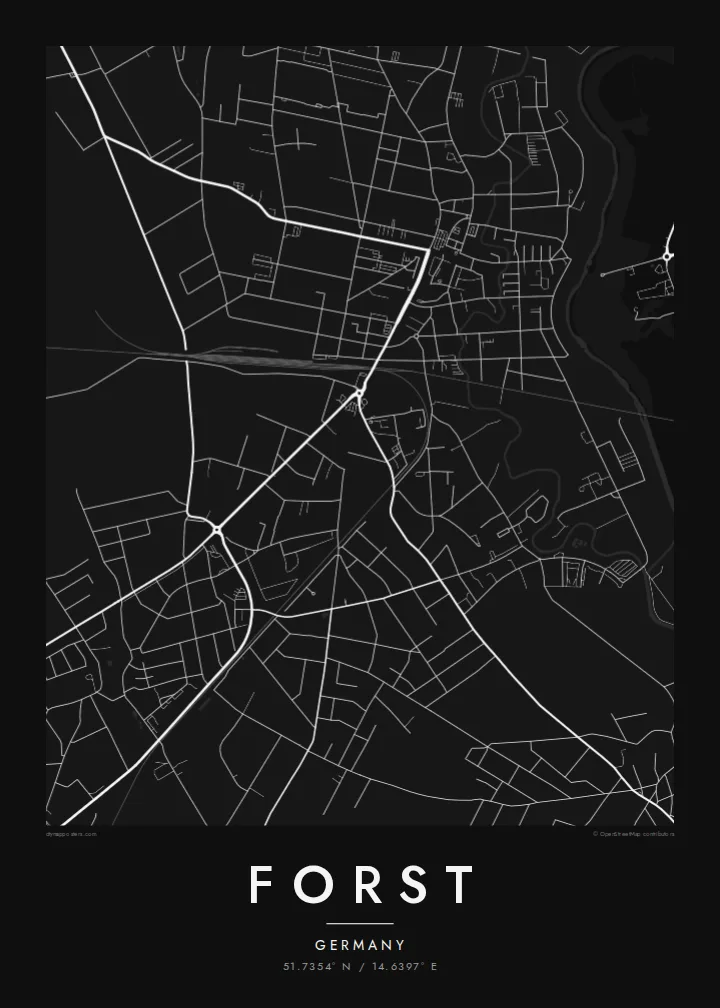
The Lusatian Neisse forms the eastern edge of the town and the frontier with Poland. It gives the map one strong vertical line, with the bridges crossing it clearly marked.
Pousita mape faigofie · Germany
51.7354° N / 14.6397° E
A textile town pressed against the Neisse, its streets stopping at the river that marks the Polish border



Taone e tasi, lagona e lima
Pau te tapaki o se style ke lavea i luga i te puipui. E tutasi te tau o style takitasi — telotele mo faaki, e aunoa io me fai ki faila HD.
 Pixel tonu · faila lolomi 24 × 36″
Manino ki te lomiga
Tenei se 100% mai te faila lolomi tonu. Poster takitasi — telotele, faaki io me download — e faite i luga i a matou server i te 300 DPI, e oko atu ki 7,200 × 10,800 pixel, ko ala e maofio ei mo maiga vaega foliki i luga i te lolomi 24 × 36″.
I te pakitala


Te mape
Forst sits in Lower Lusatia on the west bank of the Lusatian Neisse. From above the river is the town's most defined edge: it runs north to south along the eastern side, and across the water lies Poland. The streets fan out westward from the river in a loose, uneven layout. That layout owes more to a century of industrial growth than to any one plan, and the river keeps the whole map oriented.
For much of the nineteenth and early twentieth centuries Forst was a centre of cloth production, known then as a German Manchester. The mills needed rail sidings, long factory plots and workers' housing close by, and that industrial past still shows in the size of the blocks. Some districts have large, regular parcels. Others are tighter, where terraced housing filled the space between works.
The town's best-known green space is the East German Rose Garden, laid out near the river in the early twentieth century and still one of the larger rose gardens in the country. On a Forst map poster it appears as a patch of curving paths set against the straighter streets around it. The eye tends to settle there, between the town's grid and the river.
The Lusatian Neisse forms the eastern edge of the town and the frontier with Poland. It gives the map one strong vertical line, with the bridges crossing it clearly marked.
The East German Rose Garden adds a cluster of curved walks and beds near the river, a softer pattern than the streets and industrial plots that surround it.
Large parcels left by the cloth industry sit beside denser housing streets. The result is a clear contrast in scale across the town that works well in black and white.
Fai ke fakatau ki a koe
Fakaopoopo se aso, se igoa io me se fuaiupu o koe, sui te sitaila, te lasi io me te tuuga.
Te preview fua e maulalo te malamalama kae iai se watermark. Poster telotele mo faila HD e faite i te 300 DPI, e oko atu ki 7,200 × 10,800 px, aunoa mo se watermark.
Kaia a Forst
People from Forst often want a map that shows how close the town and the border are, with the river running right past the old streets. It also suits anyone with family ties to Lusatia's textile past, or to both sides of the Neisse.
Add a title, a family name or a meaningful date, and choose from Classic black & white, Noir, Paper, Blueprint or Sand. The digital files cost $9 and cover six print sizes. Printed posters on matte paper, with an optional wooden frame, ship from partners in more than 30 countries.
Otaina te poster Forst| Lasi o te lomiga | Manino | Faila |
|---|---|---|
| 30 × 40 cm (11.8 × 15.7″) | 3,543 × 4,724 px | PNG · PDF |
| 29.7 × 42 cm (A3, 11.7 × 16.5″) | 3,508 × 4,961 px | PNG · PDF |
| 42 × 59.4 cm (A2, 16.5 × 23.4″) | 4,961 × 7,016 px | PNG · PDF |
| 45.7 × 61 cm (18 × 24″) | 5,400 × 7,200 px | PNG · PDF |
| 50 × 70 cm (19.7 × 27.6″) | 5,906 × 8,268 px | PNG · PDF |
| 61 × 91.4 cm (24 × 36″) | 7,200 × 10,800 px | PNG · PDF |
Ke fakatusa, a te ata fakataitai fua e 900 px te lautele, mo te fakailoga kae mo lau lavea i luga i te komipiuta. A faila HD e oko ki te 8× te manino i itu katoa kae lomi faka‵lei i te lasi katoa o te pousita.
Filifili se style i te pito i luga o te itulau, kae filifili Poster Telotele — se lasi mo se faaki manafai e manako koe — io me Faila Digital HD. E tasi te sitepu mo te checkout, kae ka fakafou te itulau o tau ota i te taimi e mafai ei te totogi.
E telotele i luga o te pepa vali gali 200 gsm i se tasi mai lasi e ono, mai te 30 × 40 cm ki te 24 × 36″. E kamata te poster telotele mai i te $39, kae aofia ei te uta.
Ioe. Filifili se faaki lakau maoli i te kulokula, tea, oak maoli io me lakau pogisa. E oo mai ki tioata e se malepe kae toka ke tautau. E kamata te poster faaki mai i te $99, kae aofia ei te uta.
E saoloto te ave atu i te lalolagi katoa. Ko poster taki tasi e ta ne te taugasoa ta e ofi mai i fenua e 30+, kae e masani o oko atu i aso galue e 3–7. E mafai o mata ki te tulaga mo te sukesuke i lalo o Aku Poloaiga. E isi fenua e 2–5 vaiaso, kae i mea e seki ave atu ki ei, e fakailoa atu ne te saite i mua o te totogi.
Auina mai se ata i loto i te 14 aso mai te taimi e oko ei kae ka toe telotele fua ne matou io me toe totogi atu tau tupe.
Ioe. I te editor i te itulau tenei, sui te ulutala, te ulutala lalo mo te laina o coordinate ki so se mea e manako koe, kae filifili se style mo se lasi. Oga telotele, faaki mo digital e faigana katoa i tau tusiga tonu.
Mo te $9 ka maua ne koe faila PNG 300 DPI mo PDF fakatoka lolomi i lasi e ono katoa, aunoa mo se watermark, ke lolomi i so se koga. E se mautinoa koe? Download muamua se preview fua e iai te watermark.
