Regular street grid
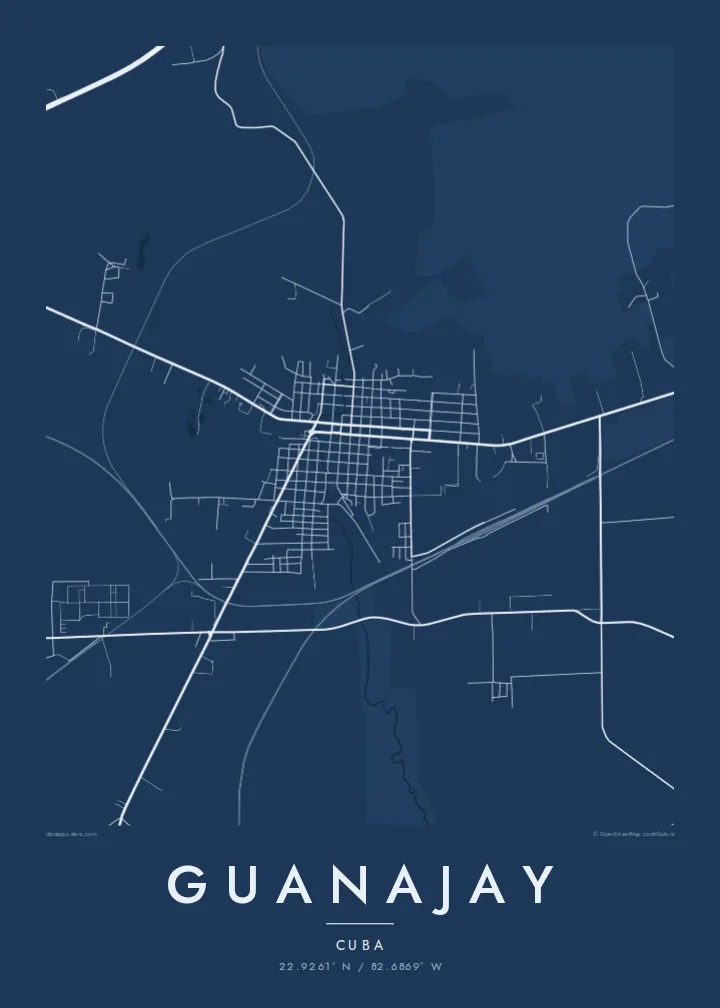
The core of town is made of evenly spaced streets crossing at close to right angles, producing a steady rhythm of small rectangular blocks that reads clearly even at the smallest print size.
Pousita mape faigofie · Cuba
22.9261° N / 82.6869° W
A compact inland grid in western Cuba, its regular blocks fading into the farmland of Artemisa province.



Taone e tasi, lagona e lima
Pau te tapaki o se style ke lavea i luga i te puipui. E tutasi te tau o style takitasi — telotele mo faaki, e aunoa io me fai ki faila HD.
 Pixel tonu · faila lolomi 24 × 36″
Manino ki te lomiga
Tenei se 100% mai te faila lolomi tonu. Poster takitasi — telotele, faaki io me download — e faite i luga i a matou server i te 300 DPI, e oko atu ki 7,200 × 10,800 pixel, ko ala e maofio ei mo maiga vaega foliki i luga i te lolomi 24 × 36″.
I te pakitala


Te mape
Guanajay lies inland in Artemisa, the province west of Havana, on gently rolling agricultural land between the capital and the hills further west. Seen from above it is a modest, orderly town: streets laid out in a largely regular pattern, blocks of similar size, and a clear edge where the built area gives way to fields and to the roads leading out toward neighbouring towns.
Like many Cuban towns of Spanish colonial origin, its layout follows the familiar logic of the grid, with the main streets carrying traffic from the centre out into the countryside. The land around it has long been farmed, and the province itself is young: Artemisa was created in 2011, when the former Havana province was divided in two.
A Guanajay map poster is a study in restraint. There are no dramatic coastlines or rivers to carry the composition, so the pattern of blocks does the work, and the way the grid loosens at the outskirts gives the image a soft, natural border. It suits anyone who prefers a quiet, balanced print to a busy one.
The core of town is made of evenly spaced streets crossing at close to right angles, producing a steady rhythm of small rectangular blocks that reads clearly even at the smallest print size.
Several roads leave the centre and head out across the flat surroundings, drawing thin lines toward the neighbouring towns of Artemisa and giving the composition a sense of direction.
Instead of a hard boundary, the built area thins gradually into farmland, so the map ends in a scatter of lanes and tracks rather than a sharp outline.
Fai ke fakatau ki a koe
Fakaopoopo se aso, se igoa io me se fuaiupu o koe, sui te sitaila, te lasi io me te tuuga.
Te preview fua e maulalo te malamalama kae iai se watermark. Poster telotele mo faila HD e faite i te 300 DPI, e oko atu ki 7,200 × 10,800 px, aunoa mo se watermark.
Kaia a Guanajay
For families with roots in Guanajay, or anyone who has spent time in this part of western Cuba, the map is a way to keep the shape of home on the wall. The town is modest in scale, which makes it an intimate subject for a print.
Add a personal title, a subtitle such as a surname or a year, and the coordinates line, then pick one of five styles; Sand and Paper feel especially warm here. The HD files cost $9 and come as a 300 DPI PNG and a print-ready PDF in six sizes.
Otaina te poster Guanajay| Lasi o te lomiga | Manino | Faila |
|---|---|---|
| 30 × 40 cm11.8 × 15.7″ | 3,543 × 4,724 px | PNG · PDF |
| 29.7 × 42 cm (A3)11.7 × 16.5″ | 3,508 × 4,961 px | PNG · PDF |
| 42 × 59.4 cm (A2)16.5 × 23.4″ | 4,961 × 7,016 px | PNG · PDF |
| 45.7 × 61 cm18 × 24″ | 5,400 × 7,200 px | PNG · PDF |
| 50 × 70 cm19.7 × 27.6″ | 5,906 × 8,268 px | PNG · PDF |
| 61 × 91.4 cm24 × 36″ | 7,200 × 10,800 px | PNG · PDF |
Ke fakatusa, a te ata fakataitai fua e 900 px te lautele, mo te fakailoga kae mo lau lavea i luga i te komipiuta. A faila HD e oko ki te 8× te manino i itu katoa kae lomi faka‵lei i te lasi katoa o te pousita.
Filifili se style i te pito i luga o te itulau, kae filifili Poster Telotele — se lasi mo se faaki manafai e manako koe — io me Faila Digital HD. E tasi te sitepu mo te checkout, kae ka fakafou te itulau o tau ota i te taimi e mafai ei te totogi.
E telotele i luga o te pepa vali gali 200 gsm i se tasi mai lasi e ono, mai te 30 × 40 cm ki te 24 × 36″. E kamata te poster telotele mai i te $39, kae aofia ei te uta.
Ioe. Filifili se faaki lakau maoli i te kulokula, tea, oak maoli io me lakau pogisa. E oo mai ki tioata e se malepe kae toka ke tautau. E kamata te poster faaki mai i te $99, kae aofia ei te uta.
E tuku fua ki fenua e 60+. A poloaiga taki tasi e ta ne te tauhaga e latalata mai i a matou tauhaga ta i fenua e 30+, kae e masani o aunoa i aso galue e 3–7. E mafai o salasala te tulaga mo te sukesuke i lalo o Aku poloaiga. I nisi fenua e 2–5 vaiaso, kae i mea e seki tuku atu ei matou, e fakailoa atu e te mea tafaoga i mua o te totogi.
Auina mai se ata i loto i te 14 aso mai te taimi e oko ei kae ka toe telotele fua ne matou io me toe totogi atu tau tupe.
Ioe. I te editor i te itulau tenei, sui te ulutala, te ulutala lalo mo te laina o coordinate ki so se mea e manako koe, kae filifili se style mo se lasi. Oga telotele, faaki mo digital e faigana katoa i tau tusiga tonu.
Mo te $9 ka maua ne koe faila PNG 300 DPI mo PDF fakatoka lolomi i lasi e ono katoa, aunoa mo se watermark, ke lolomi i so se koga. E se mautinoa koe? Download muamua se preview fua e iai te watermark.
Koga pili
