Village clusters
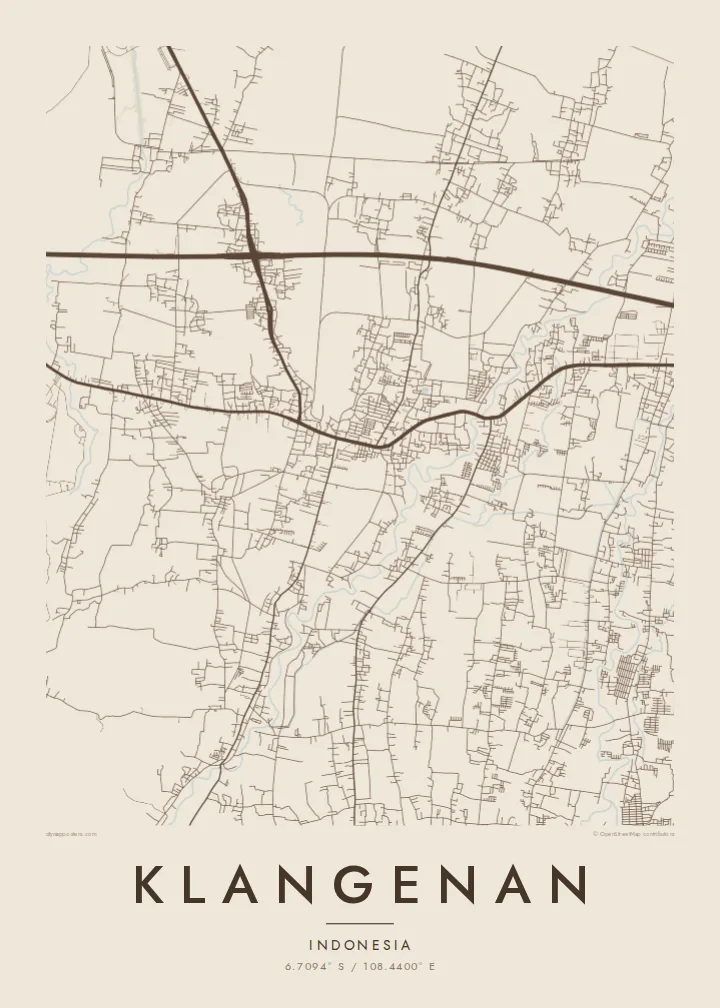
Homes gather in compact groups along the roads, with wide stretches of farmland between them. On the poster these form a steady rhythm of dark patches and pale space.
Pousita mape faigofie · Indonesia
6.7094° S / 108.4400° E
A low, level corner of the Cirebon plain, where village roads, irrigation lines and rice fields form a quiet, open pattern.


Taone e tasi, lagona e lima
Pau te tapaki o se style ke lavea i luga i te puipui. E tutasi te tau o style takitasi — telotele mo faaki, e aunoa io me fai ki faila HD.
 Pixel tonu · faila lolomi 24 × 36″
Manino ki te lomiga
Tenei se 100% mai te faila lolomi tonu. Poster takitasi — telotele, faaki io me download — e faite i luga i a matou server i te 300 DPI, e oko atu ki 7,200 × 10,800 pixel, ko ala e maofio ei mo maiga vaega foliki i luga i te lolomi 24 × 36″.
I te pakitala


Te mape
Klangenan lies in the regency of Cirebon, on the northern lowlands of West Java, a short distance inland from the Java Sea coast. From above it looks less like a single town than a loose network of villages strung along roads. Houses cluster tightly beside the lanes, and farmland spreads between the villages in broad, even blocks.
The land here is almost level, so the map is shaped by water and movement rather than by hills. Irrigation channels and small streams run in long lines across the fields, and the main roads lead east toward the city of Cirebon. The result is a drawing of fine threads and scattered clusters, with more open land than built-up space.
That openness is what makes a Klangenan map poster work so well in black and white. Settlements appear as dense grey patches, field boundaries as faint geometry, and the roads as the firm strokes that hold everything together. It is a portrait of ordinary rural Java, the kind of place that rarely appears on a wall but means a great deal to the people from it.
Homes gather in compact groups along the roads, with wide stretches of farmland between them. On the poster these form a steady rhythm of dark patches and pale space.
Channels and streams cross the lowland in long, straight lines. On a monochrome map they become some of the most graceful marks on the sheet.
The main routes run east toward Cirebon and across the coastal plain. They give the composition a clear direction and tie the scattered villages into one picture.
Fai ke fakatau ki a koe
Fakaopoopo se aso, se igoa io me se fuaiupu o koe, sui te sitaila, te lasi io me te tuuga.
Te preview fua e maulalo te malamalama kae iai se watermark. Poster telotele mo faila HD e faite i te 300 DPI, e oko atu ki 7,200 × 10,800 px, aunoa mo se watermark.
Kaia a Klangenan
For anyone who grew up in Klangenan or has family there, this map holds the familiar route between home, fields and market. It is a modest, honest view of a place that larger atlases tend to pass over, drawn with the same care as any capital.
Put the name of your village, a family surname or a meaningful date in the title and subtitle, and adjust the coordinates line. Then choose Classic black & white, Noir, Paper, Blueprint or Sand to suit the room where it will hang.
Otaina te poster Klangenan| Lasi o te lomiga | Manino | Faila |
|---|---|---|
| 30 × 40 cm11.8 × 15.7″ | 3,543 × 4,724 px | PNG · PDF |
| 29.7 × 42 cm (A3)11.7 × 16.5″ | 3,508 × 4,961 px | PNG · PDF |
| 42 × 59.4 cm (A2)16.5 × 23.4″ | 4,961 × 7,016 px | PNG · PDF |
| 45.7 × 61 cm18 × 24″ | 5,400 × 7,200 px | PNG · PDF |
| 50 × 70 cm19.7 × 27.6″ | 5,906 × 8,268 px | PNG · PDF |
| 61 × 91.4 cm24 × 36″ | 7,200 × 10,800 px | PNG · PDF |
Ke fakatusa, a te ata fakataitai fua e 900 px te lautele, mo te fakailoga kae mo lau lavea i luga i te komipiuta. A faila HD e oko ki te 8× te manino i itu katoa kae lomi faka‵lei i te lasi katoa o te pousita.
Filifili se style i te pito i luga o te itulau, kae filifili Poster Telotele — se lasi mo se faaki manafai e manako koe — io me Faila Digital HD. E tasi te sitepu mo te checkout, kae ka fakafou te itulau o tau ota i te taimi e mafai ei te totogi.
E telotele i luga o te pepa vali gali 200 gsm i se tasi mai lasi e ono, mai te 30 × 40 cm ki te 24 × 36″. E kamata te poster telotele mai i te $39, kae aofia ei te uta.
Ioe. Filifili se faaki lakau maoli i te kulokula, tea, oak maoli io me lakau pogisa. E oo mai ki tioata e se malepe kae toka ke tautau. E kamata te poster faaki mai i te $99, kae aofia ei te uta.
E tuku fua ki fenua e 60+. A poloaiga taki tasi e ta ne te tauhaga e latalata mai i a matou tauhaga ta i fenua e 30+, kae e masani o aunoa i aso galue e 3–7. E mafai o salasala te tulaga mo te sukesuke i lalo o Aku poloaiga. I nisi fenua e 2–5 vaiaso, kae i mea e seki tuku atu ei matou, e fakailoa atu e te mea tafaoga i mua o te totogi.
Auina mai se ata i loto i te 14 aso mai te taimi e oko ei kae ka toe telotele fua ne matou io me toe totogi atu tau tupe.
Ioe. I te editor i te itulau tenei, sui te ulutala, te ulutala lalo mo te laina o coordinate ki so se mea e manako koe, kae filifili se style mo se lasi. Oga telotele, faaki mo digital e faigana katoa i tau tusiga tonu.
Mo te $9 ka maua ne koe faila PNG 300 DPI mo PDF fakatoka lolomi i lasi e ono katoa, aunoa mo se watermark, ke lolomi i so se koga. E se mautinoa koe? Download muamua se preview fua e iai te watermark.
