Compact town centre
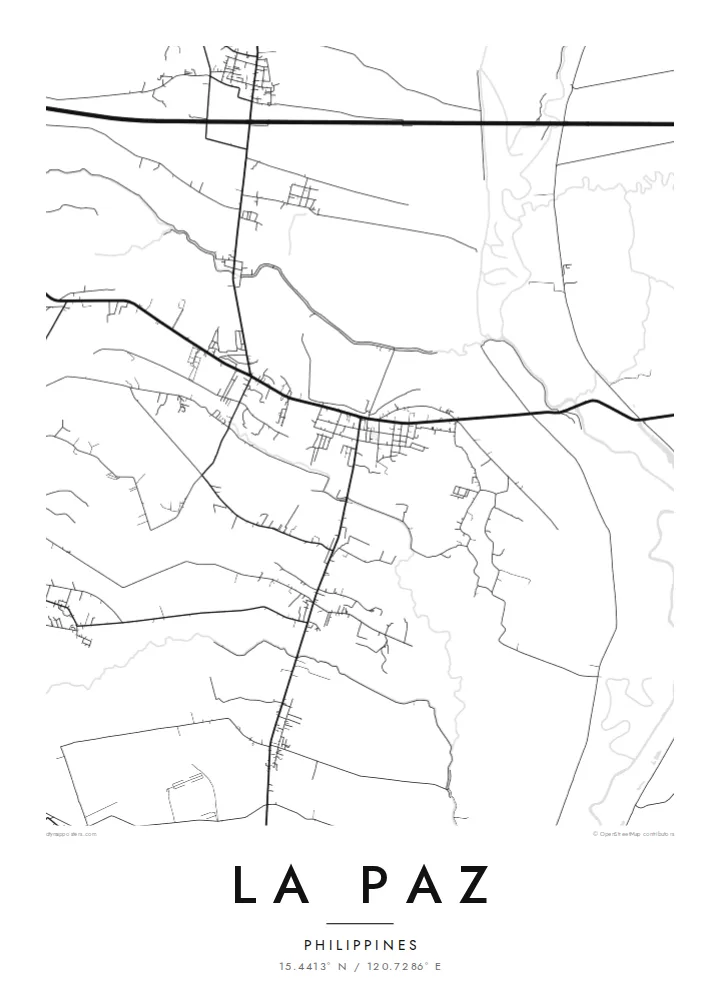
The densest part of the map is a small cluster of streets around the municipal centre. It is the one place where the lines tighten before the plain opens up around it.
Pousita mape faigofie · Philippines
15.4413° N / 120.7286° E
A farming town on the flat Central Luzon plain, where a small street grid gives way to open fields in every direction.
Taone e tasi, lagona e lima
Pau te tapaki o se style ke lavea i luga i te puipui. E tutasi te tau o style takitasi — telotele mo faaki, e aunoa io me fai ki faila HD.
 Pixel tonu · faila lolomi 24 × 36″
Manino ki te lomiga
Tenei se 100% mai te faila lolomi tonu. Poster takitasi — telotele, faaki io me download — e faite i luga i a matou server i te 300 DPI, e oko atu ki 7,200 × 10,800 pixel, ko ala e maofio ei mo maiga vaega foliki i luga i te lolomi 24 × 36″.
I te pakitala


Te mape
La Paz sits in the province of Tarlac, in the broad lowland of Central Luzon, where the land is flat enough that roads run long and straight. From above, the town centre is a compact cluster of streets. Beyond it, the lines thin out quickly into barangay roads, irrigation channels and the wide, even field patterns of the plain.
This is agricultural country. Rice is the main crop, and the map shows it in the pattern: a few built-up areas where roads meet, with open land between them. The street lines spread out slowly from the centre, and scattered villages hold small knots of streets along their access roads. The result is a quiet, spacious composition in which empty paper matters as much as ink.
A La Paz map poster suits anyone with roots in Tarlac or family ties to the province. It shows the everyday layout of a lowland Philippine municipality: the town plaza area, the roads out to the barangays and the flat country around them. Shown in black and white, it looks like a surveyor's sheet more than a tourist map, and it stays simple on the wall.
The densest part of the map is a small cluster of streets around the municipal centre. It is the one place where the lines tighten before the plain opens up around it.
Long, mostly straight roads cross the flat terrain between barangays. On a map without relief shading, they read as clean strokes across open paper.
Large unlined areas stand for rice fields and farmland. They give the poster plenty of negative space and show how much of the municipality is still worked land.
Fai ke fakatau ki a koe
Fakaopoopo se aso, se igoa io me se fuaiupu o koe, sui te sitaila, te lasi io me te tuuga.
Te preview fua e maulalo te malamalama kae iai se watermark. Poster telotele mo faila HD e faite i te 300 DPI, e oko atu ki 7,200 × 10,800 px, aunoa mo se watermark.
Kaia a La Paz
Many people hang this map to remember a home province or a family town they return to at harvest time or for fiestas. Its simplicity is the point: a few roads, a small centre and the plain around it, drawn clearly enough to recognise at a glance.
You can set the title, subtitle and coordinates line yourself, for example a family name, a year or the barangay you come from. Choose from Classic black & white, Noir, Paper, Blueprint or Sand to suit the room where it will hang.
Otaina te poster La Paz| Lasi o te lomiga | Manino | Faila |
|---|---|---|
| 30 × 40 cm11.8 × 15.7″ | 3,543 × 4,724 px | PNG · PDF |
| 29.7 × 42 cm (A3)11.7 × 16.5″ | 3,508 × 4,961 px | PNG · PDF |
| 42 × 59.4 cm (A2)16.5 × 23.4″ | 4,961 × 7,016 px | PNG · PDF |
| 45.7 × 61 cm18 × 24″ | 5,400 × 7,200 px | PNG · PDF |
| 50 × 70 cm19.7 × 27.6″ | 5,906 × 8,268 px | PNG · PDF |
| 61 × 91.4 cm24 × 36″ | 7,200 × 10,800 px | PNG · PDF |
Ke fakatusa, a te ata fakataitai fua e 900 px te lautele, mo te fakailoga kae mo lau lavea i luga i te komipiuta. A faila HD e oko ki te 8× te manino i itu katoa kae lomi faka‵lei i te lasi katoa o te pousita.
Filifili se style i te pito i luga o te itulau, kae filifili Poster Telotele — se lasi mo se faaki manafai e manako koe — io me Faila Digital HD. E tasi te sitepu mo te checkout, kae ka fakafou te itulau o tau ota i te taimi e mafai ei te totogi.
E telotele i luga o te pepa vali gali 200 gsm i se tasi mai lasi e ono, mai te 30 × 40 cm ki te 24 × 36″. E kamata te poster telotele mai i te $39, kae aofia ei te uta.
Ioe. Filifili se faaki lakau maoli i te kulokula, tea, oak maoli io me lakau pogisa. E oo mai ki tioata e se malepe kae toka ke tautau. E kamata te poster faaki mai i te $99, kae aofia ei te uta.
E tuku fua ki fenua e 60+. A poloaiga taki tasi e ta ne te tauhaga e latalata mai i a matou tauhaga ta i fenua e 30+, kae e masani o aunoa i aso galue e 3–7. E mafai o salasala te tulaga mo te sukesuke i lalo o Aku poloaiga. I nisi fenua e 2–5 vaiaso, kae i mea e seki tuku atu ei matou, e fakailoa atu e te mea tafaoga i mua o te totogi.
Auina mai se ata i loto i te 14 aso mai te taimi e oko ei kae ka toe telotele fua ne matou io me toe totogi atu tau tupe.
Ioe. I te editor i te itulau tenei, sui te ulutala, te ulutala lalo mo te laina o coordinate ki so se mea e manako koe, kae filifili se style mo se lasi. Oga telotele, faaki mo digital e faigana katoa i tau tusiga tonu.
Mo te $9 ka maua ne koe faila PNG 300 DPI mo PDF fakatoka lolomi i lasi e ono katoa, aunoa mo se watermark, ke lolomi i so se koga. E se mautinoa koe? Download muamua se preview fua e iai te watermark.
