Shrine at the centre
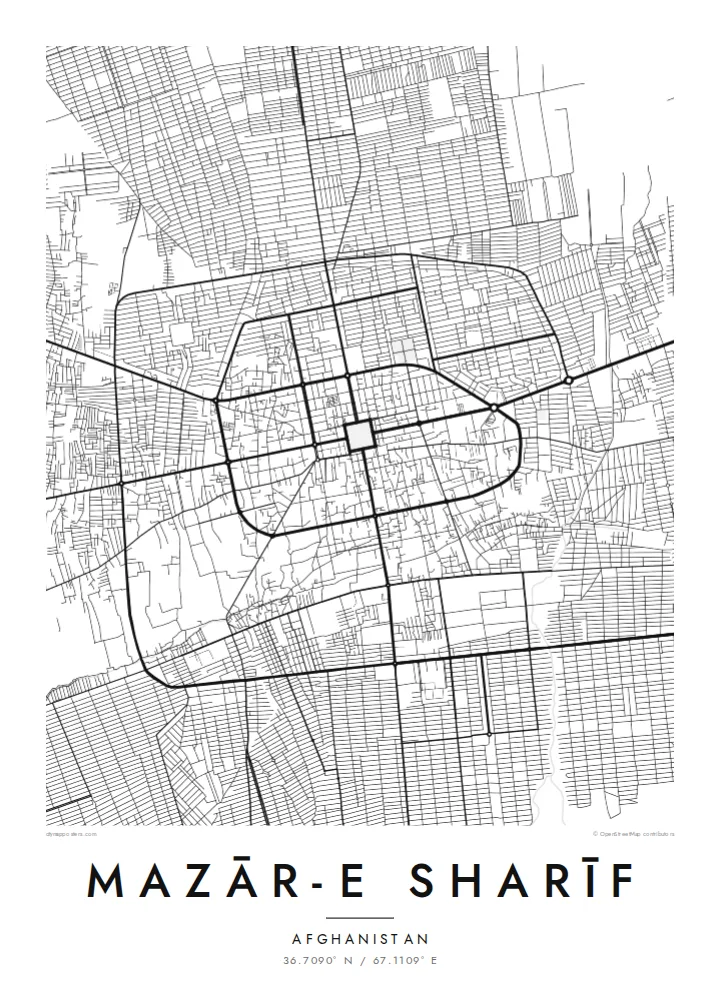
The walled grounds of the Blue Mosque form a large rectangle in the middle of the map, the point around which the city's main streets and markets are organised.
Pousita mape faigofie · Afghanistan
36.7090° N / 67.1109° E
A plains city in northern Afghanistan organised around a single great shrine, with open ground stretching north toward the Amu Darya.


Taone e tasi, lagona e lima
Pau te tapaki o se style ke lavea i luga i te puipui. E tutasi te tau o style takitasi — telotele mo faaki, e aunoa io me fai ki faila HD.
 Pixel tonu · faila lolomi 24 × 36″
Manino ki te lomiga
Tenei se 100% mai te faila lolomi tonu. Poster takitasi — telotele, faaki io me download — e faite i luga i a matou server i te 300 DPI, e oko atu ki 7,200 × 10,800 pixel, ko ala e maofio ei mo maiga vaega foliki i luga i te lolomi 24 × 36″.
I te pakitala


Te mape
Mazār-e Sharīf is the largest city in northern Afghanistan. It sits on a flat plain between the foothills of the Hindu Kush to the south and the Amu Darya to the north. Its name means the noble shrine. The city grew around the Shrine of Ali, widely known as the Blue Mosque, whose walled grounds sit at the centre of the street map.
Main avenues lead away from the shrine enclosure toward the edges of the city, and the surrounding blocks form a dense pattern of markets and low houses. Beyond them the built-up area gives way to irrigated fields and then open, dry ground. About twenty kilometres to the west lie the ruins of ancient Balkh, once one of Central Asia's great cities.
A Mazār-e Sharīf map poster reads almost like a diagram: a central enclosure, a tight block pattern around it and straight roads leaving for Balkh, Hairatan and the south. It is a strong, balanced subject, and the plain around it is so simple that the city's shape stands out clearly at any size.
The walled grounds of the Blue Mosque form a large rectangle in the middle of the map, the point around which the city's main streets and markets are organised.
Straight highways leave the city toward Balkh in the west and the Amu Darya border crossing at Hairatan in the north, drawing clean lines across open ground.
Canals and field boundaries surround the built-up area, a fine pattern of lines that gradually fades into the dry plain as the frame widens.
Fai ke fakatau ki a koe
Fakaopoopo se aso, se igoa io me se fuaiupu o koe, sui te sitaila, te lasi io me te tuuga.
Te preview fua e maulalo te malamalama kae iai se watermark. Poster telotele mo faila HD e faite i te 300 DPI, e oko atu ki 7,200 × 10,800 px, aunoa mo se watermark.
Kaia a Mazār-e Sharīf
For Afghans abroad, Mazār-e Sharīf is often remembered through Nowruz at the shrine and the white pigeons in its courtyard. A map of the city is a quiet, personal way to keep that place close without relying on photographs.
Set the title, subtitle and coordinates line in your own words, perhaps a family name or a year. Choose Classic black & white, Noir, Paper, Blueprint or Sand, then download the HD files for $9 or order a printed poster on matte paper.
Otaina te poster Mazār-e Sharīf| Lasi o te lomiga | Manino | Faila |
|---|---|---|
| 30 × 40 cm11.8 × 15.7″ | 3,543 × 4,724 px | PNG · PDF |
| 29.7 × 42 cm (A3)11.7 × 16.5″ | 3,508 × 4,961 px | PNG · PDF |
| 42 × 59.4 cm (A2)16.5 × 23.4″ | 4,961 × 7,016 px | PNG · PDF |
| 45.7 × 61 cm18 × 24″ | 5,400 × 7,200 px | PNG · PDF |
| 50 × 70 cm19.7 × 27.6″ | 5,906 × 8,268 px | PNG · PDF |
| 61 × 91.4 cm24 × 36″ | 7,200 × 10,800 px | PNG · PDF |
Ke fakatusa, a te ata fakataitai fua e 900 px te lautele, mo te fakailoga kae mo lau lavea i luga i te komipiuta. A faila HD e oko ki te 8× te manino i itu katoa kae lomi faka‵lei i te lasi katoa o te pousita.
Filifili se style i te pito i luga o te itulau, kae filifili Poster Telotele — se lasi mo se faaki manafai e manako koe — io me Faila Digital HD. E tasi te sitepu mo te checkout, kae ka fakafou te itulau o tau ota i te taimi e mafai ei te totogi.
E telotele i luga o te pepa vali gali 200 gsm i se tasi mai lasi e ono, mai te 30 × 40 cm ki te 24 × 36″. E kamata te poster telotele mai i te $39, kae aofia ei te uta.
Ioe. Filifili se faaki lakau maoli i te kulokula, tea, oak maoli io me lakau pogisa. E oo mai ki tioata e se malepe kae toka ke tautau. E kamata te poster faaki mai i te $99, kae aofia ei te uta.
E tuku fua ki fenua e 60+. A poloaiga taki tasi e ta ne te tauhaga e latalata mai i a matou tauhaga ta i fenua e 30+, kae e masani o aunoa i aso galue e 3–7. E mafai o salasala te tulaga mo te sukesuke i lalo o Aku poloaiga. I nisi fenua e 2–5 vaiaso, kae i mea e seki tuku atu ei matou, e fakailoa atu e te mea tafaoga i mua o te totogi.
Auina mai se ata i loto i te 14 aso mai te taimi e oko ei kae ka toe telotele fua ne matou io me toe totogi atu tau tupe.
Ioe. I te editor i te itulau tenei, sui te ulutala, te ulutala lalo mo te laina o coordinate ki so se mea e manako koe, kae filifili se style mo se lasi. Oga telotele, faaki mo digital e faigana katoa i tau tusiga tonu.
Mo te $9 ka maua ne koe faila PNG 300 DPI mo PDF fakatoka lolomi i lasi e ono katoa, aunoa mo se watermark, ke lolomi i so se koga. E se mautinoa koe? Download muamua se preview fua e iai te watermark.
Koga pili
