River loop
The Miryang River curves around the old centre in a broad bend, and several bridges connect the neighbourhoods on both banks.
Pousita mape faigofie · South Korea
35.4933° N / 128.7489° E
A river town in a Korean valley, where the Miryang River loops around the old centre beneath wooded hills

Taone e tasi, lagona e lima
Pau te tapaki o se style ke lavea i luga i te puipui. E tutasi te tau o style takitasi — telotele mo faaki, e aunoa io me fai ki faila HD.
 Pixel tonu · faila lolomi 24 × 36″
Manino ki te lomiga
Tenei se 100% mai te faila lolomi tonu. Poster takitasi — telotele, faaki io me download — e faite i luga i a matou server i te 300 DPI, e oko atu ki 7,200 × 10,800 pixel, ko ala e maofio ei mo maiga vaega foliki i luga i te lolomi 24 × 36″.
I te pakitala


Te mape
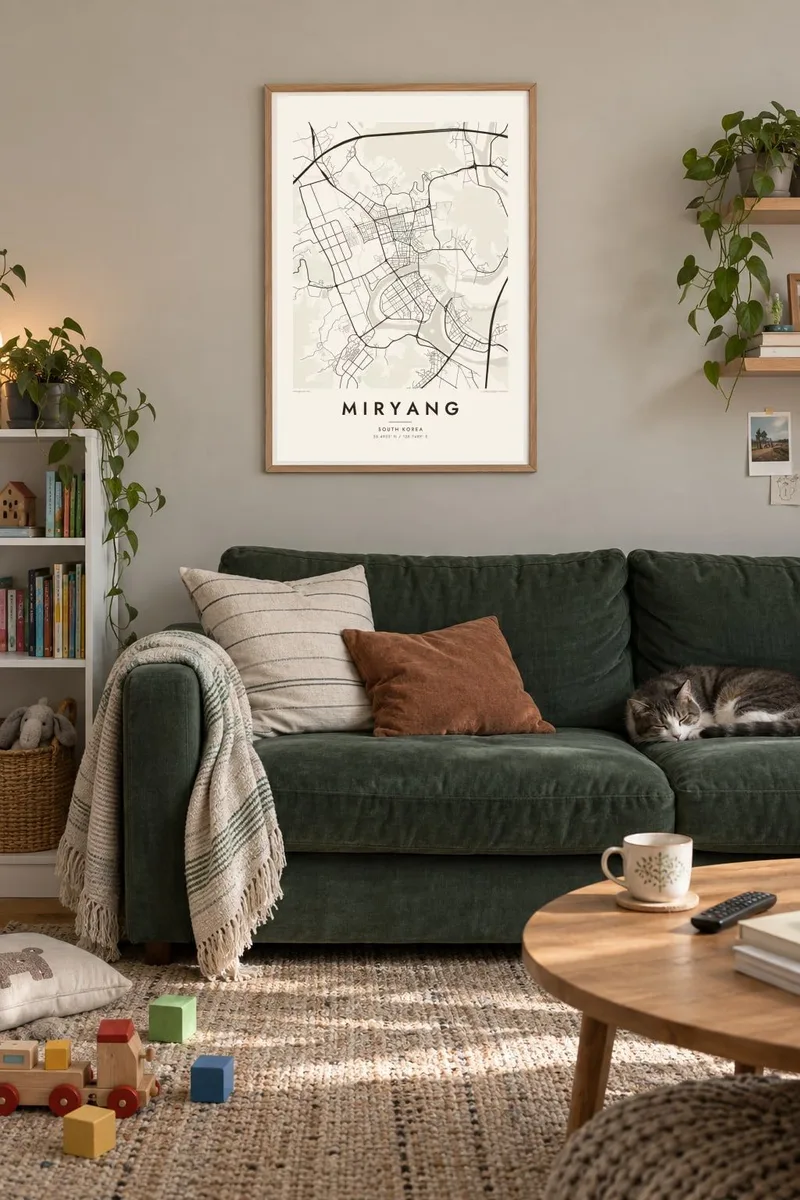
Miryang lies in South Gyeongsang Province, between Daegu and Busan. The Miryang River, a tributary of the Nakdong, shapes the city on the map. It bends around the old centre in a wide loop, and bridges cross it at several points. Beyond the river, the city is framed by forested hills, and the valleys that lead into them carry smaller roads and villages.
On a bluff above the river stands Yeongnamnu, a Joseon-era pavilion traditionally counted among Korea's three great pavilions. The railway line between Seoul and Busan runs through Miryang, and its station anchors a more modern part of the city. On the map, the older streets near the river are denser and more irregular than the later ones.
A Miryang map poster shows a city defined by water and mountains. Miryang is also known well beyond the region for Miryang Arirang, a regional version of Korea's best-known folk song, and as the title and setting of Lee Chang-dong's film Secret Sunshine.
The Miryang River curves around the old centre in a broad bend, and several bridges connect the neighbourhoods on both banks.
The historic pavilion stands on high ground by the river, at a point where the older streets gather close to the water's edge.
Wooded slopes surround the city on several sides. Roads follow the valleys between them, and forested areas remain open on the poster.
Fai ke fakatau ki a koe
Fakaopoopo se aso, se igoa io me se fuaiupu o koe, sui te sitaila, te lasi io me te tuuga.
Te preview fua e maulalo te malamalama kae iai se watermark. Poster telotele mo faila HD e faite i te 300 DPI, e oko atu ki 7,200 × 10,800 px, aunoa mo se watermark.
Kaia a Miryang
The poster suits people from Miryang, fans of Korean cinema and folk music, and anyone drawn to river cities in the hills. The loop of the river makes it an especially graphic map.
The title, subtitle and coordinates can be changed, including in Korean if you like, and you choose from Classic black & white, Noir, Paper, Blueprint and Sand. The digital files include six print sizes at 300 DPI.
Otaina te poster Miryang| Lasi o te lomiga | Manino | Faila |
|---|---|---|
| 30 × 40 cm11.8 × 15.7″ | 3,543 × 4,724 px | PNG · PDF |
| 29.7 × 42 cm (A3)11.7 × 16.5″ | 3,508 × 4,961 px | PNG · PDF |
| 42 × 59.4 cm (A2)16.5 × 23.4″ | 4,961 × 7,016 px | PNG · PDF |
| 45.7 × 61 cm18 × 24″ | 5,400 × 7,200 px | PNG · PDF |
| 50 × 70 cm19.7 × 27.6″ | 5,906 × 8,268 px | PNG · PDF |
| 61 × 91.4 cm24 × 36″ | 7,200 × 10,800 px | PNG · PDF |
Ke fakatusa, a te ata fakataitai fua e 900 px te lautele, mo te fakailoga kae mo lau lavea i luga i te komipiuta. A faila HD e oko ki te 8× te manino i itu katoa kae lomi faka‵lei i te lasi katoa o te pousita.
Filifili se style i te pito i luga o te itulau, kae filifili Poster Telotele — se lasi mo se faaki manafai e manako koe — io me Faila Digital HD. E tasi te sitepu mo te checkout, kae ka fakafou te itulau o tau ota i te taimi e mafai ei te totogi.
E telotele i luga o te pepa vali gali 200 gsm i se tasi mai lasi e ono, mai te 30 × 40 cm ki te 24 × 36″. E kamata te poster telotele mai i te $39, kae aofia ei te uta.
Ioe. Filifili se faaki lakau maoli i te kulokula, tea, oak maoli io me lakau pogisa. E oo mai ki tioata e se malepe kae toka ke tautau. E kamata te poster faaki mai i te $99, kae aofia ei te uta.
E tuku fua ki fenua e 60+. A poloaiga taki tasi e ta ne te tauhaga e latalata mai i a matou tauhaga ta i fenua e 30+, kae e masani o aunoa i aso galue e 3–7. E mafai o salasala te tulaga mo te sukesuke i lalo o Aku poloaiga. I nisi fenua e 2–5 vaiaso, kae i mea e seki tuku atu ei matou, e fakailoa atu e te mea tafaoga i mua o te totogi.
Auina mai se ata i loto i te 14 aso mai te taimi e oko ei kae ka toe telotele fua ne matou io me toe totogi atu tau tupe.
Ioe. I te editor i te itulau tenei, sui te ulutala, te ulutala lalo mo te laina o coordinate ki so se mea e manako koe, kae filifili se style mo se lasi. Oga telotele, faaki mo digital e faigana katoa i tau tusiga tonu.
Mo te $9 ka maua ne koe faila PNG 300 DPI mo PDF fakatoka lolomi i lasi e ono katoa, aunoa mo se watermark, ke lolomi i so se koga. E se mautinoa koe? Download muamua se preview fua e iai te watermark.
