Colonial checkerboard
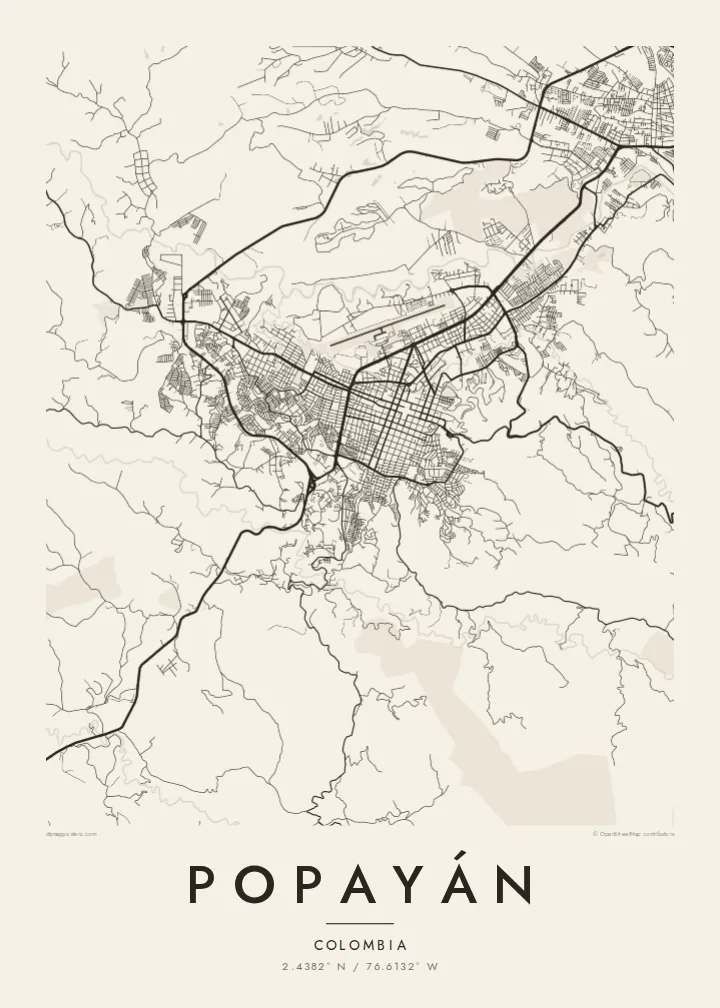
The historic core is laid out in square blocks around the central plaza. It is one of the most complete Spanish grids in Colombia and reads very cleanly in thin black lines.
Pousita mape faigofie · Colombia
2.4382° N / 76.6132° W
A tight colonial grid of whitewashed blocks at the foot of the Andes, crossed by the Molino River and overlooked by a grassy pyramid hill




Taone e tasi, lagona e lima
Pau te tapaki o se style ke lavea i luga i te puipui. E tutasi te tau o style takitasi — telotele mo faaki, e aunoa io me fai ki faila HD.
 Pixel tonu · faila lolomi 24 × 36″
Manino ki te lomiga
Tenei se 100% mai te faila lolomi tonu. Poster takitasi — telotele, faaki io me download — e faite i luga i a matou server i te 300 DPI, e oko atu ki 7,200 × 10,800 pixel, ko ala e maofio ei mo maiga vaega foliki i luga i te lolomi 24 × 36″.
I te pakitala


Te mape
Popayán sits in a high valley of southwestern Colombia at roughly 1,700 metres, between the Central and Western cordilleras. From above, the historic centre is a clean Spanish checkerboard of square blocks. Beyond it the streets loosen into newer neighbourhoods that follow the folds of the land. The Pan-American Highway runs along the western side of town, a long line that carries traffic between Cali and Ecuador.
Its nickname, the White City, comes from the lime-washed facades of the old centre. You can't see that colour on a monochrome print, but the order behind it shows up clearly: evenly spaced streets, the rectangle of the main square and the regular rhythm of churches and cloisters. A Popayán map poster keeps that colonial geometry and leaves out the noise of the modern road network.
The city is also known for its Holy Week processions, which UNESCO lists as intangible cultural heritage, and for its cooking, which earned it the title of UNESCO City of Gastronomy. Neither shows up on a street plan, but the processions follow the same streets drawn on the poster. For many people who know the city, those streets carry the memory of candlelit nights in April.
The historic core is laid out in square blocks around the central plaza. It is one of the most complete Spanish grids in Colombia and reads very cleanly in thin black lines.
A rounded hill just east of the centre, believed to be a pre-Columbian earthwork pyramid. On the map it appears as a small island of open ground among the city streets.
The Molino River cuts through the northern edge of the old town. Near the old brick Humilladero bridge, the orderly grid meets the river's natural bend.
Fai ke fakatau ki a koe
Fakaopoopo se aso, se igoa io me se fuaiupu o koe, sui te sitaila, te lasi io me te tuuga.
Te preview fua e maulalo te malamalama kae iai se watermark. Poster telotele mo faila HD e faite i te 300 DPI, e oko atu ki 7,200 × 10,800 px, aunoa mo se watermark.
Kaia a Popayán
People who studied, married or grew up in Popayán often want something quieter than a photograph of the white facades. The street plan gives them the structure of the place without the postcard. It suits a study or a hallway, where a reserved image works better than a bright one.
You can add your own title and a subtitle such as a year, a family name or a date that matters. The coordinates line can mark the old centre or a particular address. Then choose one of five styles, from Classic black and white to the warmer Sand or the technical Blueprint.
Otaina te poster Popayán| Lasi o te lomiga | Manino | Faila |
|---|---|---|
| 30 × 40 cm11.8 × 15.7″ | 3,543 × 4,724 px | PNG · PDF |
| 29.7 × 42 cm (A3)11.7 × 16.5″ | 3,508 × 4,961 px | PNG · PDF |
| 42 × 59.4 cm (A2)16.5 × 23.4″ | 4,961 × 7,016 px | PNG · PDF |
| 45.7 × 61 cm18 × 24″ | 5,400 × 7,200 px | PNG · PDF |
| 50 × 70 cm19.7 × 27.6″ | 5,906 × 8,268 px | PNG · PDF |
| 61 × 91.4 cm24 × 36″ | 7,200 × 10,800 px | PNG · PDF |
Ke fakatusa, a te ata fakataitai fua e 900 px te lautele, mo te fakailoga kae mo lau lavea i luga i te komipiuta. A faila HD e oko ki te 8× te manino i itu katoa kae lomi faka‵lei i te lasi katoa o te pousita.
Filifili se style i te pito i luga o te itulau, kae filifili Poster Telotele — se lasi mo se faaki manafai e manako koe — io me Faila Digital HD. E tasi te sitepu mo te checkout, kae ka fakafou te itulau o tau ota i te taimi e mafai ei te totogi.
E telotele i luga o te pepa vali gali 200 gsm i se tasi mai lasi e ono, mai te 30 × 40 cm ki te 24 × 36″. E kamata te poster telotele mai i te $39, kae aofia ei te uta.
Ioe. Filifili se faaki lakau maoli i te kulokula, tea, oak maoli io me lakau pogisa. E oo mai ki tioata e se malepe kae toka ke tautau. E kamata te poster faaki mai i te $99, kae aofia ei te uta.
E tuku fua ki fenua e 60+. A poloaiga taki tasi e ta ne te tauhaga e latalata mai i a matou tauhaga ta i fenua e 30+, kae e masani o aunoa i aso galue e 3–7. E mafai o salasala te tulaga mo te sukesuke i lalo o Aku poloaiga. I nisi fenua e 2–5 vaiaso, kae i mea e seki tuku atu ei matou, e fakailoa atu e te mea tafaoga i mua o te totogi.
Auina mai se ata i loto i te 14 aso mai te taimi e oko ei kae ka toe telotele fua ne matou io me toe totogi atu tau tupe.
Ioe. I te editor i te itulau tenei, sui te ulutala, te ulutala lalo mo te laina o coordinate ki so se mea e manako koe, kae filifili se style mo se lasi. Oga telotele, faaki mo digital e faigana katoa i tau tusiga tonu.
Mo te $9 ka maua ne koe faila PNG 300 DPI mo PDF fakatoka lolomi i lasi e ono katoa, aunoa mo se watermark, ke lolomi i so se koga. E se mautinoa koe? Download muamua se preview fua e iai te watermark.
