Westward corridors
Major roads linking Tehran and Karaj pass along the city, and on the map they read as long, confident lines that anchor the whole composition.
Pousita mape faigofie · Iran
35.7214° N / 51.1090° E
A dense grid of workshops and homes on the dry plain west of Tehran, crossed by highways running toward Karaj



Taone e tasi, lagona e lima
Pau te tapaki o se style ke lavea i luga i te puipui. E tutasi te tau o style takitasi — telotele mo faaki, e aunoa io me fai ki faila HD.
 Pixel tonu · faila lolomi 24 × 36″
Manino ki te lomiga
Tenei se 100% mai te faila lolomi tonu. Poster takitasi — telotele, faaki io me download — e faite i luga i a matou server i te 300 DPI, e oko atu ki 7,200 × 10,800 pixel, ko ala e maofio ei mo maiga vaega foliki i luga i te lolomi 24 × 36″.
I te pakitala


Te mape
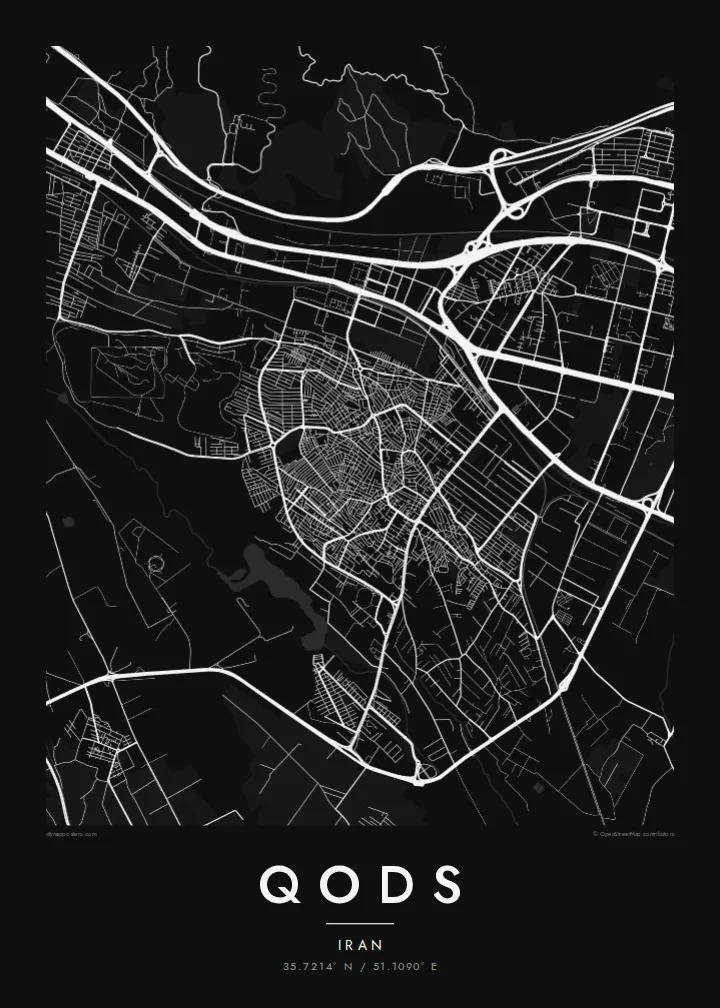
Qods sits on the flat, arid plain between Tehran and Karaj, where the capital's western edge turns into a separate city. From above it shows a tight street pattern of blocks and courtyards, broken up by wide arterial roads and the large rectangular plots of industrial zones. Its edges are hard to see on the map, because the city runs into its neighbours along the main traffic corridors.
The town grew quickly in the second half of the twentieth century from a small settlement once known as Qaleh Hasan Khan. Much of that growth came from Tehran's industrial spread westward, and the map still shows it: warehouses and factory compounds sit beside residential districts, with smaller lanes filling the space between the main roads. Nothing about the layout is decorative. It is plainly a working city.
A Qods map poster shows that practical geometry clearly. Printed in black and white, the long highways become strong horizontal strokes and the residential blocks turn into fine texture, with larger industrial parcels standing out as pale rectangles. The mountains to the north are left off the frame, so the composition stays on the city itself: a plain, well-organised street network on the high plateau.
Major roads linking Tehran and Karaj pass along the city, and on the map they read as long, confident lines that anchor the whole composition.
Large factory and warehouse plots appear as broad, quiet shapes among the finer residential streets, which gives the print a clear contrast in scale.
The residential districts are made of small blocks and narrow lanes, so parts of the city show up as dense, even hatching when printed.
Fai ke fakatau ki a koe
Fakaopoopo se aso, se igoa io me se fuaiupu o koe, sui te sitaila, te lasi io me te tuuga.
Te preview fua e maulalo te malamalama kae iai se watermark. Poster telotele mo faila HD e faite i te 300 DPI, e oko atu ki 7,200 × 10,800 px, aunoa mo se watermark.
Kaia a Qods
People who grew up in Qods, or who once worked in its factories and offices, often want a record of the place as it actually is rather than a postcard view. A street map gives them that, and a personalised title, date or coordinates line can tie it to a family home or a first job.
The design is available in five styles: Classic black & white, Noir, Paper, Blueprint and Sand. Blueprint suits the city's industrial character, and Paper gives it a softer look. The digital HD files cost $9, and printed posters on matte paper are shipped from partners in more than 30 countries.
Otaina te poster Qods| Lasi o te lomiga | Manino | Faila |
|---|---|---|
| 30 × 40 cm11.8 × 15.7″ | 3,543 × 4,724 px | PNG · PDF |
| 29.7 × 42 cm (A3)11.7 × 16.5″ | 3,508 × 4,961 px | PNG · PDF |
| 42 × 59.4 cm (A2)16.5 × 23.4″ | 4,961 × 7,016 px | PNG · PDF |
| 45.7 × 61 cm18 × 24″ | 5,400 × 7,200 px | PNG · PDF |
| 50 × 70 cm19.7 × 27.6″ | 5,906 × 8,268 px | PNG · PDF |
| 61 × 91.4 cm24 × 36″ | 7,200 × 10,800 px | PNG · PDF |
Ke fakatusa, a te ata fakataitai fua e 900 px te lautele, mo te fakailoga kae mo lau lavea i luga i te komipiuta. A faila HD e oko ki te 8× te manino i itu katoa kae lomi faka‵lei i te lasi katoa o te pousita.
Filifili se style i te pito i luga o te itulau, kae filifili Poster Telotele — se lasi mo se faaki manafai e manako koe — io me Faila Digital HD. E tasi te sitepu mo te checkout, kae ka fakafou te itulau o tau ota i te taimi e mafai ei te totogi.
E telotele i luga o te pepa vali gali 200 gsm i se tasi mai lasi e ono, mai te 30 × 40 cm ki te 24 × 36″. E kamata te poster telotele mai i te $39, kae aofia ei te uta.
Ioe. Filifili se faaki lakau maoli i te kulokula, tea, oak maoli io me lakau pogisa. E oo mai ki tioata e se malepe kae toka ke tautau. E kamata te poster faaki mai i te $99, kae aofia ei te uta.
E tuku fua ki fenua e 60+. A poloaiga taki tasi e ta ne te tauhaga e latalata mai i a matou tauhaga ta i fenua e 30+, kae e masani o aunoa i aso galue e 3–7. E mafai o salasala te tulaga mo te sukesuke i lalo o Aku poloaiga. I nisi fenua e 2–5 vaiaso, kae i mea e seki tuku atu ei matou, e fakailoa atu e te mea tafaoga i mua o te totogi.
Auina mai se ata i loto i te 14 aso mai te taimi e oko ei kae ka toe telotele fua ne matou io me toe totogi atu tau tupe.
Ioe. I te editor i te itulau tenei, sui te ulutala, te ulutala lalo mo te laina o coordinate ki so se mea e manako koe, kae filifili se style mo se lasi. Oga telotele, faaki mo digital e faigana katoa i tau tusiga tonu.
Mo te $9 ka maua ne koe faila PNG 300 DPI mo PDF fakatoka lolomi i lasi e ono katoa, aunoa mo se watermark, ke lolomi i so se koga. E se mautinoa koe? Download muamua se preview fua e iai te watermark.
