Neighbourhood clusters
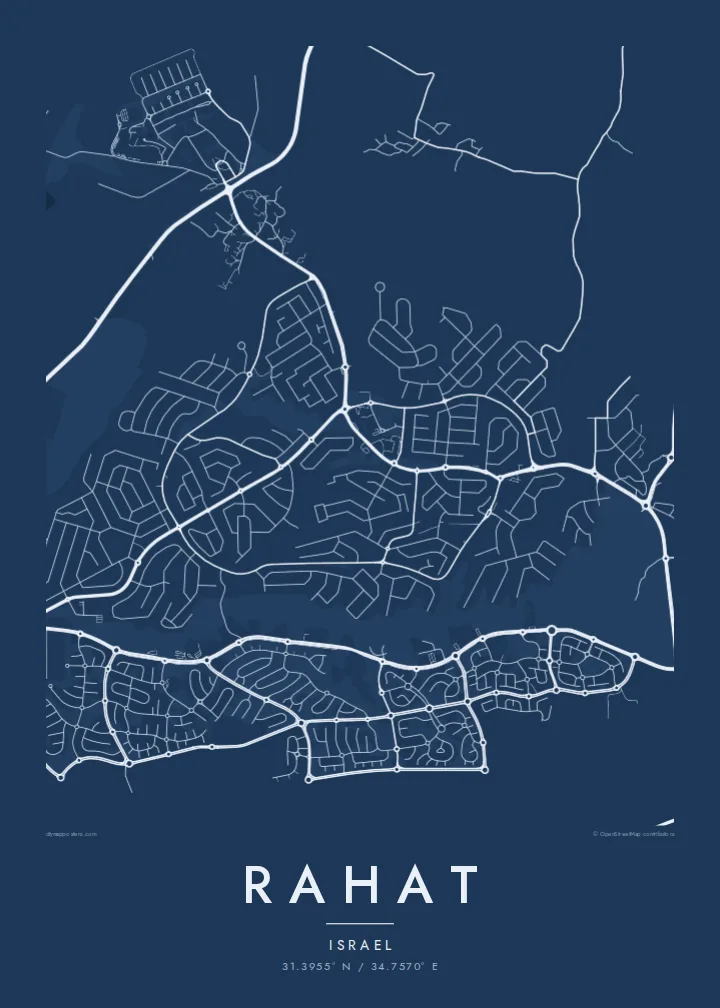
The city is organised into separate neighbourhoods, often numbered. On the map they appear as distinct groups of streets linked by main roads.
Pousita mape faigofie · Israel
31.3955° N / 34.7570° E
A planned Negev town of numbered neighbourhoods laid out in distinct clusters across the desert plain north of Beersheba.



Taone e tasi, lagona e lima
Pau te tapaki o se style ke lavea i luga i te puipui. E tutasi te tau o style takitasi — telotele mo faaki, e aunoa io me fai ki faila HD.
 Pixel tonu · faila lolomi 24 × 36″
Manino ki te lomiga
Tenei se 100% mai te faila lolomi tonu. Poster takitasi — telotele, faaki io me download — e faite i luga i a matou server i te 300 DPI, e oko atu ki 7,200 × 10,800 pixel, ko ala e maofio ei mo maiga vaega foliki i luga i te lolomi 24 × 36″.
I te pakitala


Te mape
Rahat lies in the northern Negev, a short distance north of Beersheba. It is the largest Bedouin city in Israel and was established as a planned town in the early 1970s. It received city status in 1994. Its layout reflects that planning: the town is divided into separate neighbourhoods, many identified by number, each forming its own cluster of streets.
From above, Rahat looks like a group of distinct residential units connected by main roads, with open ground between some of them. Around the town, the Negev landscape is dry and open, crossed by roads, wadis and agricultural plots. The contrast between the organised neighbourhood clusters and the surrounding land is the defining feature of the map.
A Rahat map poster captures a city that grew quickly from a planned beginning into a significant urban centre in southern Israel. Printed in black and white, the neighbourhood pattern becomes a striking modular composition. For residents and families connected to Rahat, each cluster represents a specific place and a specific set of people.
The city is organised into separate neighbourhoods, often numbered. On the map they appear as distinct groups of streets linked by main roads.
Rahat was founded as a planned town in the 1970s, and its structured layout shows clearly compared with older, more organic settlements.
Open, arid land surrounds the city, crossed by roads and dry watercourses, which gives the map generous empty space around its edges.
Fai ke fakatau ki a koe
Fakaopoopo se aso, se igoa io me se fuaiupu o koe, sui te sitaila, te lasi io me te tuuga.
Te preview fua e maulalo te malamalama kae iai se watermark. Poster telotele mo faila HD e faite i te 300 DPI, e oko atu ki 7,200 × 10,800 px, aunoa mo se watermark.
Kaia a Rahat
For families from Rahat and the wider Negev Bedouin community, this map is a portrait of home drawn at the scale of neighbourhoods. Its modular pattern also makes it a strong, distinctive graphic piece.
Set a title, a subtitle and the coordinates line, and choose from five styles. Sand suits the desert setting especially well. HD files cost $9 for six sizes, and printed posters on matte paper can be ordered with or without a frame.
Otaina te poster Rahat| Lasi o te lomiga | Manino | Faila |
|---|---|---|
| 30 × 40 cm11.8 × 15.7″ | 3,543 × 4,724 px | PNG · PDF |
| 29.7 × 42 cm (A3)11.7 × 16.5″ | 3,508 × 4,961 px | PNG · PDF |
| 42 × 59.4 cm (A2)16.5 × 23.4″ | 4,961 × 7,016 px | PNG · PDF |
| 45.7 × 61 cm18 × 24″ | 5,400 × 7,200 px | PNG · PDF |
| 50 × 70 cm19.7 × 27.6″ | 5,906 × 8,268 px | PNG · PDF |
| 61 × 91.4 cm24 × 36″ | 7,200 × 10,800 px | PNG · PDF |
Ke fakatusa, a te ata fakataitai fua e 900 px te lautele, mo te fakailoga kae mo lau lavea i luga i te komipiuta. A faila HD e oko ki te 8× te manino i itu katoa kae lomi faka‵lei i te lasi katoa o te pousita.
Filifili se style i te pito i luga o te itulau, kae filifili Poster Telotele — se lasi mo se faaki manafai e manako koe — io me Faila Digital HD. E tasi te sitepu mo te checkout, kae ka fakafou te itulau o tau ota i te taimi e mafai ei te totogi.
E telotele i luga o te pepa vali gali 200 gsm i se tasi mai lasi e ono, mai te 30 × 40 cm ki te 24 × 36″. E kamata te poster telotele mai i te $39, kae aofia ei te uta.
Ioe. Filifili se faaki lakau maoli i te kulokula, tea, oak maoli io me lakau pogisa. E oo mai ki tioata e se malepe kae toka ke tautau. E kamata te poster faaki mai i te $99, kae aofia ei te uta.
E tuku fua ki fenua e 60+. A poloaiga taki tasi e ta ne te tauhaga e latalata mai i a matou tauhaga ta i fenua e 30+, kae e masani o aunoa i aso galue e 3–7. E mafai o salasala te tulaga mo te sukesuke i lalo o Aku poloaiga. I nisi fenua e 2–5 vaiaso, kae i mea e seki tuku atu ei matou, e fakailoa atu e te mea tafaoga i mua o te totogi.
Auina mai se ata i loto i te 14 aso mai te taimi e oko ei kae ka toe telotele fua ne matou io me toe totogi atu tau tupe.
Ioe. I te editor i te itulau tenei, sui te ulutala, te ulutala lalo mo te laina o coordinate ki so se mea e manako koe, kae filifili se style mo se lasi. Oga telotele, faaki mo digital e faigana katoa i tau tusiga tonu.
Mo te $9 ka maua ne koe faila PNG 300 DPI mo PDF fakatoka lolomi i lasi e ono katoa, aunoa mo se watermark, ke lolomi i so se koga. E se mautinoa koe? Download muamua se preview fua e iai te watermark.
