Sunken palm gardens
Ghouts, the palm groves dug into hollows, form rounded shapes around the settlement. They show how the Souf has farmed the desert, working with the sand instead of against it.
Pousita mape faigofie · Algeria
33.2797° N / 6.9098° E
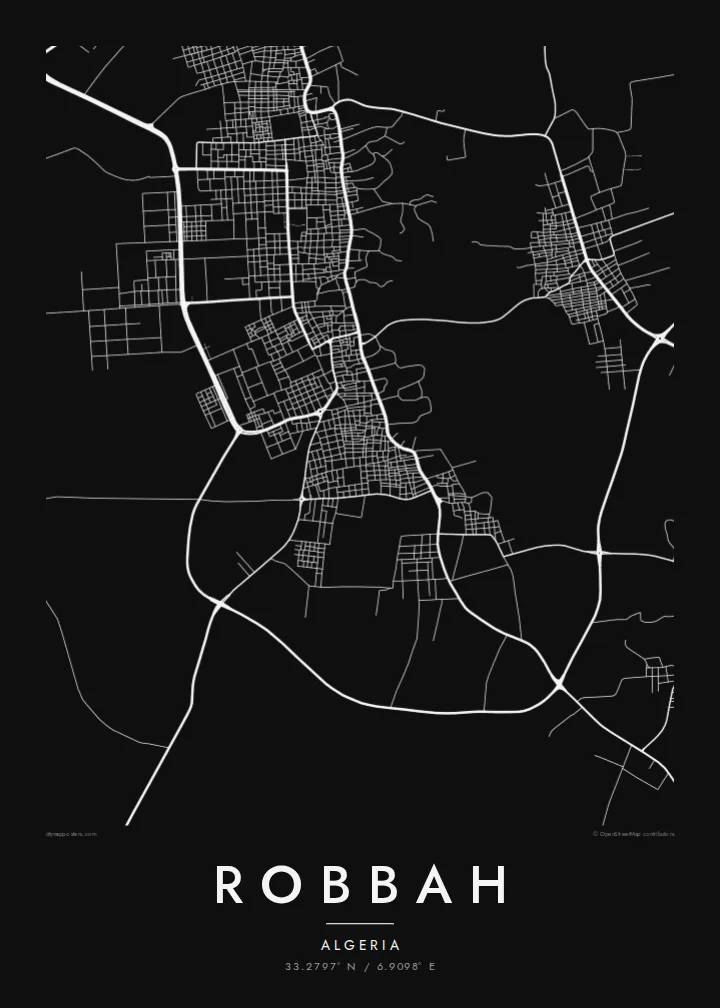
A desert town of the Souf in Algeria, set among sand dunes, with palm gardens sunk into hollows and streets laid out in compact blocks.



Taone e tasi, lagona e lima
Pau te tapaki o se style ke lavea i luga i te puipui. E tutasi te tau o style takitasi — telotele mo faaki, e aunoa io me fai ki faila HD.
 Pixel tonu · faila lolomi 24 × 36″
Manino ki te lomiga
Tenei se 100% mai te faila lolomi tonu. Poster takitasi — telotele, faaki io me download — e faite i luga i a matou server i te 300 DPI, e oko atu ki 7,200 × 10,800 pixel, ko ala e maofio ei mo maiga vaega foliki i luga i te lolomi 24 × 36″.
I te pakitala


Te mape
Robbah lies in the Souf region of El Oued province, on the edge of the Grand Erg Oriental, one of the largest dune fields in the Sahara. From above, the town is a firm cluster of built blocks surrounded by soft, rippled sand. There are no rivers or coastlines here. Instead, the patterns come from dunes, tracks and the way people have settled into the desert.
The Souf is known for its ghouts: palm groves planted in hollows dug down towards the water table, so the tree roots can reach moisture. On a map they show up as rounded pockets at the edge of town, like craters, each holding a small orchard. The region's traditional houses often have domed roofs, a building style closely tied to the area around El Oued.
A Robbah map poster works through contrast. There is the dense, orderly street grid, the looser tracks that head into the sand, and the empty space around it all, which is as much a part of the picture as the buildings. In black and white, the town reads as a single island in the dunes, joined by roads to its neighbours in the Souf.
Ghouts, the palm groves dug into hollows, form rounded shapes around the settlement. They show how the Souf has farmed the desert, working with the sand instead of against it.
The built area is tight and regular, with narrow streets between low houses. Seen from above, it looks like a solid shape pressed into the dune field.
A small number of roads and tracks leave the town and cross open sand to the nearby settlements. They are thin, deliberate lines through a landscape that is otherwise empty.
Fai ke fakatau ki a koe
Fakaopoopo se aso, se igoa io me se fuaiupu o koe, sui te sitaila, te lasi io me te tuuga.
Te preview fua e maulalo te malamalama kae iai se watermark. Poster telotele mo faila HD e faite i te 300 DPI, e oko atu ki 7,200 × 10,800 px, aunoa mo se watermark.
Kaia a Robbah
This is a map for someone who knows the Souf: the sand at the end of the street, the palms in their hollows, the quiet of the erg. The empty space around the town gives the poster its calm, and it sits well in a room that needs one strong shape.
You can add a name, a family date or coordinates in the personalised title, subtitle and coordinates line. Then choose from five styles: Classic black & white, Noir, Paper, Blueprint or Sand. Sand is the natural choice, and Noir gives the town a sharp outline.
Otaina te poster Robbah| Lasi o te lomiga | Manino | Faila |
|---|---|---|
| 30 × 40 cm11.8 × 15.7″ | 3,543 × 4,724 px | PNG · PDF |
| 29.7 × 42 cm (A3)11.7 × 16.5″ | 3,508 × 4,961 px | PNG · PDF |
| 42 × 59.4 cm (A2)16.5 × 23.4″ | 4,961 × 7,016 px | PNG · PDF |
| 45.7 × 61 cm18 × 24″ | 5,400 × 7,200 px | PNG · PDF |
| 50 × 70 cm19.7 × 27.6″ | 5,906 × 8,268 px | PNG · PDF |
| 61 × 91.4 cm24 × 36″ | 7,200 × 10,800 px | PNG · PDF |
Ke fakatusa, a te ata fakataitai fua e 900 px te lautele, mo te fakailoga kae mo lau lavea i luga i te komipiuta. A faila HD e oko ki te 8× te manino i itu katoa kae lomi faka‵lei i te lasi katoa o te pousita.
Filifili se style i te pito i luga o te itulau, kae filifili Poster Telotele — se lasi mo se faaki manafai e manako koe — io me Faila Digital HD. E tasi te sitepu mo te checkout, kae ka fakafou te itulau o tau ota i te taimi e mafai ei te totogi.
E telotele i luga o te pepa vali gali 200 gsm i se tasi mai lasi e ono, mai te 30 × 40 cm ki te 24 × 36″. E kamata te poster telotele mai i te $39, kae aofia ei te uta.
Ioe. Filifili se faaki lakau maoli i te kulokula, tea, oak maoli io me lakau pogisa. E oo mai ki tioata e se malepe kae toka ke tautau. E kamata te poster faaki mai i te $99, kae aofia ei te uta.
E tuku fua ki fenua e 60+. A poloaiga taki tasi e ta ne te tauhaga e latalata mai i a matou tauhaga ta i fenua e 30+, kae e masani o aunoa i aso galue e 3–7. E mafai o salasala te tulaga mo te sukesuke i lalo o Aku poloaiga. I nisi fenua e 2–5 vaiaso, kae i mea e seki tuku atu ei matou, e fakailoa atu e te mea tafaoga i mua o te totogi.
Auina mai se ata i loto i te 14 aso mai te taimi e oko ei kae ka toe telotele fua ne matou io me toe totogi atu tau tupe.
Ioe. I te editor i te itulau tenei, sui te ulutala, te ulutala lalo mo te laina o coordinate ki so se mea e manako koe, kae filifili se style mo se lasi. Oga telotele, faaki mo digital e faigana katoa i tau tusiga tonu.
Mo te $9 ka maua ne koe faila PNG 300 DPI mo PDF fakatoka lolomi i lasi e ono katoa, aunoa mo se watermark, ke lolomi i so se koga. E se mautinoa koe? Download muamua se preview fua e iai te watermark.
