Patchwork developments
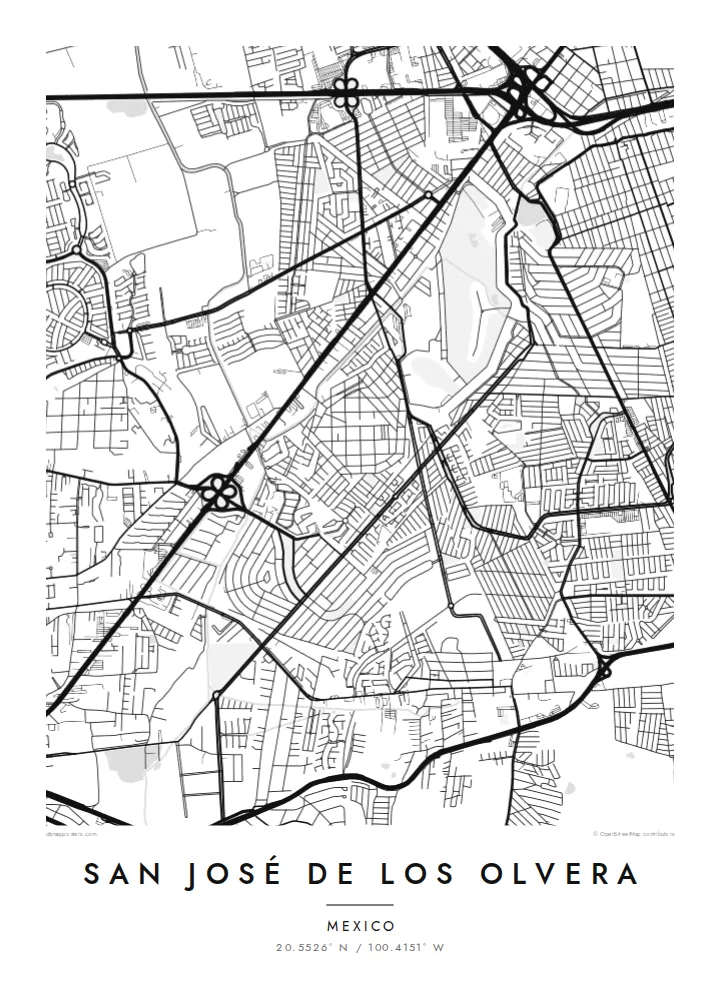
Distinct residential areas sit side by side, each with its own street pattern, from curving loops to straighter blocks, creating a varied and detailed map surface.
Pousita mape faigofie · Mexico
20.5526° N / 100.4151° W
A fast-growing suburb south of Querétaro, where new residential streets fill the land between highways
Taone e tasi, lagona e lima
Pau te tapaki o se style ke lavea i luga i te puipui. E tutasi te tau o style takitasi — telotele mo faaki, e aunoa io me fai ki faila HD.
 Pixel tonu · faila lolomi 24 × 36″
Manino ki te lomiga
Tenei se 100% mai te faila lolomi tonu. Poster takitasi — telotele, faaki io me download — e faite i luga i a matou server i te 300 DPI, e oko atu ki 7,200 × 10,800 pixel, ko ala e maofio ei mo maiga vaega foliki i luga i te lolomi 24 × 36″.
I te pakitala


Te mape
San José de los Olvera lies in the municipality of Corregidora, just south of the city of Querétaro, and its map reflects the region's rapid growth. From above it shows a mix of older street patterns and newer residential developments, each with its own internal layout. The result is a patchwork, with distinct neighbourhoods fitting together around the main roads that link them.
The newer developments tend to follow curving streets and closed loops, while older parts keep simpler, straighter lines. Larger roads cut across the area and connect it with central Querétaro and the surrounding metropolitan area. A San José de los Olvera map poster shows that layered composition, where each piece of the pattern records a different stage of the town's expansion.
Corregidora and its communities have become part of the wider Querétaro metropolitan area, one of the fastest-growing urban regions in central Mexico. San José de los Olvera is largely residential, a place many people chose to build a life in recent years. For them, its map is less about history than about a neighbourhood that is still taking shape.
Distinct residential areas sit side by side, each with its own street pattern, from curving loops to straighter blocks, creating a varied and detailed map surface.
Main routes run through the area and connect it to the city of Querétaro, forming strong lines that hold the different neighbourhoods together on the poster.
At the margins, streets meet open or developing land, showing where the suburb is still extending outward into the landscape of the Querétaro valley.
Fai ke fakatau ki a koe
Fakaopoopo se aso, se igoa io me se fuaiupu o koe, sui te sitaila, te lasi io me te tuuga.
Te preview fua e maulalo te malamalama kae iai se watermark. Poster telotele mo faila HD e faite i te 300 DPI, e oko atu ki 7,200 × 10,800 px, aunoa mo se watermark.
Kaia a San José de los Olvera
For families who moved into a new home in San José de los Olvera, the map marks a beginning: the street, the neighbourhood, the place they chose. It makes a thoughtful housewarming gift or a record of a first home.
Set your own title and subtitle, such as a family name, an address or a moving-in date, and personalise the coordinates line. Choose one of five styles, Classic black and white, Noir, Paper, Blueprint or Sand.
Otaina te poster San José de los Olvera| Lasi o te lomiga | Manino | Faila |
|---|---|---|
| 30 × 40 cm11.8 × 15.7″ | 3,543 × 4,724 px | PNG · PDF |
| 29.7 × 42 cm (A3)11.7 × 16.5″ | 3,508 × 4,961 px | PNG · PDF |
| 42 × 59.4 cm (A2)16.5 × 23.4″ | 4,961 × 7,016 px | PNG · PDF |
| 45.7 × 61 cm18 × 24″ | 5,400 × 7,200 px | PNG · PDF |
| 50 × 70 cm19.7 × 27.6″ | 5,906 × 8,268 px | PNG · PDF |
| 61 × 91.4 cm24 × 36″ | 7,200 × 10,800 px | PNG · PDF |
Ke fakatusa, a te ata fakataitai fua e 900 px te lautele, mo te fakailoga kae mo lau lavea i luga i te komipiuta. A faila HD e oko ki te 8× te manino i itu katoa kae lomi faka‵lei i te lasi katoa o te pousita.
Filifili se style i te pito i luga o te itulau, kae filifili Poster Telotele — se lasi mo se faaki manafai e manako koe — io me Faila Digital HD. E tasi te sitepu mo te checkout, kae ka fakafou te itulau o tau ota i te taimi e mafai ei te totogi.
E telotele i luga o te pepa vali gali 200 gsm i se tasi mai lasi e ono, mai te 30 × 40 cm ki te 24 × 36″. E kamata te poster telotele mai i te $39, kae aofia ei te uta.
Ioe. Filifili se faaki lakau maoli i te kulokula, tea, oak maoli io me lakau pogisa. E oo mai ki tioata e se malepe kae toka ke tautau. E kamata te poster faaki mai i te $99, kae aofia ei te uta.
E tuku fua ki fenua e 60+. A poloaiga taki tasi e ta ne te tauhaga e latalata mai i a matou tauhaga ta i fenua e 30+, kae e masani o aunoa i aso galue e 3–7. E mafai o salasala te tulaga mo te sukesuke i lalo o Aku poloaiga. I nisi fenua e 2–5 vaiaso, kae i mea e seki tuku atu ei matou, e fakailoa atu e te mea tafaoga i mua o te totogi.
Auina mai se ata i loto i te 14 aso mai te taimi e oko ei kae ka toe telotele fua ne matou io me toe totogi atu tau tupe.
Ioe. I te editor i te itulau tenei, sui te ulutala, te ulutala lalo mo te laina o coordinate ki so se mea e manako koe, kae filifili se style mo se lasi. Oga telotele, faaki mo digital e faigana katoa i tau tusiga tonu.
Mo te $9 ka maua ne koe faila PNG 300 DPI mo PDF fakatoka lolomi i lasi e ono katoa, aunoa mo se watermark, ke lolomi i so se koga. E se mautinoa koe? Download muamua se preview fua e iai te watermark.
Koga pili
