Station valley
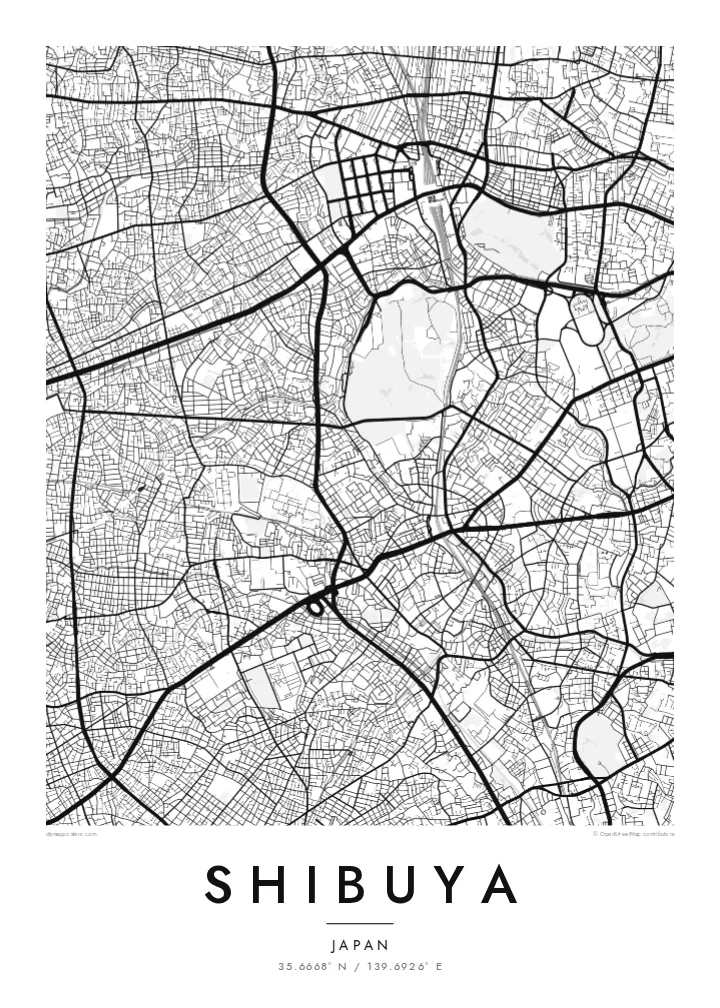
All the main roads slope down to Shibuya Station. On the map they converge like streams into a single low point where rail tracks and elevated roads overlap.
Pousita mape faigofie · Japan
35.6668° N / 139.6926° E
Streets pour down into a valley where rail lines, expressways and a famous crossing all converge


Taone e tasi, lagona e lima
Pau te tapaki o se style ke lavea i luga i te puipui. E tutasi te tau o style takitasi — telotele mo faaki, e aunoa io me fai ki faila HD.
 Pixel tonu · faila lolomi 24 × 36″
Manino ki te lomiga
Tenei se 100% mai te faila lolomi tonu. Poster takitasi — telotele, faaki io me download — e faite i luga i a matou server i te 300 DPI, e oko atu ki 7,200 × 10,800 pixel, ko ala e maofio ei mo maiga vaega foliki i luga i te lolomi 24 × 36″.
I te pakitala


Te mape
Shibuya takes its name from a valley, and the map still shows it. Streets descend from the surrounding heights of Aoyama, Dogenzaka and Daikanyama toward the station, where the JR Yamanote Line, several metro lines and the elevated expressway meet at the lowest point. The old Shibuya River now runs mostly underground, but its course still shapes the streets that follow it south.
Around the station the street pattern is dense and irregular, full of lanes that climb at odd angles. To the north the grid gives way to the large green spaces of Yoyogi Park and the forest around Meiji Shrine, both inside the ward. The scramble crossing and the Hachiko statue outside the station are among the most photographed places in Tokyo.
A Shibuya map poster captures how much of Tokyo's energy flows through one small basin. In black and white the rail lines read as strong, straight strokes crossing a fine mesh of alleys, while the parks to the north open up as calm, empty shapes that balance the density of the centre.
All the main roads slope down to Shibuya Station. On the map they converge like streams into a single low point where rail tracks and elevated roads overlap.
North of the centre, Yoyogi Park and the wooded Meiji Shrine grounds form one of the largest open areas in central Tokyo, a broad quiet patch on the poster.
The famous crossing sits where several wide roads meet outside the station. On paper it is a small, clear junction that anyone who has stood there will recognise immediately.
Fai ke fakatau ki a koe
Fakaopoopo se aso, se igoa io me se fuaiupu o koe, sui te sitaila, te lasi io me te tuuga.
Te preview fua e maulalo te malamalama kae iai se watermark. Poster telotele mo faila HD e faite i te 300 DPI, e oko atu ki 7,200 × 10,800 px, aunoa mo se watermark.
Kaia a Shibuya
Shibuya is where many first trips to Tokyo begin, and where many people have lived, studied or worked for a season. A map of it is a reminder of crowded crossings, late trains and side streets that led somewhere unexpected.
You can set your own title and subtitle, perhaps a date or a neighbourhood name, and adjust the coordinates line. Noir suits the neon-lit reputation of the district, while Classic black and white keeps the dense street pattern crisp.
Otaina te poster Shibuya| Lasi o te lomiga | Manino | Faila |
|---|---|---|
| 30 × 40 cm11.8 × 15.7″ | 3,543 × 4,724 px | PNG · PDF |
| 29.7 × 42 cm (A3)11.7 × 16.5″ | 3,508 × 4,961 px | PNG · PDF |
| 42 × 59.4 cm (A2)16.5 × 23.4″ | 4,961 × 7,016 px | PNG · PDF |
| 45.7 × 61 cm18 × 24″ | 5,400 × 7,200 px | PNG · PDF |
| 50 × 70 cm19.7 × 27.6″ | 5,906 × 8,268 px | PNG · PDF |
| 61 × 91.4 cm24 × 36″ | 7,200 × 10,800 px | PNG · PDF |
Ke fakatusa, a te ata fakataitai fua e 900 px te lautele, mo te fakailoga kae mo lau lavea i luga i te komipiuta. A faila HD e oko ki te 8× te manino i itu katoa kae lomi faka‵lei i te lasi katoa o te pousita.
Filifili se style i te pito i luga o te itulau, kae filifili Poster Telotele — se lasi mo se faaki manafai e manako koe — io me Faila Digital HD. E tasi te sitepu mo te checkout, kae ka fakafou te itulau o tau ota i te taimi e mafai ei te totogi.
E telotele i luga o te pepa vali gali 200 gsm i se tasi mai lasi e ono, mai te 30 × 40 cm ki te 24 × 36″. E kamata te poster telotele mai i te $39, kae aofia ei te uta.
Ioe. Filifili se faaki lakau maoli i te kulokula, tea, oak maoli io me lakau pogisa. E oo mai ki tioata e se malepe kae toka ke tautau. E kamata te poster faaki mai i te $99, kae aofia ei te uta.
E tuku fua ki fenua e 60+. A poloaiga taki tasi e ta ne te tauhaga e latalata mai i a matou tauhaga ta i fenua e 30+, kae e masani o aunoa i aso galue e 3–7. E mafai o salasala te tulaga mo te sukesuke i lalo o Aku poloaiga. I nisi fenua e 2–5 vaiaso, kae i mea e seki tuku atu ei matou, e fakailoa atu e te mea tafaoga i mua o te totogi.
Auina mai se ata i loto i te 14 aso mai te taimi e oko ei kae ka toe telotele fua ne matou io me toe totogi atu tau tupe.
Ioe. I te editor i te itulau tenei, sui te ulutala, te ulutala lalo mo te laina o coordinate ki so se mea e manako koe, kae filifili se style mo se lasi. Oga telotele, faaki mo digital e faigana katoa i tau tusiga tonu.
Mo te $9 ka maua ne koe faila PNG 300 DPI mo PDF fakatoka lolomi i lasi e ono katoa, aunoa mo se watermark, ke lolomi i so se koga. E se mautinoa koe? Download muamua se preview fua e iai te watermark.
Koga pili
