Gulf coastline
The shore of the Gulf of Gabès forms the eastern edge of the map, a long, gentle line that anchors the whole composition and sets the town firmly beside the sea.
Pousita mape faigofie · Tunisia
33.8455° N / 10.1142° E
A low coastal settlement on the Gulf of Gabès, where palm groves, farm plots and the shoreline meet on flat ground




Taone e tasi, lagona e lima
Pau te tapaki o se style ke lavea i luga i te puipui. E tutasi te tau o style takitasi — telotele mo faaki, e aunoa io me fai ki faila HD.
 Pixel tonu · faila lolomi 24 × 36″
Manino ki te lomiga
Tenei se 100% mai te faila lolomi tonu. Poster takitasi — telotele, faaki io me download — e faite i luga i a matou server i te 300 DPI, e oko atu ki 7,200 × 10,800 pixel, ko ala e maofio ei mo maiga vaega foliki i luga i te lolomi 24 × 36″.
I te pakitala


Te mape
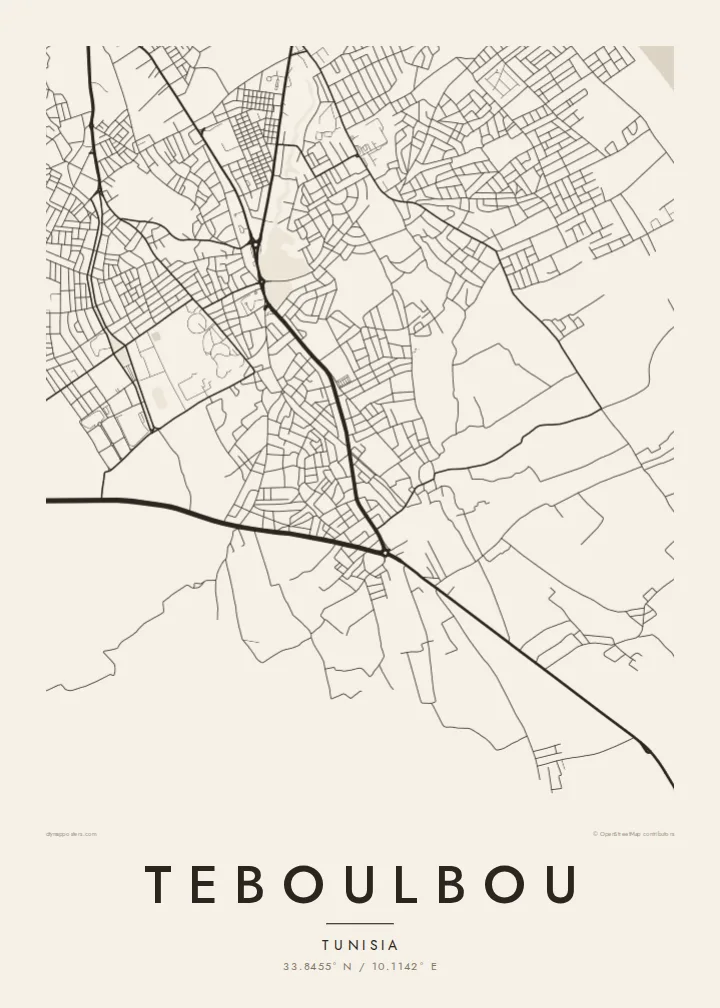
Teboulbou lies just south of the city of Gabès, on the flat coastal plain that runs along the Gulf of Gabès in southeastern Tunisia. On a map, the town reads as a loose spread of streets and compounds instead of a dense core. Irrigated garden plots, palm groves and open ground sit between the built blocks, and the coastline stays close on the eastern edge.
The Gabès area is known for its maritime oasis, where date palms grow within reach of the Mediterranean, which is rare anywhere in the world. Around Teboulbou that relationship shows up in the drawing as a patchwork: narrow lanes running between cultivated parcels, tracks heading down toward the water, and roads that link the settlement north to Gabès and on along the coast.
A Teboulbou map poster turns that mixed ground into fine black lines on white. Because the town has no single monumental centre, the composition rests on texture: the rhythm of small streets, the long line of the coast and the way building gives way to gardens. It suits a wall that needs something quiet and detailed rather than a bold graphic statement.
The shore of the Gulf of Gabès forms the eastern edge of the map, a long, gentle line that anchors the whole composition and sets the town firmly beside the sea.
Garden plots and palm groves break up the streets into an irregular mosaic, which gives this part of the Gabès coast its distinctive texture from above.
A main route runs north toward the city of Gabès, tying Teboulbou into the wider coastal plain and giving the drawing a clear direction.
Fai ke fakatau ki a koe
Fakaopoopo se aso, se igoa io me se fuaiupu o koe, sui te sitaila, te lasi io me te tuuga.
Te preview fua e maulalo te malamalama kae iai se watermark. Poster telotele mo faila HD e faite i te 300 DPI, e oko atu ki 7,200 × 10,800 px, aunoa mo se watermark.
Kaia a Teboulbou
People hang this map because they have family roots in the Gabès region, because they spent time on this stretch of coast, or because they like the meeting of oasis and sea. It is a personal place, and the poster treats it with restraint.
You can change the title, subtitle and coordinates line, for example to add a family name or a year, and choose from Classic black & white, Noir, Paper, Blueprint or Sand. The digital files cost $9 and come in six print sizes.
Otaina te poster Teboulbou| Lasi o te lomiga | Manino | Faila |
|---|---|---|
| 30 × 40 cm11.8 × 15.7″ | 3,543 × 4,724 px | PNG · PDF |
| 29.7 × 42 cm (A3)11.7 × 16.5″ | 3,508 × 4,961 px | PNG · PDF |
| 42 × 59.4 cm (A2)16.5 × 23.4″ | 4,961 × 7,016 px | PNG · PDF |
| 45.7 × 61 cm18 × 24″ | 5,400 × 7,200 px | PNG · PDF |
| 50 × 70 cm19.7 × 27.6″ | 5,906 × 8,268 px | PNG · PDF |
| 61 × 91.4 cm24 × 36″ | 7,200 × 10,800 px | PNG · PDF |
Ke fakatusa, a te ata fakataitai fua e 900 px te lautele, mo te fakailoga kae mo lau lavea i luga i te komipiuta. A faila HD e oko ki te 8× te manino i itu katoa kae lomi faka‵lei i te lasi katoa o te pousita.
Filifili se style i te pito i luga o te itulau, kae filifili Poster Telotele — se lasi mo se faaki manafai e manako koe — io me Faila Digital HD. E tasi te sitepu mo te checkout, kae ka fakafou te itulau o tau ota i te taimi e mafai ei te totogi.
E telotele i luga o te pepa vali gali 200 gsm i se tasi mai lasi e ono, mai te 30 × 40 cm ki te 24 × 36″. E kamata te poster telotele mai i te $39, kae aofia ei te uta.
Ioe. Filifili se faaki lakau maoli i te kulokula, tea, oak maoli io me lakau pogisa. E oo mai ki tioata e se malepe kae toka ke tautau. E kamata te poster faaki mai i te $99, kae aofia ei te uta.
E tuku fua ki fenua e 60+. A poloaiga taki tasi e ta ne te tauhaga e latalata mai i a matou tauhaga ta i fenua e 30+, kae e masani o aunoa i aso galue e 3–7. E mafai o salasala te tulaga mo te sukesuke i lalo o Aku poloaiga. I nisi fenua e 2–5 vaiaso, kae i mea e seki tuku atu ei matou, e fakailoa atu e te mea tafaoga i mua o te totogi.
Auina mai se ata i loto i te 14 aso mai te taimi e oko ei kae ka toe telotele fua ne matou io me toe totogi atu tau tupe.
Ioe. I te editor i te itulau tenei, sui te ulutala, te ulutala lalo mo te laina o coordinate ki so se mea e manako koe, kae filifili se style mo se lasi. Oga telotele, faaki mo digital e faigana katoa i tau tusiga tonu.
Mo te $9 ka maua ne koe faila PNG 300 DPI mo PDF fakatoka lolomi i lasi e ono katoa, aunoa mo se watermark, ke lolomi i so se koga. E se mautinoa koe? Download muamua se preview fua e iai te watermark.
