The hydroelectric dam
A straight concrete line across the Volkhov, dating from the 1920s. In black and white it reads as the town's anchor, the point where the river's curve meets industrial geometry.
Pousita mape faigofie · Russia
59.9233° N / 32.3397° E
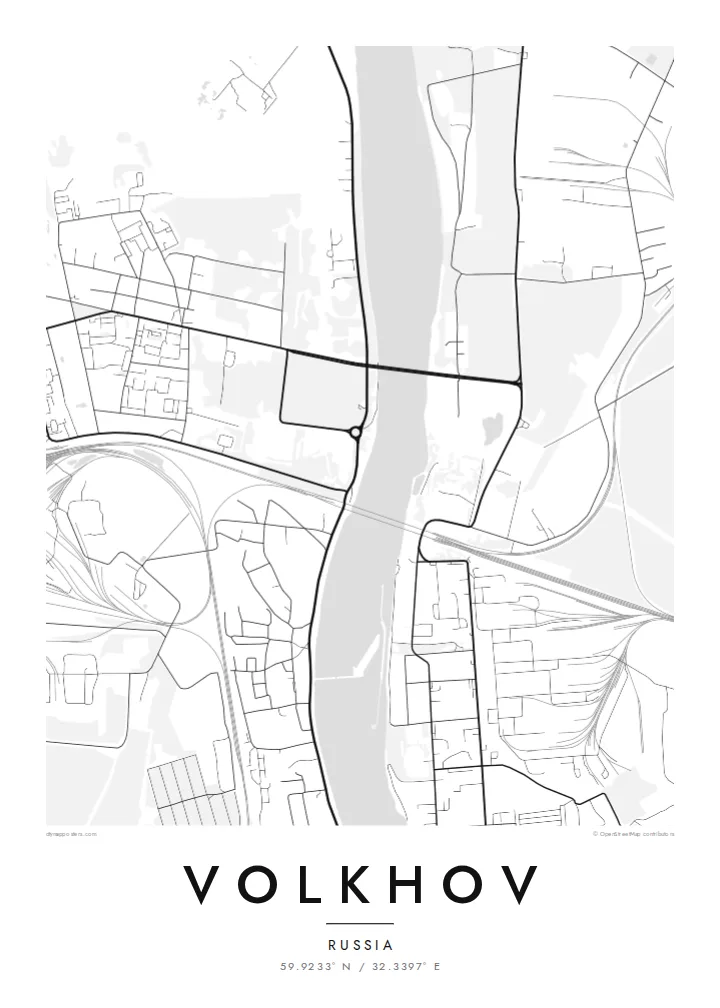
A river town split by the Volkhov, its two banks tied together by bridges, rail lines and the long line of a dam


Taone e tasi, lagona e lima
Pau te tapaki o se style ke lavea i luga i te puipui. E tutasi te tau o style takitasi — telotele mo faaki, e aunoa io me fai ki faila HD.
 Pixel tonu · faila lolomi 24 × 36″
Manino ki te lomiga
Tenei se 100% mai te faila lolomi tonu. Poster takitasi — telotele, faaki io me download — e faite i luga i a matou server i te 300 DPI, e oko atu ki 7,200 × 10,800 pixel, ko ala e maofio ei mo maiga vaega foliki i luga i te lolomi 24 × 36″.
I te pakitala


Te mape
From above, Volkhov is organised around its river. The Volkhov runs north through the town toward Lake Ladoga, and the built-up area sits on both banks. Residential blocks, industrial sites and rail yards line the water, and the bridges between the two halves give the plan its structure. Outside the town the streets give way to forest, fields and the pale, winding line of the river.
The town grew around one of the first large hydroelectric stations of the Soviet era, built on the Volkhov in the 1920s as part of the national electrification plan. On a map the dam shows as a clean straight bar across the river, one of the few hard geometric lines in a landscape of soft curves. A Volkhov map poster puts that bar at the centre of the composition.
Railways matter here as much as the river. Volkhov grew up as a rail junction, and the tracks fan out across the plan in long parallel lines that cut between neighbourhoods. The mix of rail geometry, planned Soviet housing blocks and the curve of the river makes the town look engineered, but not rigid.
A straight concrete line across the Volkhov, dating from the 1920s. In black and white it reads as the town's anchor, the point where the river's curve meets industrial geometry.
The town sits on both sides of the Volkhov, so the river runs down the middle of the map, a wide pale ribbon between two dense halves of streets and blocks.
Tracks and sidings run in long parallel bundles across the plan, marking Volkhov's role as a rail hub and adding strong linear texture to the print.
Fai ke fakatau ki a koe
Fakaopoopo se aso, se igoa io me se fuaiupu o koe, sui te sitaila, te lasi io me te tuuga.
Te preview fua e maulalo te malamalama kae iai se watermark. Poster telotele mo faila HD e faite i te 300 DPI, e oko atu ki 7,200 × 10,800 px, aunoa mo se watermark.
Kaia a Volkhov
For people who grew up here or worked at the plant, the map traces a town built around the river, the dam and the railway. It is an industrial place, and the print shows the logic behind it without decoration.
You can set the title and subtitle, and add a date or coordinates, then pick Classic black & white, Noir, Paper, Blueprint or Sand. Blueprint suits the engineering story particularly well. The HD files cost $9, or you can order a printed poster with an optional wooden frame.
Otaina te poster Volkhov| Lasi o te lomiga | Manino | Faila |
|---|---|---|
| 30 × 40 cm11.8 × 15.7″ | 3,543 × 4,724 px | PNG · PDF |
| 29.7 × 42 cm (A3)11.7 × 16.5″ | 3,508 × 4,961 px | PNG · PDF |
| 42 × 59.4 cm (A2)16.5 × 23.4″ | 4,961 × 7,016 px | PNG · PDF |
| 45.7 × 61 cm18 × 24″ | 5,400 × 7,200 px | PNG · PDF |
| 50 × 70 cm19.7 × 27.6″ | 5,906 × 8,268 px | PNG · PDF |
| 61 × 91.4 cm24 × 36″ | 7,200 × 10,800 px | PNG · PDF |
Ke fakatusa, a te ata fakataitai fua e 900 px te lautele, mo te fakailoga kae mo lau lavea i luga i te komipiuta. A faila HD e oko ki te 8× te manino i itu katoa kae lomi faka‵lei i te lasi katoa o te pousita.
Filifili se style i te pito i luga o te itulau, kae filifili Poster Telotele — se lasi mo se faaki manafai e manako koe — io me Faila Digital HD. E tasi te sitepu mo te checkout, kae ka fakafou te itulau o tau ota i te taimi e mafai ei te totogi.
E telotele i luga o te pepa vali gali 200 gsm i se tasi mai lasi e ono, mai te 30 × 40 cm ki te 24 × 36″. E kamata te poster telotele mai i te $39, kae aofia ei te uta.
Ioe. Filifili se faaki lakau maoli i te kulokula, tea, oak maoli io me lakau pogisa. E oo mai ki tioata e se malepe kae toka ke tautau. E kamata te poster faaki mai i te $99, kae aofia ei te uta.
E tuku fua ki fenua e 60+. A poloaiga taki tasi e ta ne te tauhaga e latalata mai i a matou tauhaga ta i fenua e 30+, kae e masani o aunoa i aso galue e 3–7. E mafai o salasala te tulaga mo te sukesuke i lalo o Aku poloaiga. I nisi fenua e 2–5 vaiaso, kae i mea e seki tuku atu ei matou, e fakailoa atu e te mea tafaoga i mua o te totogi.
Auina mai se ata i loto i te 14 aso mai te taimi e oko ei kae ka toe telotele fua ne matou io me toe totogi atu tau tupe.
Ioe. I te editor i te itulau tenei, sui te ulutala, te ulutala lalo mo te laina o coordinate ki so se mea e manako koe, kae filifili se style mo se lasi. Oga telotele, faaki mo digital e faigana katoa i tau tusiga tonu.
Mo te $9 ka maua ne koe faila PNG 300 DPI mo PDF fakatoka lolomi i lasi e ono katoa, aunoa mo se watermark, ke lolomi i so se koga. E se mautinoa koe? Download muamua se preview fua e iai te watermark.
Koga pili
