The Neisse border
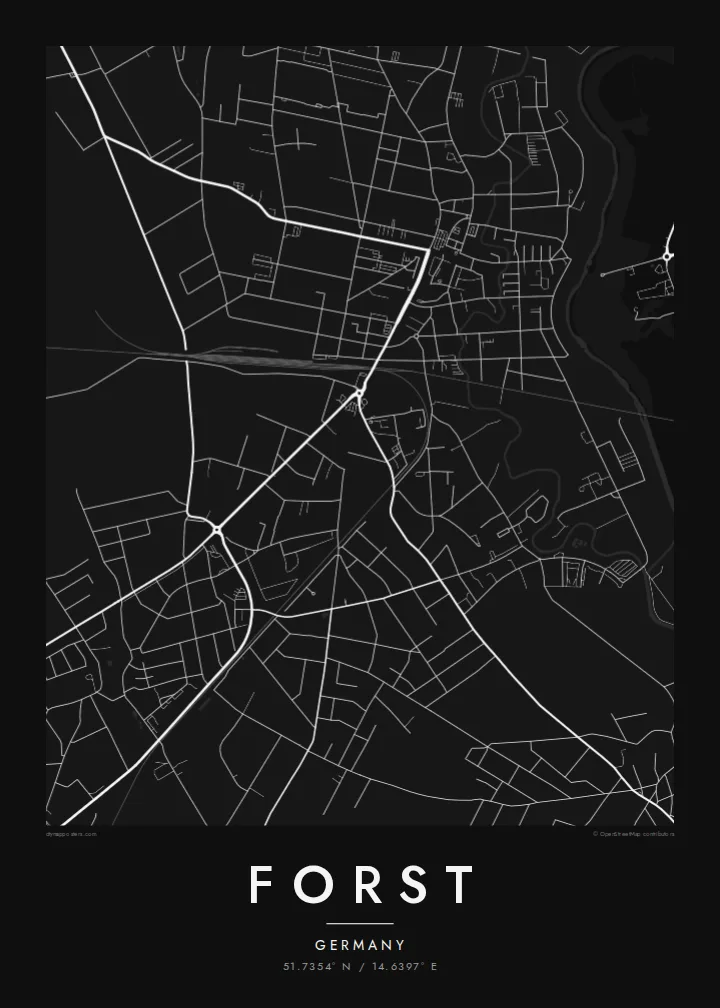
The Lusatian Neisse forms the eastern edge of the town and the frontier with Poland. It gives the map one strong vertical line, with the bridges crossing it clearly marked.
Постери минималистии харита · Германия
51.7354° N / 14.6397° E
A textile town pressed against the Neisse, its streets stopping at the river that marks the Polish border



Як шаҳр, панҷ кайфият
Ба як услуб зер кунед, то онро дар девор бинед. Ҳамаи услубҳо нархи якхела доранд — чопшуда, дар қолаб ё файлҳои HD.
 Пикселҳои воқеӣ · файли чоп барои 24 × 36″
Возеҳ барои чоп
Ин порчаи 100%-и файли воқеии чоп аст. Ҳар як постер — чопшуда, дар қолаб ё зеркашидашуда — дар серверҳои мо бо 300 DPI, то 7,200 × 10,800 пиксел, тарҳрезӣ мешавад, то ҳатто хурдтарин кӯчаҳо дар чопи 24 × 36″ равшан бимонанд.
Дар девор


Харита
Forst sits in Lower Lusatia on the west bank of the Lusatian Neisse. From above the river is the town's most defined edge: it runs north to south along the eastern side, and across the water lies Poland. The streets fan out westward from the river in a loose, uneven layout. That layout owes more to a century of industrial growth than to any one plan, and the river keeps the whole map oriented.
For much of the nineteenth and early twentieth centuries Forst was a centre of cloth production, known then as a German Manchester. The mills needed rail sidings, long factory plots and workers' housing close by, and that industrial past still shows in the size of the blocks. Some districts have large, regular parcels. Others are tighter, where terraced housing filled the space between works.
The town's best-known green space is the East German Rose Garden, laid out near the river in the early twentieth century and still one of the larger rose gardens in the country. On a Forst map poster it appears as a patch of curving paths set against the straighter streets around it. The eye tends to settle there, between the town's grid and the river.
The Lusatian Neisse forms the eastern edge of the town and the frontier with Poland. It gives the map one strong vertical line, with the bridges crossing it clearly marked.
The East German Rose Garden adds a cluster of curved walks and beds near the river, a softer pattern than the streets and industrial plots that surround it.
Large parcels left by the cloth industry sit beside denser housing streets. The result is a clear contrast in scale across the town that works well in black and white.
Аз они худ кунед
Сана, ном ё сатри худро илова кунед, услуб, андоза ё самтро иваз кунед.
Пешнамоиши ройгон бо резолютсияи паст ва нишони обӣ аст. Чопҳо ва файлҳои HD бо 300 DPI, то 7,200 × 10,800 px, бидуни нишони обӣ тарҳрезӣ мешаванд.
Чаро Forst
People from Forst often want a map that shows how close the town and the border are, with the river running right past the old streets. It also suits anyone with family ties to Lusatia's textile past, or to both sides of the Neisse.
Add a title, a family name or a meaningful date, and choose from Classic black & white, Noir, Paper, Blueprint or Sand. The digital files cost $9 and cover six print sizes. Printed posters on matte paper, with an optional wooden frame, ship from partners in more than 30 countries.
Постери Forst-ро фармоиш диҳед| Андозаи чоп | Ҳалнокӣ | Файлҳо |
|---|---|---|
| 30 × 40 cm (11.8 × 15.7″) | 3,543 × 4,724 px | PNG · PDF |
| 29.7 × 42 cm (A3, 11.7 × 16.5″) | 3,508 × 4,961 px | PNG · PDF |
| 42 × 59.4 cm (A2, 16.5 × 23.4″) | 4,961 × 7,016 px | PNG · PDF |
| 45.7 × 61 cm (18 × 24″) | 5,400 × 7,200 px | PNG · PDF |
| 50 × 70 cm (19.7 × 27.6″) | 5,906 × 8,268 px | PNG · PDF |
| 61 × 91.4 cm (24 × 36″) | 7,200 × 10,800 px | PNG · PDF |
Барои муқоиса, пешнамоиши ройгон 900 px паҳно дорад, бо тамғаи обӣ аст ва барои экран пешбинӣ шудааст. Файлҳои HD дар ҳар самт то 8 маротиба ҳалнокии баландтар доранд ва дар андозаи пурраи постер тоза чоп мешаванд.
Дар боло саҳифа як услубро интихоб кунед, сипас Постери чопшударо — андоза ва агар хоҳед, қолабро — ё Файлҳои рақамии HD-ро интихоб кунед. Пардохт танҳо як қадам мегирад ва саҳифаи фармоиши шумо баробари пардохт нав мешавад.
Он дар коғази матти дараҷаи олӣ 200 gsm дар яке аз шаш андоза, аз 30 × 40 см то 24 × 36″, чоп мешавад. Нархи постерҳои чопшуда аз $39 оғоз мешавад ва интиқол дар нарх ҳисоб шудааст.
Бале. Қолаби чӯбии яклухтро дар ранги сиёҳ, сафед, булути табиӣ ё чӯби торик интихоб кунед. Он бо шишаи зиддипартоӣ меояд ва барои овехтан омода аст. Нархи постерҳои дар қолаб аз $99 оғоз мешавад ва интиқол дар нарх ҳисоб шудааст.
Таҳвил дар саросари ҷаҳон ройгон аст. Ҳар постерро наздиктарин шарики чопии мо аз беш аз 30 кишвар чоп мекунад ва одатан дар муддати 3–7 рӯзи корӣ мерасад. Ҳолат ва рақами пайгириро дар «Фармоишҳои ман» дидан мумкин аст. Ба баъзе кишварҳо 2–5 ҳафта лозим мешавад ва ба ҷое, ки ҳоло намефиристем, сайт пеш аз пардохт хабар медиҳад.
Дар давоми 14 рӯз пас аз расидан ба мо сурат фиристед ва мо онро ройгон дубора чоп мекунем ё пулатонро бармегардонем.
Бале. Дар муҳаррири ин саҳифа сарлавҳа, зерсарлавҳа ва сатри координатаро ба дилхоҳ тарзе тағйир диҳед ва услуб ва андозаро интихоб кунед. Фармоишҳои чопшуда, дар қолаб ва рақамӣ ҳамагӣ айнан тарҳи шуморо истифода мебаранд.
Бо $9 шумо файлҳои PNG бо 300 DPI ва PDF-и омодаи чоп дар ҳамаи шаш андоза, бидуни нишони обӣ, мегиред, то дар ҳар ҷо чоп кунед. Ҳанӯз мутмаин нестед? Аввал пешнамоиши ройгони дорои нишони обиро зеркашӣ кунед.
