Hagåtña waist
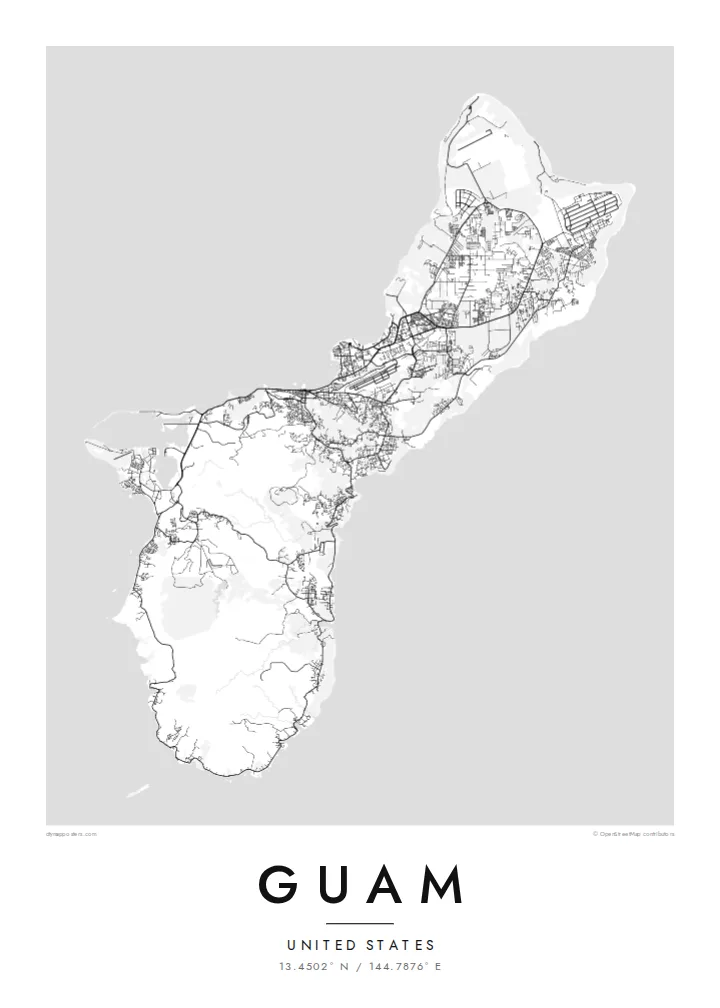
The capital sits where the island narrows, its compact streets pressed between the bay and a limestone ridge. It marks the natural midpoint of the composition and holds the clearest urban texture on the map.
Постери минималистии харита · Иёлоти Муттаҳида
13.4502° N / 144.7876° E
A long, pinched island with a flat limestone north, volcanic southern hills and a harbour carved into its western shore.


Як шаҳр, панҷ кайфият
Ба як услуб зер кунед, то онро дар девор бинед. Ҳамаи услубҳо нархи якхела доранд — чопшуда, дар қолаб ё файлҳои HD.
 Пикселҳои воқеӣ · файли чоп барои 24 × 36″
Возеҳ барои чоп
Ин порчаи 100%-и файли воқеии чоп аст. Ҳар як постер — чопшуда, дар қолаб ё зеркашидашуда — дар серверҳои мо бо 300 DPI, то 7,200 × 10,800 пиксел, тарҳрезӣ мешавад, то ҳатто хурдтарин кӯчаҳо дар чопи 24 × 36″ равшан бимонанд.
Дар девор


Харита
Guam is the largest and southernmost of the Mariana Islands, a United States territory in the western Pacific. From above it reads as a narrow island about fifty kilometres long, drawn in at the middle where the capital, Hagåtña, sits on the western coast. North of that waist lies a raised limestone plateau with long straight roads and large cleared areas. To the south the land folds into ridges and river valleys.
On a Guam map poster the western shoreline carries most of the detail. Marine Corps Drive traces the coast past Tumon Bay, where hotels line a curved sandy beach, and continues south to Apra Harbor, a deep port sheltered by a breakwater and the Orote Peninsula. The eastern side faces the open ocean and is quieter on paper, with scattered villages and fewer roads between the cliffs and the reef.
Chamorro people settled the island thousands of years before European contact, and village names across the map still reflect that heritage. Not far offshore lies the Mariana Trench, whose Challenger Deep is the deepest known point of the ocean floor, though a poster shows only the reef edge and the coast. What remains is a clear portrait of a small island shaped by both volcanic rock and coral.
The capital sits where the island narrows, its compact streets pressed between the bay and a limestone ridge. It marks the natural midpoint of the composition and holds the clearest urban texture on the map.
A wide, sheltered anchorage on the west coast, framed by the Orote Peninsula and a long breakwater. Its hard-edged piers and basins give the southern half of the poster a strong graphic anchor.
Above the waist, the land becomes a flat limestone table crossed by long straight roads and the broad rectangles of airfields, a far more geometric pattern than the winding valleys of the south.
Аз они худ кунед
Сана, ном ё сатри худро илова кунед, услуб, андоза ё самтро иваз кунед.
Пешнамоиши ройгон бо резолютсияи паст ва нишони обӣ аст. Чопҳо ва файлҳои HD бо 300 DPI, то 7,200 × 10,800 px, бидуни нишони обӣ тарҳрезӣ мешаванд.
Чаро Guam
A Guam poster suits people who were stationed on the island, grew up in one of its villages or spent time along Tumon Bay. The outline is compact enough to show whole, so the print works as a complete portrait of the island rather than a cropped fragment of it.
You can change the title, add a subtitle such as a family name or a date, and edit the coordinates line. Choose from five styles, Classic black & white, Noir, Paper, Blueprint or Sand, then take the $9 HD files in six sizes or order a matte print, framed if you prefer.
Постери Guam-ро фармоиш диҳед| Андозаи чоп | Ҳалнокӣ | Файлҳо |
|---|---|---|
| 30 × 40 cm (11.8 × 15.7″) | 3,543 × 4,724 px | PNG · PDF |
| 29.7 × 42 cm (A3, 11.7 × 16.5″) | 3,508 × 4,961 px | PNG · PDF |
| 42 × 59.4 cm (A2, 16.5 × 23.4″) | 4,961 × 7,016 px | PNG · PDF |
| 45.7 × 61 cm (18 × 24″) | 5,400 × 7,200 px | PNG · PDF |
| 50 × 70 cm (19.7 × 27.6″) | 5,906 × 8,268 px | PNG · PDF |
| 61 × 91.4 cm (24 × 36″) | 7,200 × 10,800 px | PNG · PDF |
Барои муқоиса, пешнамоиши ройгон 900 px паҳно дорад, бо тамғаи обӣ аст ва барои экран пешбинӣ шудааст. Файлҳои HD дар ҳар самт то 8 маротиба ҳалнокии баландтар доранд ва дар андозаи пурраи постер тоза чоп мешаванд.
Дар боло саҳифа як услубро интихоб кунед, сипас Постери чопшударо — андоза ва агар хоҳед, қолабро — ё Файлҳои рақамии HD-ро интихоб кунед. Пардохт танҳо як қадам мегирад ва саҳифаи фармоиши шумо баробари пардохт нав мешавад.
Он дар коғази матти дараҷаи олӣ 200 gsm дар яке аз шаш андоза, аз 30 × 40 см то 24 × 36″, чоп мешавад. Нархи постерҳои чопшуда аз $39 оғоз мешавад ва интиқол дар нарх ҳисоб шудааст.
Бале. Қолаби чӯбии яклухтро дар ранги сиёҳ, сафед, булути табиӣ ё чӯби торик интихоб кунед. Он бо шишаи зиддипартоӣ меояд ва барои овехтан омода аст. Нархи постерҳои дар қолаб аз $99 оғоз мешавад ва интиқол дар нарх ҳисоб шудааст.
Таҳвил дар саросари ҷаҳон ройгон аст. Ҳар постерро наздиктарин шарики чопии мо аз беш аз 30 кишвар чоп мекунад ва одатан дар муддати 3–7 рӯзи корӣ мерасад. Ҳолат ва рақами пайгириро дар «Фармоишҳои ман» дидан мумкин аст. Ба баъзе кишварҳо 2–5 ҳафта лозим мешавад ва ба ҷое, ки ҳоло намефиристем, сайт пеш аз пардохт хабар медиҳад.
Дар давоми 14 рӯз пас аз расидан ба мо сурат фиристед ва мо онро ройгон дубора чоп мекунем ё пулатонро бармегардонем.
Бале. Дар муҳаррири ин саҳифа сарлавҳа, зерсарлавҳа ва сатри координатаро ба дилхоҳ тарзе тағйир диҳед ва услуб ва андозаро интихоб кунед. Фармоишҳои чопшуда, дар қолаб ва рақамӣ ҳамагӣ айнан тарҳи шуморо истифода мебаранд.
Бо $9 шумо файлҳои PNG бо 300 DPI ва PDF-и омодаи чоп дар ҳамаи шаш андоза, бидуни нишони обӣ, мегиред, то дар ҳар ҷо чоп кунед. Ҳанӯз мутмаин нестед? Аввал пешнамоиши ройгони дорои нишони обиро зеркашӣ кунед.
