Pearl River channels
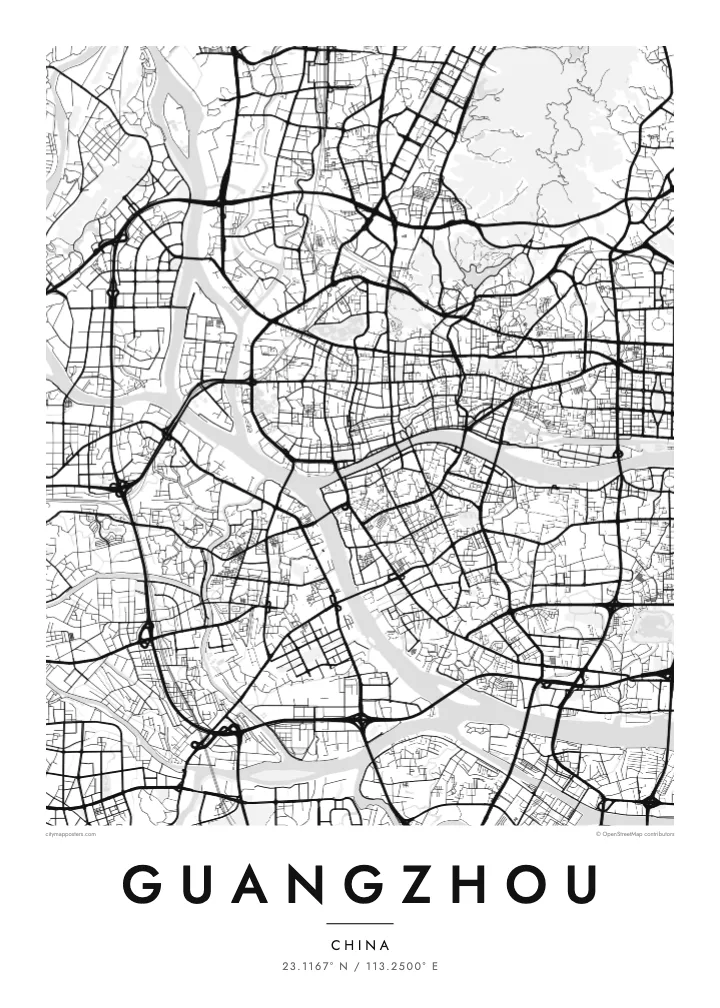
The river splits and rejoins as it crosses the city, leaving islands and peninsulas between its branches. These ribbons of water give the poster its main structure and divide north from south.
Постери минималистии харита · Хитой
23.1167° N / 113.2500° E
A dense river city where the Pearl River splits around islands, with the slopes of Baiyun Mountain holding back the streets to the north


Як шаҳр, панҷ кайфият
Ба як услуб зер кунед, то онро дар девор бинед. Ҳамаи услубҳо нархи якхела доранд — чопшуда, дар қолаб ё файлҳои HD.
 Пикселҳои воқеӣ · файли чоп барои 24 × 36″
Возеҳ барои чоп
Ин порчаи 100%-и файли воқеии чоп аст. Ҳар як постер — чопшуда, дар қолаб ё зеркашидашуда — дар серверҳои мо бо 300 DPI, то 7,200 × 10,800 пиксел, тарҳрезӣ мешавад, то ҳатто хурдтарин кӯчаҳо дар чопи 24 × 36″ равшан бимонанд.
Дар девор


Харита
Guangzhou is organised around water. The Pearl River runs through the city from west to east, and its channels divide the urban area into distinct banks and islands. Haizhu, on the south side, is a district entirely wrapped by river branches, and further downstream the delta begins to widen toward the sea. On a map, bridges cross these channels at close intervals, stitching the halves of the city together.
The older districts of Liwan and Yuexiu hold the historic core, with an irregular, closely packed street pattern. Small Shamian Island, once a foreign concession, appears as a neat elongated shape on the river’s edge. To the east, Zhujiang New Town lays down a wide, formal axis that faces the Canton Tower across the water, and the long ridge of Baiyun Mountain closes off the north.
The city, historically known in the West as Canton, has been a trading port for more than two thousand years and was an early hub of maritime trade with Southeast Asia and beyond. The Canton Fair, held here since 1957, remains one of the largest trade fairs in China. A Guangzhou map poster captures that river-bound, commercial character in a single frame.
The river splits and rejoins as it crosses the city, leaving islands and peninsulas between its branches. These ribbons of water give the poster its main structure and divide north from south.
A small island on the river bank in Liwan, laid out with a tidy grid of tree-lined streets. Its regular plan stands out clearly against the tighter lanes of the surrounding old town.
A broad central axis of parks and plazas runs north to south through the business district and continues across the river toward the Canton Tower, giving the modern city a clear ceremonial line.
Аз они худ кунед
Сана, ном ё сатри худро илова кунед, услуб, андоза ё самтро иваз кунед.
Пешнамоиши ройгон бо резолютсияи паст ва нишони обӣ аст. Чопҳо ва файлҳои HD бо 300 DPI, то 7,200 × 10,800 px, бидуни нишони обӣ тарҳрезӣ мешаванд.
Чаро Guangzhou
Guangzhou tends to belong to people with a real connection to it, whether through family in Guangdong, years spent studying there or regular trips to the Canton Fair. The river divides the frame into strong shapes, so the poster reads well from across a room.
The title, subtitle and coordinates line are all editable, so the print can carry a name, a district or the date you moved there. Pick one of five styles, Classic black & white, Noir, Paper, Blueprint or Sand, to match the room it will hang in.
Постери Guangzhou-ро фармоиш диҳед| Андозаи чоп | Ҳалнокӣ | Файлҳо |
|---|---|---|
| 30 × 40 cm11.8 × 15.7″ | 3,543 × 4,724 px | PNG · PDF |
| 29.7 × 42 cm (A3)11.7 × 16.5″ | 3,508 × 4,961 px | PNG · PDF |
| 42 × 59.4 cm (A2)16.5 × 23.4″ | 4,961 × 7,016 px | PNG · PDF |
| 45.7 × 61 cm18 × 24″ | 5,400 × 7,200 px | PNG · PDF |
| 50 × 70 cm19.7 × 27.6″ | 5,906 × 8,268 px | PNG · PDF |
| 61 × 91.4 cm24 × 36″ | 7,200 × 10,800 px | PNG · PDF |
Барои муқоиса, пешнамоиши ройгон 900 px паҳно дорад, бо тамғаи обӣ аст ва барои экран пешбинӣ шудааст. Файлҳои HD дар ҳар самт то 8 маротиба ҳалнокии баландтар доранд ва дар андозаи пурраи постер тоза чоп мешаванд.
Дар боло саҳифа як услубро интихоб кунед, сипас Постери чопшударо — андоза ва агар хоҳед, қолабро — ё Файлҳои рақамии HD-ро интихоб кунед. Пардохт танҳо як қадам мегирад ва саҳифаи фармоиши шумо баробари пардохт нав мешавад.
Он дар коғази матти дараҷаи олӣ 200 gsm дар яке аз шаш андоза, аз 30 × 40 см то 24 × 36″, чоп мешавад. Нархи постерҳои чопшуда аз $39 оғоз мешавад ва интиқол дар нарх ҳисоб шудааст.
Бале. Қолаби чӯбии яклухтро дар ранги сиёҳ, сафед, булути табиӣ ё чӯби торик интихоб кунед. Он бо шишаи зиддипартоӣ меояд ва барои овехтан омода аст. Нархи постерҳои дар қолаб аз $99 оғоз мешавад ва интиқол дар нарх ҳисоб шудааст.
Расонидан ба зиёда аз 60 кишвар ройгон аст. Ҳар постер аз ҷониби наздиктарин шарики чопии мо дар зиёда аз 30 кишвар чоп мешавад ва одатан дар муддати 3–7 рӯзи корӣ мерасад. Ҳолат ва пайгирии фармоишро дар бахши «Фармоишҳои ман» дидан мумкин аст. Ба чанд кишвар 2–5 ҳафта лозим мешавад ва дар ҷое, ки мо ҳоло намерасонем, сайт пеш аз пардохт хабар медиҳад.
Дар давоми 14 рӯз пас аз расидан ба мо сурат фиристед ва мо онро ройгон дубора чоп мекунем ё пулатонро бармегардонем.
Бале. Дар муҳаррири ин саҳифа сарлавҳа, зерсарлавҳа ва сатри координатаро ба дилхоҳ тарзе тағйир диҳед ва услуб ва андозаро интихоб кунед. Фармоишҳои чопшуда, дар қолаб ва рақамӣ ҳамагӣ айнан тарҳи шуморо истифода мебаранд.
Бо $9 шумо файлҳои PNG бо 300 DPI ва PDF-и омодаи чоп дар ҳамаи шаш андоза, бидуни нишони обӣ, мегиред, то дар ҳар ҷо чоп кунед. Ҳанӯз мутмаин нестед? Аввал пешнамоиши ройгони дорои нишони обиро зеркашӣ кунед.
Дар наздикӣ
