The Gond ramparts
The historic wall and its gates still shape the street pattern, leaving a clear ring of older, tighter lanes at the centre of the modern city.
Pōhita mape faigofie · India
19.9508° N / 79.2952° E
An old walled town between two small rivers, its stone circuit still traced by roads that loop the historic core.


Taone e tahi, lagona e lima
Pa'i se ata ke va'ai ai i luga o te pā. E tutusa te tau o ata uma — i lomiga, fakapipi'i i faleata, pe ko faila HD.
 Pixels mo'i · Faila lomiga 24 × 36″
Manino mo te lomiga
Ko se kupega 100% mai te faila lomiga mo'i. Poster uma — pe lomiina, fakapipi'i i faleata, pe download-ina — e fakaatagia i luga o a matou setula i te 300 DPI, e oo atu ki te 7,200 × 10,800 pixels, ina ia mautinoa e ma'ai pea auala tuai foki i luga o se lomiga 24 × 36″.
I luga o te pa


Te mape
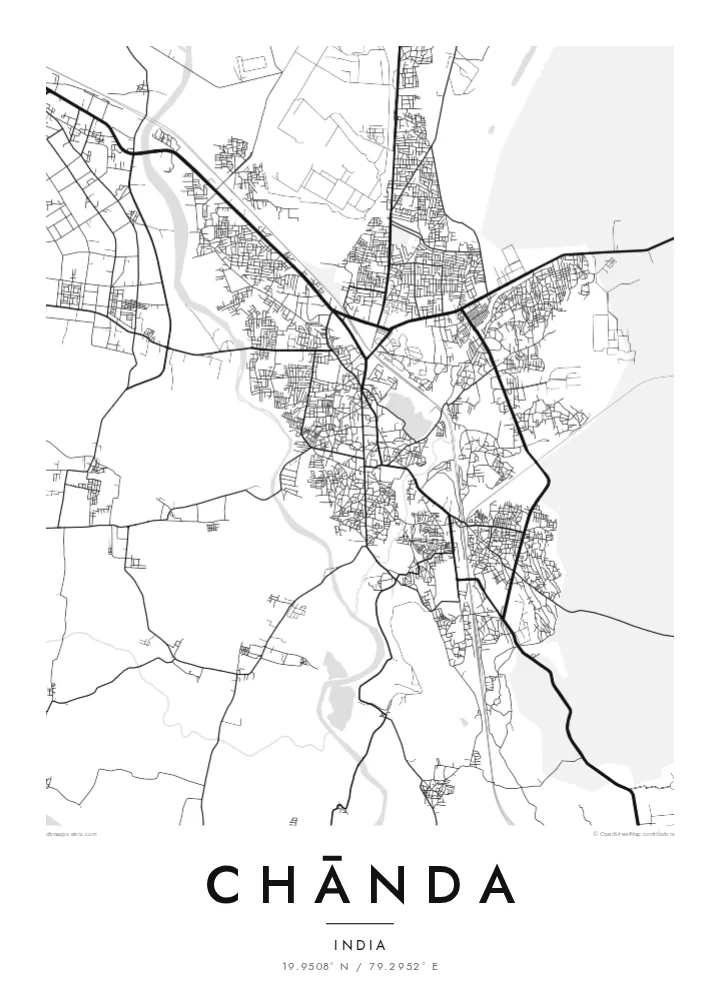
Chānda, officially Chandrapur, grew up inside a long stone wall built under the Gond kings who ruled this part of eastern Maharashtra. On a map the old town still shows that outline: a rough loop of roads following the line of the ramparts, with gateways where traffic squeezes through and denser lanes packed inside. Newer districts spread outward in looser blocks on every side.
Water frames the town to the west and east. The Erai River runs down its western edge and the smaller Zarpat stream passes the eastern side, so the built-up area sits on the higher ground between two thin blue lines. Rail tracks and highways cut across the plain, and broad industrial sites mark the power station and coal workings that made the district's name.
A Chānda map poster reduces all of this to line and space: the curve of the old wall, the river channels, the rail spur and the grid of the newer colonies. Beyond the frame lies the teak forest of Tadoba-Andhari Tiger Reserve, one of Maharashtra's best-known wildlife areas, which gives the town a reputation that reaches well past its coal and cement.
The historic wall and its gates still shape the street pattern, leaving a clear ring of older, tighter lanes at the centre of the modern city.
The Erai runs along the western side of town, a narrow river line that gives the map a firm boundary and a sense of direction.
Large rectangular footprints of the thermal power station and mining areas sit on the fringes, contrasting sharply with the fine grain of the old town.
Fai mo koe
Fakaopoopo he aho, he igoa pe he upu a koe, hui te faiga, te lahi pe te tūlaga.
Ko te va'aiga e leai se totogi e maualalo tona resolution ma iai se fakailoga vai. E fakaatagia lomiga ma faila HD i te 300 DPI, e oo atu ki te 7,200 × 10,800 px, e aunoa ma se fakailoga vai.
Aiheā Chānda
People from Chandrapur often carry the old town in their heads as a set of gates and turns. A framed map puts that memory on the wall, whether it marks a family home, a first posting, or a stop on the way to the tiger reserve.
The title, subtitle and coordinates line can be changed to a name, a date or a phrase. Choose Classic black & white, Noir, Paper, Blueprint or Sand, download the HD files for $9, or order a matte print with an optional wooden frame.
Oka te poster Chānda| Lahi o te lomiga | Manino | Faila |
|---|---|---|
| 30 × 40 cm (11.8 × 15.7″) | 3,543 × 4,724 px | PNG · PDF |
| 29.7 × 42 cm (A3, 11.7 × 16.5″) | 3,508 × 4,961 px | PNG · PDF |
| 42 × 59.4 cm (A2, 16.5 × 23.4″) | 4,961 × 7,016 px | PNG · PDF |
| 45.7 × 61 cm (18 × 24″) | 5,400 × 7,200 px | PNG · PDF |
| 50 × 70 cm (19.7 × 27.6″) | 5,906 × 8,268 px | PNG · PDF |
| 61 × 91.4 cm (24 × 36″) | 7,200 × 10,800 px | PNG · PDF |
Mo te fakatatau, ko te fakaakoakoga e hē totogi e 900 px te lautele, e ihi te fakailoga ma mo te lau komipiuta. Ko nā faila HD e oko ki te 8× te manino i itū taki tahi ma e lomia lelei i te lahi kātoa o te pōhita.
Filifili se ata i te pito i luga o te itulau, ona filifili lea o te Poster Lomiina — se lapoa ma, ka manako ai koe, se faleata — pe ko Faila HD Fakaonaonaina. E tasi te laasaga o te ōkaina, ma ka fakafou loa lau itulau ōkaina pe a mae'a te totogi.
E lomiina i luga o se pepa matte kaliki maualuga e 200 gsm, i se tasi o ni lapoa e ono, mai le 30 × 40 cm ki te 24 × 36″. E kamata te tau o poster lomiina mai le {printFrom}, aofia ai te uta.
Ioe. Filifili se faleata lakau malō i te lanu uli, tea, oki masani pe lakau pouli. E aumai fakatasi mo se tioata e le gagamu ma ua sauni ke tautau. E kamata te tau o poster fakapipi'i i se faleata mai le {framedFrom}, aofia ai te uta.
E fua noa te uta i te lalolagi katoa. Poster ta'itasi e lomiina e te pāketiha lomiga pili mai i lo matou 30+ atunu'u, ma e masani ona oo mai i loto i te 3–7 aso gāluega. E mafai ona ke va'aiina te tulaga o lau okaina i lalo ifo o My Orders.
Auina mai se ata pikitia i loto o te 14 aso mai te taimi na oo mai ai, ka toe lomiina e matou e leai se totogi pe toe totogi atu lau tupe.
Ioe. I te mea fakasa'o i luga o lenei itulau, sui te ulutala, te ulutala lalo ma te laina fakamaoniga tulaga ki so se mea e manako ai koe, ona filifili lea o se ata ma se lapoa. Okaina lomiina, fakapipi'i i faleata, ma fakaonaonaina e fakaaogā uma i tau ata tonu.
Mo le $9 e maua e koe ni faila PNG 300 DPI ma PDF sauni-mo-lomiga i lapoa e ono uma, e aunoa ma se fakailoga vai, ke lomiina i so se mea. E le'i mautinoa? Download muamua se va'aiga fakailoga vai e leai se totogi.
