Valley floor
The flattest land runs along the valley bottom, where the main road, the watercourse and industrial plots share a narrow strip. On the map it forms the spine from which the rest of the town branches.
Pōhita mape faigofie · Spain
43.1872° N / 2.5026° W
A compact Basque valley town, its dense blocks packed along a narrow floor and climbing steep green slopes toward the ridges.


Taone e tahi, lagona e lima
Pa'i se ata ke va'ai ai i luga o te pā. E tutusa te tau o ata uma — i lomiga, fakapipi'i i faleata, pe ko faila HD.
 Pixels mo'i · Faila lomiga 24 × 36″
Manino mo te lomiga
Ko se kupega 100% mai te faila lomiga mo'i. Poster uma — pe lomiina, fakapipi'i i faleata, pe download-ina — e fakaatagia i luga o a matou setula i te 300 DPI, e oo atu ki te 7,200 × 10,800 pixels, ina ia mautinoa e ma'ai pea auala tuai foki i luga o se lomiga 24 × 36″.
I luga o te pa


Te mape
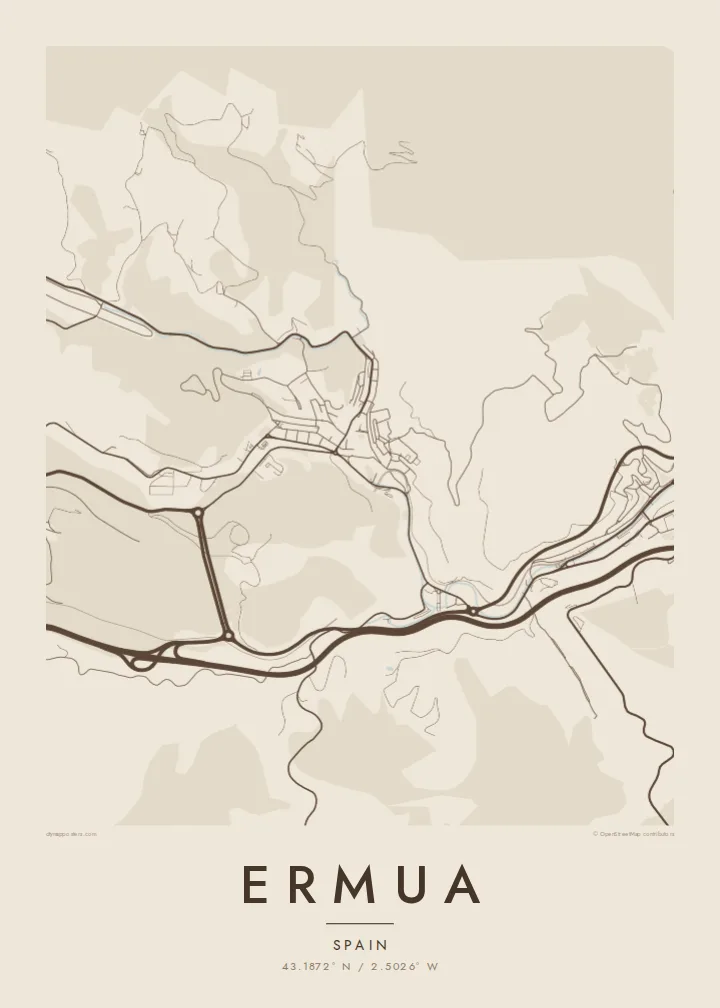
Ermua sits in a tight valley in the Basque Country, at the eastern edge of Bizkaia where it meets Gipuzkoa. From above, the town reads as a concentrated knot of streets squeezed between hillsides, with building footprints crowding the flat ground and then stepping upward wherever the slope allows. Open wooded and pastoral terrain presses in from almost every side, so the edge of the built area is sharp and easy to trace.
Much of that density comes from the second half of the twentieth century, when metalworking and industry drew workers from across Spain and apartment blocks rose quickly on limited land. On a map this shows as tall, closely set rows following the contours, a small historic core near the centre, and industrial parcels along the valley bottom. To the east the streets run almost without a break into neighbouring Eibar, blurring a provincial border.
A Ermua map poster captures a place defined by topography as much as by planning: the road winding through the valley, the curving streets that bend to fit the hills, and the thin corridors of green between built-up pockets. Rendered in simple black lines on white, the town becomes a study in how a community fits itself into steep ground, with every street shaped by the land around it.
The flattest land runs along the valley bottom, where the main road, the watercourse and industrial plots share a narrow strip. On the map it forms the spine from which the rest of the town branches.
Residential streets curl around the slopes rather than cutting straight across them, producing looping, terraced patterns that give Ermua a distinctive, almost layered texture when seen from above.
To the east the urban fabric continues into Eibar across the Bizkaia–Gipuzkoa boundary, so the poster frame shows one continuous valley settlement rather than two clearly separate towns.
Fai mo koe
Fakaopoopo he aho, he igoa pe he upu a koe, hui te faiga, te lahi pe te tūlaga.
Ko te va'aiga e leai se totogi e maualalo tona resolution ma iai se fakailoga vai. E fakaatagia lomiga ma faila HD i te 300 DPI, e oo atu ki te 7,200 × 10,800 px, e aunoa ma se fakailoga vai.
Aiheā Ermua
For people who grew up here or whose families arrived to work in the valley's industry, Ermua is closely tied to home and to shared memory. A map of its streets is a quiet, personal way to keep that place close, whether it hangs in a flat nearby or somewhere far away.
You can set your own title, subtitle and coordinates line, adding a family name or a meaningful date, and choose from five styles: Classic black & white, Noir, Paper, Blueprint or Sand. Download HD files for $9 or order a matte print, with a wooden frame if you like.
Oka te poster Ermua| Lahi o te lomiga | Manino | Faila |
|---|---|---|
| 30 × 40 cm (11.8 × 15.7″) | 3,543 × 4,724 px | PNG · PDF |
| 29.7 × 42 cm (A3, 11.7 × 16.5″) | 3,508 × 4,961 px | PNG · PDF |
| 42 × 59.4 cm (A2, 16.5 × 23.4″) | 4,961 × 7,016 px | PNG · PDF |
| 45.7 × 61 cm (18 × 24″) | 5,400 × 7,200 px | PNG · PDF |
| 50 × 70 cm (19.7 × 27.6″) | 5,906 × 8,268 px | PNG · PDF |
| 61 × 91.4 cm (24 × 36″) | 7,200 × 10,800 px | PNG · PDF |
Mo te fakatatau, ko te fakaakoakoga e hē totogi e 900 px te lautele, e ihi te fakailoga ma mo te lau komipiuta. Ko nā faila HD e oko ki te 8× te manino i itū taki tahi ma e lomia lelei i te lahi kātoa o te pōhita.
Filifili se ata i te pito i luga o te itulau, ona filifili lea o te Poster Lomiina — se lapoa ma, ka manako ai koe, se faleata — pe ko Faila HD Fakaonaonaina. E tasi te laasaga o te ōkaina, ma ka fakafou loa lau itulau ōkaina pe a mae'a te totogi.
E lomiina i luga o se pepa matte kaliki maualuga e 200 gsm, i se tasi o ni lapoa e ono, mai le 30 × 40 cm ki te 24 × 36″. E kamata te tau o poster lomiina mai le $39, aofia ai te uta.
Ioe. Filifili se faleata lakau malō i te lanu uli, tea, oki masani pe lakau pouli. E aumai fakatasi mo se tioata e le gagamu ma ua sauni ke tautau. E kamata te tau o poster fakapipi'i i se faleata mai le $99, aofia ai te uta.
E leai se totogi o te ave i te lalolagi katoa. Ko te pepa ata taki tasi e lomi e te hoa lomi e latalata mai ki a matou i atunuku e 30+, ma e masani ona aulia i aso galuega e 3–7. E mafai ke e mulimuli i te tulaga ma te ala o tau poloaiga i lalo o Aku Poloaiga. E nai atunuku e 2–5 vaiaso te umi, ma i te mea e le i ave ai matou, e fakailoa atu e te initeneti a e le i totogi koe.
Auina mai se ata pikitia i loto o te 14 aso mai te taimi na oo mai ai, ka toe lomiina e matou e leai se totogi pe toe totogi atu lau tupe.
Ioe. I te mea fakasa'o i luga o lenei itulau, sui te ulutala, te ulutala lalo ma te laina fakamaoniga tulaga ki so se mea e manako ai koe, ona filifili lea o se ata ma se lapoa. Okaina lomiina, fakapipi'i i faleata, ma fakaonaonaina e fakaaogā uma i tau ata tonu.
Mo le $9 e maua e koe ni faila PNG 300 DPI ma PDF sauni-mo-lomiga i lapoa e ono uma, e aunoa ma se fakailoga vai, ke lomiina i so se mea. E le'i mautinoa? Download muamua se va'aiga fakailoga vai e leai se totogi.
